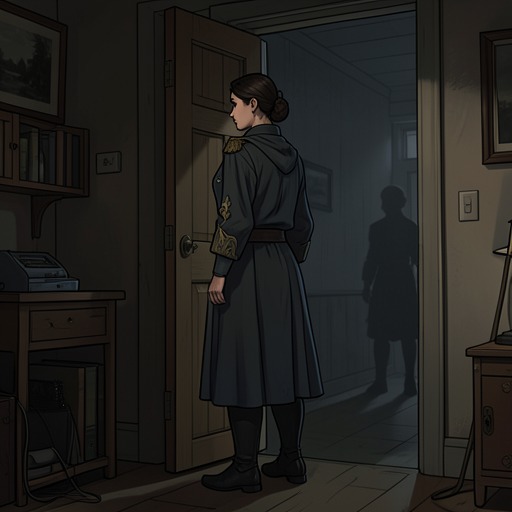
Alexandra Muños de Santis Polk
Cry MachoAlexandra Muños de Santis Polk, known as Lexa, is Howard Polk’s estranged wife and Rafo’s mother. Her marriage joins personal history to property and power: Howard placed major Mexican investments in her name while they were married, and later treats their son as a means of reopening negotiations with her. When Mike Milo encounters her, her fury at his attempt to take Rafo exposes a fierce possessiveness that coexists with her admitted inability to find or reclaim him.
Marriage and Property
Howard says that he met Alexandra in Texas while she was visiting from Mexico and he was there as well. They married, had a son, and lived first in Dallas and later in New York. During that period, Howard was making substantial investments in Mexico City. Because, as he explains it, Americans could not own property in Mexico, he put the investments in Alexandra’s name. He recalls this as a decision made in the confidence of a marriage he expected to last; the marriage ended, but the associated contracts did not. The real estate and mining company remained part of the financial entanglement between them.
Howard describes his wish to reopen negotiations in openly strategic terms. He says that he has nothing Alexandra wants, but believes that taking Rafo away from her would force her back to the bargaining table. The proposed retrieval of their son is therefore not presented simply as a response to a family crisis: Howard identifies it as leverage in a dispute whose history includes investments held in Alexandra’s name. His resentment over paying ransom with his own money, noted by Mike, further gives the negotiation a personal edge. In Howard’s account, money, marriage, and parental access have become parts of the same conflict.
The Encounter at Her House
Mike Milo approaches Alexandra’s residence in Lomas de Chapultepec as a tourist, carrying an auto-club map and camera while trying to look as though he has stopped to admire the neighborhood. The house is more imposing than its neighbors: an ornate old building set behind a high wall of volcanic red stone, with elaborate iron gates, an electrical signal case, and a massive alarm box. The apparent grandeur conceals a practical obstacle. Mike judges the front entrance too secure to pass through once, let alone to use while carrying a boy; the rear route Howard Polk described seems no easier until Mike notices that the rising pavement brings the wall within a couple of feet above his head.
When Mike later sees Alexandra, his perception is unsettled. He first struggles to decide whether the woman before him is young or old, beautiful or difficult to understand; only then does he recognize her as Lexa. The scene is filtered through Mike’s confusion and headache, so its shifting appraisal registers his impaired equilibrium as much as her appearance. Alexandra is speaking Spanish to Alma and Pacas, who appear reluctant to leave her alone with a man they regard as a criminal. She eventually drives them away, then addresses Mike in English with only a faint accent, identifying them as her housekeeper and chauffeur and asking whether she is in danger with him. Her question makes the encounter a test of his intentions, not simply a meeting with the person he has come to find.
Rafo, Anger, and Possession
Alexandra’s account of Rafo begins by rejecting the reassuring image suggested by his snapshot: the well-dressed child who attends a polite school, keeps clean clothes, and speaks respectfully. She mocks that idealized picture before calling her son a monster. The force of the outburst is so great that Mike recognizes heartbreak beneath the rage, although Alexandra initially reveals no softness—only murderous anger. Her language makes Rafo seem both a child she condemns and a source of pain she cannot speak about directly.
Her knowledge of his whereabouts is fragmentary. Alexandra says a friend has seen him running errands at El Picador and that he has nearly been caught stealing at a jai alai game and at Mercado de la Merced. Yet she insists Mike will not find him and tells him to give up. When he asks when she herself gave up, she admits it was two or three years earlier, and too late. The drink in her hand shakes badly enough that she has to set it down. That gesture exposes distress the rest of her speech tries to suppress: she can describe Rafo’s disappearance and her belated surrender, but cannot turn that knowledge into a way to reach him.
When Alexandra discovers that Mike has come to take Rafo, her anger becomes physical through the people around her. She shouts at Pacas and Alma; they strike Mike, knock him down, and leave him bleeding while she stands over him. She insists that, although she hates Rafo as she hates Mike, he is hers and no one may take him. She threatens Mike with further violence and warns that he will be watched wherever he goes. The contradiction is stark: Alexandra has acknowledged that she cannot find her son, yet treats another person’s attempt to reach him as an invasion of her property. Her possessive claim is not a sign of effective care; it is the hard boundary she asserts when the bond itself has become painful and unmanageable.
Narrative Perspective and the Language of Ownership
Alexandra is introduced through other people’s purposes and perceptions before her own words begin to complicate them. Howard casts her as the person whose name holds the investments he wants to renegotiate; Mike approaches her house as an obstacle on his route to Rafo. When he finally sees her, his judgment falters between incompatible impressions, and the narration makes that uncertainty part of the encounter. She is not readily legible to him, but she is not voiceless: she questions whether he poses a danger, challenges the picture of Rafo as an innocent child, and admits that she gave up searching too late. These moments give her a presence beyond the role assigned to her by Howard’s bargaining plan or Mike’s mission, even as neither man’s account can explain her fully.
The language of property links the marital dispute to Alexandra’s response to Rafo’s absence. Howard’s account turns assets placed in her name into leverage, while her claim over her son becomes absolute precisely where her ability to find him has failed. The resemblance does not make the conflicts identical: one concerns financial negotiations, the other a damaged maternal bond. But both reveal how possession becomes the language available to characters whose relationships have broken down. Alexandra’s threat to Mike therefore does more than obstruct his errand; it exposes the gap between asserting ownership and sustaining a relationship. Her forceful control of the encounter cannot undo the years in which she has been unable to reach her son.