Calle Cacha
Cry MachoCalle Cacha is a narrow passage in the Tepito section of Mexico City whose significance lies in the way its name connects Mike Milo’s search for Rafo to a concealed cockfight. First encountered as an uncertain clue in a street directory, it becomes a physical route through darkness, disorientation, and danger, ending at the warehouse where Mike finds Rafo among the spectators.
Name and Setting
The name begins as a misunderstanding. When Mike asks a girl about the word Cacha, she tells him it means street, but her growing distrust makes him suspect that her answer is meant to deflect him. He considers another possibility: that Cacha is not a general word for a street but the name of one. The shift from word to place gives his search a concrete direction, although it does not yet explain what he will find there.
Mike checks a map of the city but cannot locate the name. It appears instead in his pocket-sized street directory, listed under Tepito with no further information. The entry offers little more than a location, leaving him to test the clue in the city itself. The discrepancy between a neat name in a directory and the place he eventually encounters is important: Calle Cacha proves not to be a proper street in the ordinary sense, but a tight passage embedded in a difficult neighborhood.
The surrounding Tepito is presented at night as mean, dirty, and dismal. Mike associates its poverty with violence that seems to inhabit doorways and alleys. Having visited this part of the neighborhood only once in daylight, he now finds it deserted. That change in time transforms the area: its passages no longer function as obvious connections between streets, but as a maze in which a visitor can lose his bearings.
The Search and the Alley
When Mike decides to return to his hotel, he cannot find his way out. One narrow passage follows another, twisting without seeming to open onto a wider street. The cobblestones are slippery and slimy; in the darkness and damp, he longs to encounter even a person or one of the homeless dogs he expects to roam the city. The absence of either leaves him alone with the sense that he has been rejected in an alley, an unnecessary man whom nobody would ask after.
A shop window gives him a brief point of light. Inside, he recognizes a shoemaker’s shop, but nobody is there to direct him. Turning away from the window, he sees painted letters on a wall: Calle Cacha. The sight joins the directory’s bare listing to a place he has already passed. Mike obscurely remembers seeing the same alley, and perhaps the same letters, in daylight. What had been an indistinct memory becomes a usable clue only after his nighttime disorientation has brought him back to it.
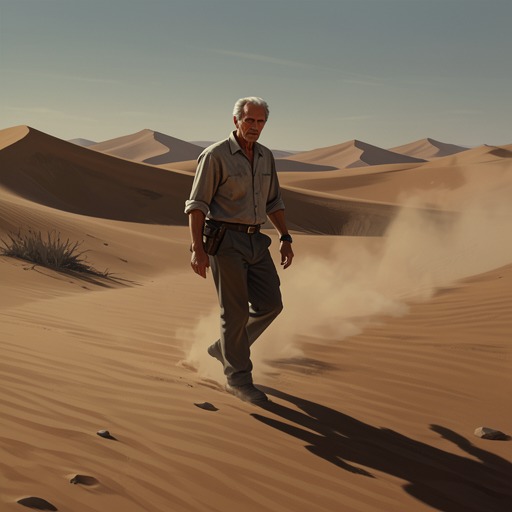
He crosses into Calle Cacha and discovers that its name promises more than its form delivers. It is not a conventional street but a passage narrower than the other alleys, pitch-black and wet underfoot. Mike can make out his breath in the damp air and hear his steps slide across the cobbles; the scene reduces navigation to movement and sound. The passage’s physical narrowness extends the maze rather than resolving it, so following the name does not immediately mean finding a way out.
Encounter and Hidden Destination
A faint sound behind Mike interrupts the silence. A man emerges from what had seemed to be a blank wall and shoves him against it. In the dark, Mike first mistakes him for Pacas, then makes out an older, shorter, more powerful man with a distorted face, alongside a taller, wiry young man. The encounter makes the passage more than an obscure address: it is a place where Mike can be approached suddenly and physically overpowered.
After the men direct him farther into the alley, Mike puts his money away and continues cautiously. The route bends sharply right; the cobblestones give way to bare, muddy earth. What feels as though it might be endless eventually opens onto a small plaza. A broken fence, an abandoned warehouse and a junkyard of wrecked vehicles and bent metal surround the space. The plaza is strewn with rubbish and slime and appears empty and silent. These details mark a hidden destination that the directory could not describe and that the passage’s turns had concealed.
At the warehouse loading platform, Mike notices a sliver of light behind canvas used as a stall curtain. The light disappears, but a rooster’s faint chooking gives him a new reason to approach. Low voices and another crowing sound confirm that people are gathered inside. Through the curtain he sees a cock ring lit by a smoking kerosene lamp, with roughly a dozen men and six or seven boys watching. The passage has led him not simply to a location but to a concealed gathering within the warehouse.
Rafo and the Raid
The location’s decisive discovery is Rafo. A man carrying a bronze gamecock calls the boy by name, and Rafo rises from the crouched spectators with a white rooster whose red comb is described as high and proud. The handlers present their birds for inspection, then place bets on an old oil drum. After provoking the roosters, the man and Rafo release them into the ring. Mike has reached the place he was seeking, but the discovery occurs through observation: he is close enough to see Rafo and the fight before the gathering becomes a police target.
A whistle sounds from the alleyway, followed by a siren. Flashlights, a motorcycle and a police car suddenly illuminate the plaza, and the spectators scramble. Mike jumps from the platform and hides beneath it. Someone throws the kerosene lantern into the courtyard; the spilled oil catches fire, and a gunshot follows the police shouting and whistles. The raid ends the cockfight and turns the warehouse’s secluded setting into a scene of flight and exposure.
Calle Cacha therefore links a small act of interpretation to a risky discovery. Its name is initially no more than a sparse directory entry; its actual shape is a dark, muddy passage that appears to deepen Mike’s isolation before it opens onto Rafo’s hidden world. The contrast between the faint rooster sounds and the abrupt lights and gunfire gives the place its narrative force: the route carries Mike from uncertain clue to direct sight of Rafo, then leaves him concealed beneath the platform as the gathering collapses.