Chickens and fighting cocks
Cry MachoChickens and fighting cocks recur as working animals, objects of play, and participants in publicized contests. Their role becomes decisive when Mike Milo follows a tenuous lead through the poultry trade and finds Rafo at an illegal cockfight. The birds also sharpen the novel’s contrast between the heroic image sold by rodeo and the harm that such spectacles make ordinary: to Mike, the language of macho that surrounds a rooster’s fight comes to resemble the language he has spent his career seeking in arenas.
From poultry to a lead
Mike’s search for Rafo has reached an impasse. Having divided Mexico City’s underworld into six districts and canvassed them systematically, he has repeated the circuit without finding the boy. The cockfights remain his last lead, but the connection between them and wholesale poultry is tenuous. On an eccentric hunch, he shifts his search to the city’s poultry section—and finds a small clue in children’s play.
Two boys, both much younger than Rafo, hold tiny pullets and make them seem to fight. Their cries sound to Mike like an English expression, but he recognizes that the Spanish-speaking children are unlikely to be using it. Nearby, their older sister tends her father’s chicken coops. She understands English, tells Mike that the word the boys are shouting is Cacha, and spells it for him. The encounter does not itself locate Rafo; its value is that it gives Mike a concrete strand to follow from the everyday business of keeping chickens toward the hidden world of cockfighting.
The clandestine ring
Mike follows the lead to a warehouse and detects activity in one of its storage stalls. A faint light shows behind a lowered canvas, and the sound of a rooster gives him reason to approach. Inside, a smoking kerosene lamp hangs above a ring surrounded by roughly a dozen men and six or seven boys. The audience is assembled at close range, with the birds and their handlers at the center of attention.
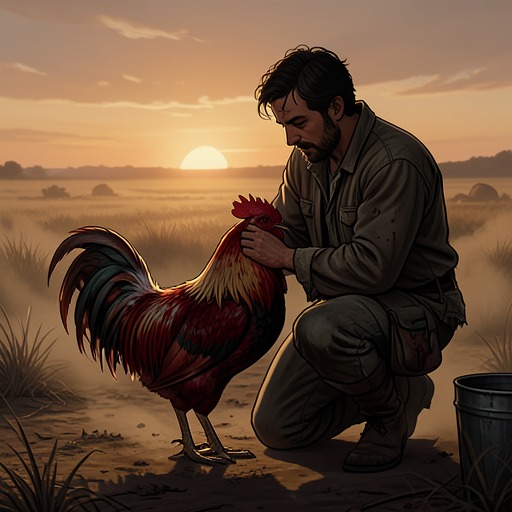
One handler presents a gleaming bronze gamecock for inspection. When it is the other bird’s turn, its owner does not immediately bring it forward. The man with the bronze bird says something impatiently, then says Rafo’s name. Rafo rises from his crouch with a spotless white rooster, its high red comb carefully described. Though younger than the teenagers around him, he appears confident in the way he handles the bird. The spectators inspect it too, and their silence registers approval.
Coins and bills are placed on an old oil drum as wagers. The handlers take their birds to opposite sides of the circle and prepare them for the contest; the roosters are released, and the fight begins. Mike edges closer for a better view, but the police interrupt the gathering almost at once. Whistles, a siren, and lights announce the raid. Mike takes cover beneath the platform as the spectators scatter. The episode leaves the outcome of this particular contest unresolved, but it has accomplished what Mike’s search required: he has found Rafo in the company of fighting cocks.
Contest, care, and danger
The birds reveal different aspects of Rafo’s life. The white rooster is presented to the crowd with care, examined by the boys, and handled confidently by Rafo. That attention stands beside the wagered contest, where handlers prepare their animals to fight and the spectators assess them. The scene does not reduce the birds to background decoration: their contrasting appearance and the audience’s close scrutiny make them the immediate focus of the gathering. At the same time, their value there is bound to competition, reputation, and risk.
The earlier scene of the children playing with pullets offers a quieter counterpoint. The small birds are part of an ordinary household setting, as the sister tends the family’s chicken coops; in the boys’ game, however, that domestic world already echoes the cockfight. The echo connects childhood imitation to a broader culture in which animal contests are familiar enough to be rehearsed in play. The novel does not need the children to understand the stakes for the resemblance to matter: the gestures of the ring have entered everyday imagination.
A later cockfight makes the cost of that culture more explicit for Mike. He sees a dead rooster while those around him praise Rafo’s bird for its courage and fighting ability. Their response is not his. Rather than treating the contest as an uncomplicated display of bravery, Mike recoils from the word macho as it is applied to the animal. The dead bird turns a familiar celebration into a question about what that celebration asks spectators to accept.
The rodeo’s mirrored spectacle
Mike recognizes the same logic in the arenas where he has performed. At Polk’s Cow Stadium, a huge banner and a poster of Mike on a rearing bronc make the rodeo’s hero image visible before the show begins. The poster presents him as a confident cowboy, while the arena’s special Ride-Out bills him as a star and recalls his championship honors. Elsewhere, Howard Polk strips away the cowboys’ self-image as heroes by calling them actors. The fighting-cock scene gives that criticism an animal counterpart: both rodeo and cockfighting turn risk into a show and attach masculine prestige to a contest witnessed by a crowd.
For Mike, the parallel is personal as well as structural. He has spent his working life entering arenas in search of the recognition that macho signifies. Seeing a rooster’s death celebrated under the same ideal makes the word newly difficult to accept. He reflects that people may direct their anger not at death itself but at one another and at the animals around them, while the arenas become places where cruelty is staged as courage. He also cannot pretend to stand outside the system: he acknowledges having given the first half of his life to those arenas and still wanting to break wild horses for money. The birds therefore do not simply symbolize a lesson Mike has mastered; they expose a contradiction he continues to inhabit. Their fights bring the novel’s heroic spectacle down to the fate of a single animal, and make Mike’s attraction to the arena inseparable from his growing recognition of its cost.