Cissy Brewer
Cry MachoCissy Brewer is a sex worker Mike Milo comes to care for, but she is never reducible to the role of someone he can rescue. Open about the terms of her work and guarded about her past, she lives with a profound inability to remember her own life. After a violent attack leaves her badly injured, she disappears; Mike eventually finds her living in an abandoned roadside stand, where recognition returns only in fragments. Their later intimacy and her calm response to it do not erase the instability that has shaped their relationship.
Identity and Background
Cissy first enters Mike’s story through his memory of the Red Rio Bar. While trying to find something useful to do for someone else, he recalls her—not as she is in the present, but as the young woman he remembers from several years earlier. The resemblance of another woman in a bar brings Cissy to mind, and the Red Rio Bar is the place attached to that recollection. Mike’s impulse is practical and personal: he decides to visit, bring her a few things, and spend an hour with her. Helping someone, he recognizes, can take him out of himself and restore a sense of generosity and worth.
Cissy had appeared at the Red Rio Bar about two weeks after Donna went to Nevada for a divorce. No one seemed to know where she had come from. She spent time getting to know men, and Mike liked her; she, in turn, adored him. She made clear that payment remained part of her work even when she liked a man, and she did not go to bed with just anyone. Her candor gave the relationship a boundary from the beginning: affection did not cancel the terms under which she earned a living.
Her privacy also set her apart from the other men at the bar. Some liked her, while others resented being refused access to her bedroom or her history. Cissy offered contradictory accounts of that history: she named Amarillo on one occasion and Memphis on another, said she had never married and elsewhere said she had married twice, and described twin daughters before later saying she was childless. The accounts do not resolve into a stable biography. Mike, like the other men, is mystified, but she tolerates his questions even when he is drunk.
Memory and Relationship with Mike
The contradictions are not simply a strategy for keeping Mike at a distance. He comes to understand that Cissy herself cannot remember her life: what looks like evasion is the outward form of a past that is elusive even to her. This distinction changes the meaning of her mystery. Her stories cannot be assembled into a dependable account, and the text gives no settled explanation for their inconsistency; what it does establish is that she does not possess the memories that would make such an account possible.
Mike’s interest in her is entangled with his need to be useful. Remembering Cissy gives him someone to visit and something concrete to do at a time when he is trying to escape his own inward preoccupations. Yet she is not merely a device for his self-repair. At the Red Rio Bar she sets limits, chooses whom to trust, and keeps parts of herself private. Later, even as memory makes recognition uncertain, she retains the ability to invite him in and to respond to him. Their connection is therefore marked both by Mike’s wish to care for her and by the fact that he cannot make her past—or her memory—his to manage.
The Attack and Its Aftermath
At the stable, Cissy is attacked by men associated with Ewell Macmillan. Mike fights in confusion and is struck with a tire iron; a horse breaks out of its stall amid the chaos. When he regains consciousness near dawn, he is covered in blood, and Cissy is lying nearby, more badly injured than he is. The account establishes the severity of the assault without turning her suffering into a spectacle.
The case comes to trial about two months later, while Cissy can still barely walk. Ewell’s friends have jumped bail and disappeared. Ewell claims that he and Mike tried to prevent the attack and shifts responsibility to Lem and Burt. Cissy’s memory is limited: the one thing she can clearly recall is Mike repeatedly telling the attackers no. Mike is fined five hundred dollars; Ewell is fined one thousand dollars and receives a six-month jail sentence that is suspended. The legal aftermath does not restore Cissy’s health or provide a reliable account of everything that happened. Her impaired memory remains central to what can be established about the assault.
Disappearance and Return to Recognition
After the trial, Cissy disappears. Reports place her working the wharves of Galveston and later describe her being arrested in the Panhandle, but these are circulating stories rather than a confirmed account of her movements. Ewell uses them to disparage her. Mike instead continues looking, convinced she needs help and reasoning that she could not have traveled far without the means to do so.
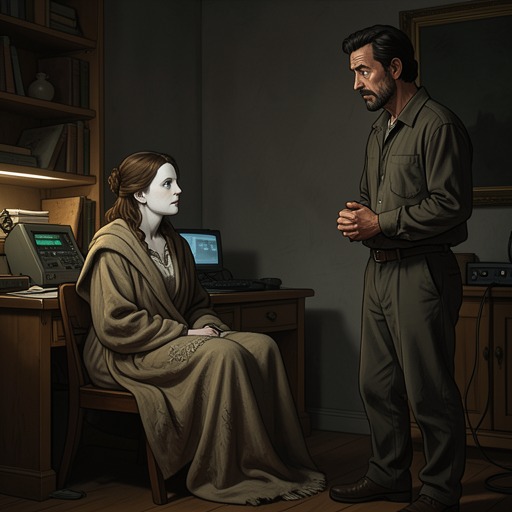
He finds her by chance on a trip to Fort Worth. A hot-dog stand on a largely empty stretch of highway, where Route 73 turns north, has closed and been boarded up; as Mike passes it, he spots Cissy. She has made a makeshift home in the abandoned place, living in the dark and hiding there. At first she does not recognize him. During Mike’s sporadic visits, recognition returns unevenly: sometimes she remembers his name, and only rarely does she recall the Red Rio Bar or things he told her there. The gradualness matters. Their reunion is not a single recovery of the past but a series of brief, uncertain returns.
When Mike identifies himself, Cissy’s long silence leaves him unsure whether she knows him. She eventually invites him inside, then asks hesitantly whether the man is Mike. The dim, cluttered room and her uncertainty make the invitation a modest but consequential act: she admits him without being able to rely on a continuous memory of who he is. Mike’s visits do not produce a cure in the evidence presented. They offer contact that may be recognized one day and lost again the next.
Intimacy and Narrative Significance
In a later intimate exchange, Mike speaks to Cissy tenderly, telling her that it was wonderful; she smiles and says she is glad. The moment is quiet and mutual in its immediate response, but its effect on Mike is not simple reassurance. Back in his car, he cannot make himself leave or cry. He recognizes a state of paralysis like the one that followed Laurie’s death and fears another lost year, before resisting that conclusion. Cissy’s response and Mike’s collapse occupy different emotional registers: the encounter does not prevent grief from returning, nor does his distress cancel the tenderness between them.
Cissy’s arc is defined by the contrast between the stories told about her and the limits of what she can remember, between the rumors following her disappearance and Mike’s chance discovery of her actual shelter. Her past remains unresolved, and her intermittent recognition prevents their relationship from settling into a conventional rescue narrative. She is both vulnerable to the consequences of violence and capable of establishing terms, receiving Mike, and answering him in the present. Through her, the book makes care an act of attention rather than mastery: Mike can keep returning, but he cannot recover Cissy’s lost history for her.