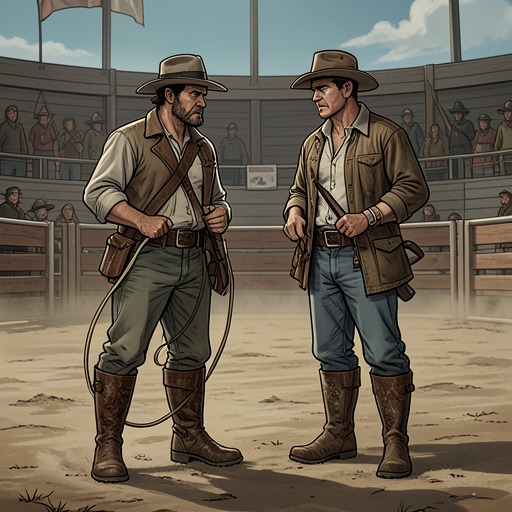
Company attendance-ledger sign-in rule
Cry MachoThe Company attendance-ledger sign-in rule is Howard Polk’s requirement that the rodeo company record its attendance in a ledger at half-hour intervals. Introduced soon after Howard took over the stadium, it was meant to end the cowboys’ habitual lateness. But its importance extends beyond punctuality: in the conflict between Howard and Mike Milo, the ledger becomes a small, visible instrument of authority, and signing it exposes the uneasy balance between personal resistance and concern for someone more vulnerable.
Introduction and Purpose
Hardly a month after taking over the stadium, Howard announced that lateness would no longer be tolerated. The cowpunchers were to sign an attendance ledger at half-hour intervals, a procedure that made their presence legible to management and imposed a regular discipline on a company accustomed to arriving late. The rule was straightforward; the response was not. The men fumed, cursed Howard behind his back, and spat tobacco juice out of his sight, yet they complied.
The requirement also reflected Howard’s larger effort to change how the men understood their work. He rejected their picture of themselves as cowboy heroes and National Finals contenders, arguing that those with the talent and nerve for the highest competition would have entered its circuit. The men still working under salary, in his view, were performers rather than heroes. Against that background, the ledger resembles one more part of a tightly managed show: like musical extras, the cowboys were expected to appear on time and follow the company’s procedures. Their resentment did not undo the rule’s practical force.
Mike Milo’s Refusal
Mike Milo did not openly challenge the order. He simply never signed the ledger. His quiet refusal set him apart from the other cowboys, who resented the new discipline but followed it. At first, Howard did not call Mike to account, leaving the omission unaddressed. Mike nevertheless expected that this forbearance would not last and understood that Howard would eventually retaliate.
The confrontation arrives when Howard points to the ledger and directs Mike to sign. Mike tells him he never does. Howard responds with elaborate surprise and asks Andy whether members of the company are being allowed to pass without signing. The exchange makes the rule’s enforcement a matter of public accountability: rather than simply reprimanding Mike, Howard presents the omission as a failure by the manager responsible for the company’s procedure.
Andy’s position turns the ledger from a dispute between employer and employee into a test of Mike’s response to pressure on someone else. The old man’s mouth trembles; tobacco juice dribbles toward his chin; he struggles to answer. He then moves the ledger a few inches toward Mike and hands him a pencil with a shaking hand. He asks Mike to sign, his voice as unsteady as his grip. The scene gives the routine act a human cost: refusing would mean continuing to defy Howard while leaving Andy caught between them.
Enforcement and Consequences
Mike signs his name and walks toward the tackroom. His action ends his refusal in that moment, but it does not arise from an admission that Howard’s rule is fair or from a change in his earlier practice. Howard has put Andy in the position of asking, and Mike will not make the old man endure more pressure on his behalf. The enforcement succeeds by changing the immediate stakes of disobedience: Mike must choose not only whether to comply, but whether to force Andy to remain in the confrontation.
As Mike passes the iron rail, he sees Andy covering his mouth to stifle a giggle. Andy takes pleasure in having won a small victory over the cowboy he has maneuvered into signing. The sight alters Mike’s understanding of what his compliance has accomplished. He had acted to spare Andy, but receives neither gratitude nor warmth; instead, he feels contempt for having been fooled. The rule has therefore secured Mike’s signature while leaving him resentful of both Howard’s tactic and Andy’s response.
In the tackroom, Mike swings his right arm more vigorously than usual to hide its pain, then realizes no one is there to observe him. The Grand Entry is finishing, and the cowboys are already in the alleyway by the chutes. The scene moves from the public pressure surrounding the ledger to Mike alone among the familiar equipment of his work. That contrast does not cancel the humiliation he feels, but it places the confrontation within the routine world the company rule is meant to organize.
Significance
The ledger is both a practical attendance record and a stage on which Howard can make compliance visible. His enforcement of the rule exposes the difference between open rebellion and effective resistance: Mike’s silent refusal unsettles the procedure for a time, but Howard can turn that refusal into a confrontation by involving Andy. Mike ultimately signs, yet the manner of enforcement leaves the act charged with resentment rather than reconciliation.
A separate company-wide salary cut underscores the limited choices available to the men without being identified as a direct penalty for the ledger dispute. Howard reduces everyone’s pay by twenty-five percent, and nobody leaves. Mike is troubled by the cut but more troubled by the prospect of returning to competition, so he stays. Howard does not fire him, and Mike accepts the reduced salary; each interprets the other’s restraint as weakness. In that broader standoff, the sign-in rule is a small but concrete measure of Howard’s control and of Mike’s habit of resisting without openly breaking their uneasy equilibrium.