Dallas Buckle
Cry MachoThe Dallas Buckle is the signature rodeo prize in Mike Milo’s collection: an award for bareback riding that certifies a history of public achievement. Its decisive appearance comes when Mike, preparing to leave his rodeo identity behind, first withholds the buckle from a sale and then gives it up under pressure. The reversal makes the object more than a trophy. It becomes a material test of the value Mike places on his reputation when the career that earned it is no longer available to him.
Award and public identity
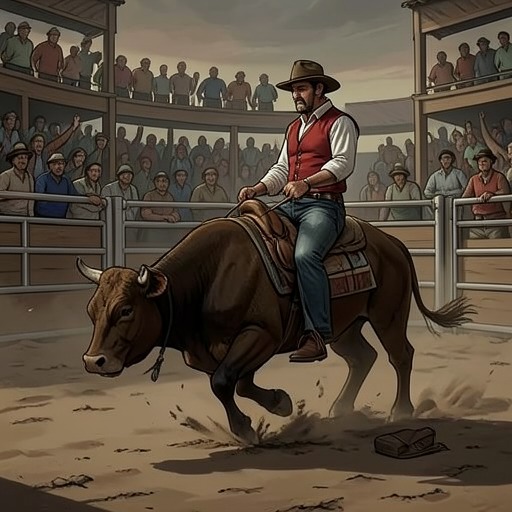
The buckle’s standing is established in the arena, where the announcer presents Mike as a champion and identifies him as a winner of the Dallas Buckle for bareback riding. The announcement places it among the distinctions accumulated through his rodeo career, alongside nine Cattlemen Trophies. Its prestige is therefore public as well as personal: it belongs to the record through which spectators and fellow riders know Mike.
That public image is reinforced by his carefully cultivated appearance. Mike wears an all-white outfit, including a silk shirt, a beaver hat, and iguana-skin boots, as a deliberate declaration of fearlessness and expertise. The text does not say that he wears the buckle with this costume, but the two belong to the same world of visible rodeo distinction. The outfit stages the champion; the buckle records the achievement behind that staging. Together, they show how a rodeo identity can be fashioned through both performance and the honors attached to it.
The award’s meaning is sharpened by the danger of the performance it recognizes. Before riding, Mike experiences the Ride-Out as frightening and exhilarating, with the possibility of a broken neck in his thoughts and the challenge of remaining on the animal at the center of the event. Afterward, he performs his familiar flourish, tossing his white hat into the air and catching it as the crowd cheers. The buckle stands for accomplishments produced in this arena of risk, but the applause and the signature gesture show that public acclaim is also part of what the champion receives.
The trophies put up for sale
Later, Mike goes to the stadium tackroom to empty his locker. He discards the equipment and clothes associated with his working life, as well as a magazine bearing his picture, then takes down the awards, buckles, trophies, and ribbons that remain. The contrast is stark: objects once precious to him are now gathered up with the rest of a career he cannot continue. He carries the heavy rigging bag to the Red Rio Bar, uncertain what he will do with the prizes.
There, Mike empties the bag onto the counter and offers the collection for sale. The Dallas Buckle is the exception he makes visible: he separates the large gold award from the heap and says that everything else is available. When Robbie asks whether he means the entire collection, Mike again distinguishes the buckle from the other prizes. At this point, the object marks a boundary. Mike can contemplate selling the accumulated record of his success, but he still treats this particular award as inseparable from his name.
The distinction lasts only briefly. A low offer prompts laughter, and Mike insists that even the small bid be taken seriously. The collection eventually sells for one hundred and sixty dollars to a young man who counts out the money beside an empty glass. Mike puts the Dallas Buckle back into his bag, apparently preserving it after the other prizes have changed hands. But Buxby, a steer dogger, then asks about the larger buckle. Mike says it is not for sale because it has his name on it. Buxby answers that all the awards bear Mike’s name and that their inscriptions will eventually wear away. His taunt turns the sale from a simple exchange into a confrontation about whether a name engraved on a prize can secure lasting recognition.
The buckle’s surrender
Mike responds to the challenge by asking what Buxby will pay. When Buxby offers one hundred dollars, Mike throws the buckle onto the bar as if it were an ordinary piece of merchandise. Buxby pays, and Mike accepts the bills. The sequence reverses the earlier gesture: the object he had singled out as beyond sale becomes the most valuable individual item in the transaction, yet it is also the one he relinquishes only after his claim of permanence has been attacked.
The buckle’s price does not resolve what it is worth to Mike. A moment after the sale, he finds himself alone at the counter, moving his head from side to side and wondering whether he is becoming dizzy. The bartender quietly sets a shot of whiskey beside his hand; Mike drinks, pays, and leaves. These details place the exchange amid physical unease and emotional uncertainty, rather than presenting the sale as a clean, triumphant break. The money is immediate and countable; the career and the identity attached to the award cannot be recovered through the transaction.
Achievement and the ideal of toughness
The buckle’s significance extends beyond the sale because the novel questions the kind of heroism that rodeo celebrates. Later, at an illegal cockfight, Mike watches the crowd praise Rafo’s rooster for its fighting qualities and recognizes the word used for such toughness as one he himself had sought in arenas across several states and in Mexico. The spectacle leads him to question whether dominating an animal proves courage, or whether the desire to be seen as a hero conceals fear of being a coward. His thoughts connect the hero’s performance to the wish to face death, while also confronting the cruelty that can result when that anger is directed at other people and animals.
The Dallas Buckle does not reappear in that reflection, and it is not itself shown to cause Mike’s doubts. Its established role as the emblem of his bareback achievement nevertheless gives the earlier sale an added resonance: the honor certifies success within a culture of daring, while Mike’s later questioning complicates the heroic meaning attached to such success. Rafo’s unexpected use of the word Macho for Mike after watching him ride provides a contrast. Recognition can arise from another person’s admiration, not only from a championship record or a prized object. The buckle is thus both a genuine record of Mike’s accomplishments and a fragile token of the public identity he eventually parts with.