Fonda de los Quinos
Cry MachoFonda de los Quinos is a dreary old inn that becomes a temporary holding place for Mike Milo and Rafo during their journey north. Under the watch of a sergeant and his armed driver, its shabby lobby is the setting for a tense wait, a painful disclosure about Rafo’s parents, and the separation that enables Mike’s escape. The inn’s architecture matters to the action: a concealed-looking panel in the ceiling and a route across the roof give Mike a way to leave without taking Rafo with him.
Setting and Physical Character
The inn is described as an old building whose original purpose is uncertain. It may once have been a hermitage or a modest hacienda, but it was not built around the open courtyard common to many Mexican inns. Instead, a small, mean paso serves as its lobby. The building’s uncertain past and present use give it the air of a place adapted to purposes other than hospitality.
The lobby is crowded with massive furniture in a Californian Spanish style, once called mission, whose construction seems designed chiefly to endure. A plastic cover protects the davenport’s fabric, but the fabric is already stained and threadbare. The room’s furnishings therefore offer little comfort or reassurance: their solidity is worn down by neglect. Mike finds the interior so gloomy that he would almost prefer to wait in a jail.
A Lobby Under Watch
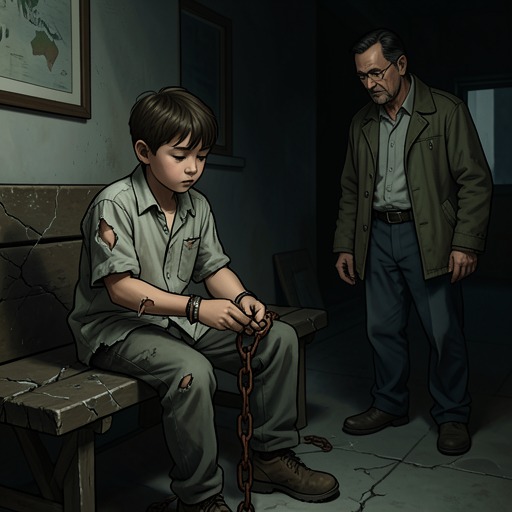
The sergeant treats the paso as a controlled waiting area. He invites Mike and Rafo to make themselves comfortable while he makes telephone calls, but the invitation amounts to an order to remain seated in view of the front desk and the telephone. The sergeant keeps them within sight, as does his driver, who has a gun. The inn is not formally described as a jail, yet its lobby functions as a place of confinement while the authorities decide what to do.
Mike declines to sit. Rafo takes a place on the wooden bench, upright and tense, watching and listening for clues in the sergeant’s hushed calls. Mike wonders whether the boy’s leg hurts, but Rafo gives no sign of pain or of any other feeling. The contrast between Mike’s unease and Rafo’s guarded stillness makes the wait feel less like a pause in the journey than a contest over what the boy’s future will be.
The sergeant has already demanded to see Mike’s tourist card and asks about the boy. At the inn, he continues his inquiries by contacting the national police and Rafo’s parents. He first speaks with Rafo’s father; after that call, the telephone rings again, and the sergeant answers quickly and privately. These calls turn the inn’s front desk into an improvised center of authority, where a family dispute and the prospect of police action are decided at a distance.
The News About Rafo’s Parents
When the sergeant finally addresses Mike and Rafo, he reports that the police are looking for Rafo in the Distrito Federal to arrest him for truancy, petty theft, and resisting arrest. Rafo’s mother, he says, will not defend him because she does not know how to defend him; she thinks it may be better for the boy to learn that the law is the law. The sergeant is less certain how to convey his father’s answer: Howard Polk says he knows nothing about the situation.
Rafo begins to speak, stops, and tries again, struggling to trust what his voice will do. He interprets his father’s involvement as evidence that Howard has sent for him. The report at the inn therefore makes the boy’s expectation collide with the words attributed to his father. The scene turns on the difference between the summons Rafo believes he has received and the denial the sergeant has just relayed. The inn is where that contradiction is spoken aloud, with Mike and Rafo sitting together under the sergeant’s supervision.
The Roof and the Departure
As morning light enters their room, Mike notices a roughly two-foot-square section of slats between the rafters. A narrow border of light outlines it; the panel is imperfectly fitted, and when Mike pushes it, it shifts askew. He suspects what it may be covering and turns to Rafo, who is now standing beside his bed, taut and watchful. The panel draws attention upward, away from the guarded lobby and toward a possible exit.
Mike leaves by way of the roof. He crosses carefully above the lobby, sees Rafo lie flat on the rooftop so that he cannot be seen from the street, and continues toward the eaves. Rather than risk jumping directly to the street, Mike follows a sloping roof to a lean-to in an alley and drops down there. The inn’s upper surfaces offer a route the authorities below cannot immediately control, but taking it means Mike and Rafo do not leave together.
Outside, Mike waits before driving off at speed in his truck. The patrol car follows him toward a ravine where trees and scrub might let him disappear; beyond the thicket, the border runs through the brush and Texas lies on the other side. Fonda de los Quinos thus marks a decisive change in the pursuit: the two travelers have been held together inside, but Mike’s escape turns the truck into the visible target of the chase while Rafo remains behind. The inn’s significance comes from this double role—as a place where official custody closes around them, and as the structure whose roof makes a divided escape possible.