Horses
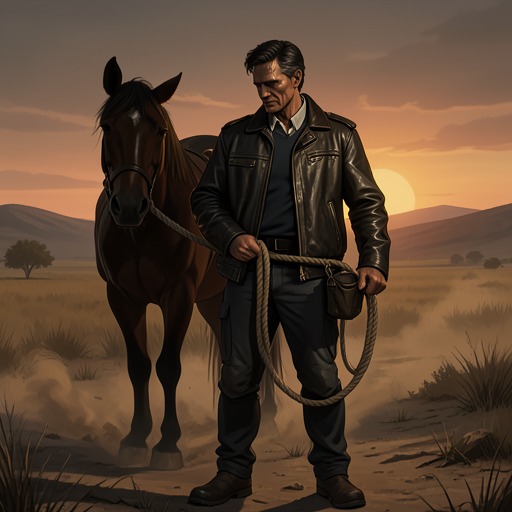
Cry MachoHorses in Cry Macho are never only scenery for the cowboy’s performance: they make Mike Milo’s career possible, test his physical limits, and bring the cost of rodeo spectacle into view. From the bronc displayed on the stadium banner to the injured yearling Mike tries to protect, the animals occupy an uneasy place between partners, adversaries, property, and vulnerable lives. The contrast between their force and the human appetite for control makes them central to the book’s examination of the cowboy hero.
Work, Memory, and the Rodeo
Horses shape Mike Milo’s professional identity long before the novel’s central journey. A photograph above the entrances to Polk’s Cow Stadium presents him mounted on a rearing bronc, hat raised and smile fixed for the crowd. Mike avoids looking at it. The image dates from his final year of competition, when poor results, repeated injuries, fear, sleepless nights, and increasing drinking made every horse seem like a possible disaster. The bronc in the photograph therefore advertises a confident star while recalling a period when the work had become physically and emotionally harder to endure.
The resident rodeo at Polk’s Cow Stadium turns the relationship between rider and horse into a public show. Howard Polk’s management makes the cowboys’ theatrical role explicit: in his view, they are salaried performers rather than the heroic competitors they imagine themselves to be. Horses are central to that transformation. They supply the danger and movement that distinguish a rodeo performance, while the program and crowd make a spectacle of the rider’s apparent command over them. Mike’s skill can win applause, but the animal’s unpredictability is never fully contained by the show’s presentation.
Mike’s proposal for The Ride-Out grew from the rodeo’s need for a crowd-drawing event. Instead of ending a ride at the standard eight seconds for a bareback horse or ten for a saddle bronc, the rider would stay on until thrown or until the horse settled. The event made the horse’s continued resistance—not simply the rider’s timed performance—the source of suspense. It quickly attracted newspaper attention and larger audiences, and Mike returned to stardom. Later, Howard placed another Ride-Out near the start of the program and introduced fresh, more difficult horses to heighten the attraction. The change increased the risk for Mike as the show sought ever more excitement.
Tabasco and the Limits of Control
Tabasco embodies the danger that the Ride-Out depends upon. The sorrel stallion is described as unusually fast, difficult, and intelligent, with a build that fits neither bareback nor saddle-bronc work especially well. Mike has not succeeded in making him accept the Ride-Out, and feels more tense than usual when preparing to ride him. That unease makes the horse’s individuality matter: Tabasco is not a neutral prop but a particular animal whose temperament resists the routine imposed on him.
Before the ride, the announcer presents Mike as a champion and names Tabasco as the featured mount. Once the chute opens, the stallion bucks and turns across the arena while the crowd responds to each movement. Mike experiences the familiar combination of fear and exhilaration, with the possibility of a fatal fall always part of the risk he accepts. He stays on long enough to receive the audience’s acclaim and then turns toward the exit. As he is leaving, Tabasco rears and twists; Mike is thrown and trampled. He eventually stands and waves his hat to reassure the crowd. The apparent triumph of the performance thus ends in a sudden reversal: the horse’s movement breaks through the show’s expected finish, while Mike’s effort to look unhurt becomes another performance for the spectators.
The incident sharpens a recurring distinction in the book between human confidence and bodily reality. Mike has built a career on reading horses and enduring their force, yet he cannot dictate Tabasco’s final movement. The crowd’s applause, his reputation, and his practiced gestures do not remove the danger. The horse’s power is real even when the rodeo packages that power as entertainment.
Care, Use, and Animal Suffering
Mike’s attachment to horses also comes through his family history. His maternal grandfather was a saddler who worked with the equipment used on horses and treated sick animals when he could. Horses are among Mike’s earliest clear memories, and his love of them is bound up with his love for his grandfather, despite their frequent quarrels. This background presents practical knowledge of animals as an intimate inheritance: horses belong not only to Mike’s work but also to the earliest relationships he can remember.
That closeness does not protect Mike from the harsher economics of animal care. Before leaving veterinary work, he is troubled by the treatment of sick animals that might be curable but are judged not worth the time or cost. An anthrax outbreak makes that conflict immediate. The number of affected horses rises from twenty-two by midnight to fifty by dawn. Mike takes part in the response, and the episode deepens his existing objection to a system that treats the value of an animal as a calculation of expense. The outbreak becomes the point at which his dissatisfaction with the work hardens into a decision to leave it.
A later crisis gives that conflict a single, vulnerable focus. Among the healthy horses at the outbreak site, a frightened chestnut yearling falls and breaks a leg. Mr. Croag and others stand over the injured animal, and Mike sees that Mr. Croag has drawn another gun. Mike runs toward them and protests. The scene places his resistance to the accepted logic of disposal in direct conflict with his employer’s authority. The evidence establishes Mike’s intervention, not the yearling’s eventual fate; its significance lies in the choice to oppose an immediate act of killing rather than accept it as routine.
Wildness, Spectacle, and the Cowboy Ideal
Horses also connect the rodeo to the broader image of the West as a place where a skilled rider proves himself by mastering a powerful animal. Yet the novel repeatedly unsettles that promise. At Polk’s Cow Stadium, the cowboy’s public image depends on danger being visible but manageable. The Ride-Out sells a contest of endurance, while the horses’ unpredictable behavior exposes the limits of that control. When Mike later leaps onto a white wild horse from a moving truck, the animal continues forward and then rises in an effort to throw its burden. Mike holds on, but the moment offers no easy conversion of wildness into a triumphant symbol of human mastery.
The book’s reflections on the word macho extend this tension from horses to other animal spectacles. After witnessing a cockfight, Mike connects the celebration of animal and human violence with the arenas in which he has spent his life. He recognizes that he has given the first half of his life to those arenas and remains willing to break wild horses to earn enough money to leave. The contradiction is deliberate: he recoils from cruelty yet still depends on a livelihood built around risky contests with animals. Horses therefore embody both the attraction of the cowboy ideal and its costs. They make Mike’s skill and courage visible, but they also remain beings whose fear, strength, injury, and resistance cannot be reduced to the story the crowd wants to see.