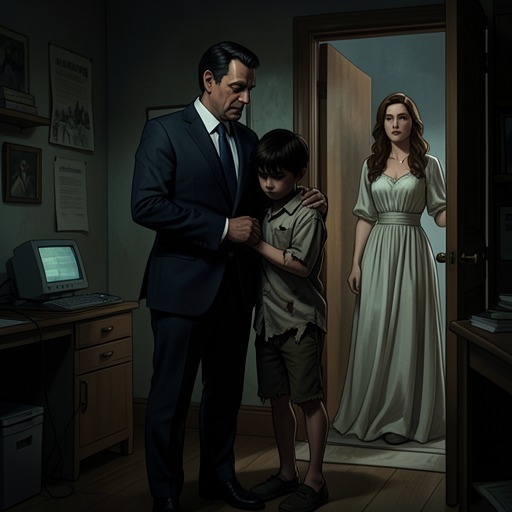
Howard Polk and Alexandra Muños de Santis Polk’s marriage
Cry MachoHoward Polk and Alexandra Muños de Santis Polk’s marriage joins affection, business, and parenthood in an arrangement that survives its emotional collapse in altered form. Howard recalls a union begun in love, but after their divorce he sees Rafo as leverage in a financial negotiation; Alexandra, in turn, insists that her son remains hers to control. Their marriage’s decisive legacy is thus not reconciliation but a contest in which money, custody, and possession become difficult to separate.
Marriage and Its Financial Legacy
Howard says he met Alexandra in Texas while she was visiting from Mexico and he was also traveling. They married, had a son, and lived first in Dallas and later in New York. During that period, Howard was making major investments in Mexico City. Because, as he explains it, Americans could not own property in Mexico, he placed the investments in his wife’s name. He recalls this choice as something he would not have made had he expected the marriage to end: in love, he believed the marriage would last forever.
His account draws a sharp distinction between the marriage and the contracts created around it. The marriage contract ended; the real-estate holdings, mining company, and other business arrangements did not. That contrast gives the divorce a material afterlife: the relationship is over, but the property structure formed during it remains consequential. Howard’s rueful description of the arrangement does not establish that Alexandra acted improperly; it shows how he understands his predicament, as a man whose romantic trust and financial decisions have left him with little bargaining power.
Divorce as Negotiation
Howard tells Mike that he wants to reopen negotiations with Alexandra, but admits that he has nothing she wants. His proposed solution is to take Rafo from her: he believes that losing their son would drive her back to the bargaining table. He presents the plan with striking candor, not as an attempt to repair the marriage or improve Rafo’s circumstances, but as a way to gain leverage over his former wife.
The scale of the existing dispute is made concrete when Howard says he has spent more than two hundred thousand dollars in lawyers’ fees. If he had Rafo, he argues, the negotiations would cost him much less. He then offers Mike fifty thousand dollars to bring the boy back. The figures turn a family conflict into an explicit calculation: legal fees are a burden, the child is leverage, and the proposed payment is the price of carrying out the plan. Howard’s language exposes how far his present dealings with Alexandra have moved from the enduring-love ideal he describes from the beginning of their story.
Rafo and the Struggle for Authority
Alexandra’s encounter with Mike makes the custody conflict visible from the other side. After finding Mike’s employment cards and a photograph of Rafo among his belongings, she asks why he is carrying her son’s picture and challenges him over whether he is kidnapping the boy. She ultimately tells him to collect Rafo, but insists that he sign a receipt. Her permission is therefore conditional and pointedly formal: she allows the transfer while naming the suspicion surrounding it and requiring a record of what has happened.
When Mike’s attempt to take Rafo ends in violence, Alexandra tells him to keep his hands off her son and says that, although she hates Rafo as she hates Mike, the boy is hers. She calls him her property and warns that nobody takes what belongs to her. The declaration is not evidence that she and Howard have identical motives; it is evidence that both parents frame their claim to Rafo in possessive terms. Howard would use the boy to force a financial negotiation, while Alexandra asserts an immediate, personal right to keep others from taking him. In that confrontation, the marriage’s unresolved conflict is carried forward through the child, with Mike caught between rival claims of authority.
Significance of the Marriage’s Afterlife
The relationship is revealed through Howard’s explanation and through the consequences of his plan, rather than through a scene of shared married life. That structure makes the marriage legible as a history of decisions whose effects remain active after separation: investments placed in Alexandra’s name, expensive legal proceedings, and a son made central to the parents’ negotiations. Howard’s recollection of love and permanence sits beside his present calculation of costs and leverage; the contrast is not merely between a marriage and a divorce, but between the promise he remembers and the terms on which he now approaches his former wife.
Alexandra’s words sharpen that tension without resolving it. Her authorization for Mike to collect Rafo does not erase the threat she later makes, and her claim over her son does not settle the financial dispute Howard wants reopened. The marriage persists in the story as an adversarial structure rather than a continuing partnership: its shared history supplies the money and family ties at stake, while its breakdown leaves each parent asserting control in a different way.