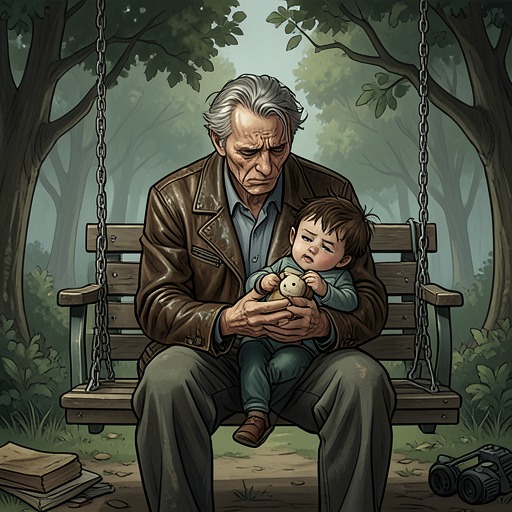
Laurie
Cry MachoLaurie is the only child of Mike Milo and Donna, and the person through whom Mike discovers a form of love he had never trusted in himself. Born healthy after a pregnancy shadowed by the family’s earlier losses, she becomes both the focus of her father’s devotion and the lasting absence around which much of his grief is organized. Her short life changes how Mike understands giving; her death leaves that understanding inseparable from loss.
Identity and Family Background
Laurie is born after two failed pregnancies have made her parents wary of hope. During the third pregnancy, Mike and Donna spend nine months saying little and deliberately slowing their lives. They are so guarded that they nearly persuade themselves the pregnancy is unreal and that no child will come. Laurie’s healthy birth breaks that silence and, for Donna, lifts the sense of a curse over the marriage. Donna becomes a deeply devoted mother, though she does not recover the earlier, untroubled happiness she had once known.
Mike understands Laurie’s arrival as a turning point in his own capacity to love. Before her birth, he had not been sure that he had ever loved anyone without suspecting his motives. He describes his relationships with women as negotiations and even sees himself as a taker in relation to the grandparents who gave to him. Laurie alters that pattern: caring for her gives him a pleasure in generosity that he had not experienced before.
A Bond Built on Giving
Mike makes giving to Laurie an organizing practice of family life. He turns it into ritual and celebration, finding happiness in being the giver and expecting little in return. At first he thinks of fatherhood as a one-way act of provision. As Laurie nears six, however, he recognizes that she is beginning to return his affection, making their bond reciprocal in a way he had not anticipated.
The child Mike remembers is grave, gallant, and decent, qualities he associates with both parents as well as with Laurie herself. He also sees her as difficult to read in a distinctive way: she seems to express only part of what she means, as though she is approaching an idea tentatively and might return to it later. Her reserve does not make her distant from him. Mike believes she can read the directions of his moods and find her way to the heart of him when he is troubled. He is moved, and somewhat frightened, by the sense that she wants to give him the same comfort he has given her.
Illness and Death
In early May of Laurie’s seventh year, Mike comes home on a spring evening to find her feverish. She describes unusual sensations involving her eyes and loud noises in her head. The doctor thinks the illness may be one of the childhood diseases and expects it to be more identifiable by morning; meanwhile, he advises aspirin at regular intervals and bed rest. Mike stays awake with Laurie through the night. When he tries to give her aspirin a second time, she has died.
At the funeral, as Laurie’s casket is put into the ground, Donna cries and Mike does not. He also does not cry when he locks Laurie’s room. The narrative describes his grief as remaining held within him rather than finding an outward release. Her death does not bring the surviving parents closer: Donna withdraws further from Mike, and their relationship changes under the pressure of bereavement. Laurie’s absence thus marks not only a private loss but a fracture in the family they had formed around her.
Grief and Its Returns
Mike’s grief breaks through later in an episode that begins the period he calls his lost year. After leaving Donna, he goes to Laurie’s grave in the rain, drunk, and pounds the earth while blaming her. The outburst is directed at the grave, but it shows how his sorrow has become anger as well as silence. The contrast with his restrained behavior at the funeral makes the later scene a return of what he had not been able to express there.
Laurie also remains present in Mike’s thinking when he considers what children mean. When Rafo asks about his family, Mike says that he and Donna had one child and that she died. The boy receives this news solemnly. A later question about whether Mike likes children unsettles him because he cannot answer simply even to himself. His thoughts move through the possibility of children growing up, growing away, or being lost through death. He finally says that he does not like them, a blunt answer that sits uneasily beside the depth of his attachment to Laurie. The passage makes the answer less a settled judgment about children than an expression of how closely affection has become tied, for him, to the prospect of losing them.
Lasting Significance
When Mike reflects on cruelty and the arenas in which people dominate animals, Laurie’s death returns as the one time he remembers wanting to retaliate against life. He considers the possibility that the desire to confront death may be displaced into contests of domination, but recognizes the cruelty that follows when anger is directed at other people and animals instead. The reflection connects his daughter’s loss to the book’s recurring tension between toughness and vulnerability: the posture of the hero cannot undo mortality, and rage at death can become harm inflicted elsewhere.
Laurie also remains the measure of a gentleness Mike later finds difficult to recover. In Janasco, when he feels a renewed need to give care to Marta, he recognizes that this impulse has not returned in the same way since Laurie died. The connection does not erase his grief; it shows that the capacity he discovered through fatherhood survives it, though it is intermittent. Near the end of his journey, Mike thinks of returning to Texas and confronts the fact that Laurie, along with other people and pursuits from his former life, will not be there. Her absence is part of what makes home feel unchanged and empty, while his memory of loving her remains one of the few sources of meaning he carries back.