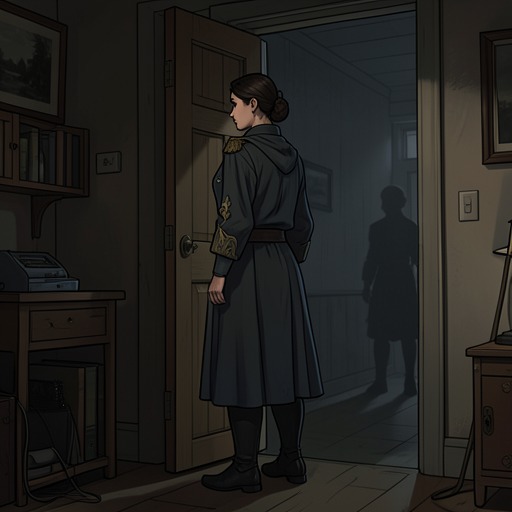
Lexa's house
Cry MachoLexa's house, the residence of Alexandra Muños de Santis Polk, is both the destination of Mike Milo's attempted nighttime entry and the obstacle that exposes the limits of his plan. Set behind a red volcanic-stone wall in Lomas de Chapultepec, the house presents an imposing public face and a difficult, tightly controlled rear boundary. Mike's effort to reach Rafo moves from reconnaissance to a painful encounter with the household's dogs and a failed attempt at entry; the decisive change comes not from overcoming the architecture but from Lexa's permission to take her son.
Setting and Appearance
Mike first approaches the house by day, after leaving the cab and using Howard's marked street map. The surrounding neighborhood is defined by spacious, individually designed homes, broad driveways, emerald lawns, and vivid flower beds. Among them, Lexa's house appears especially grand: older-looking and more ornate than its neighbors, with an abundance of columns, archways, and porticoes. Its design seems to possess an accidental unity, making it beautiful despite its excess. Mike sees it through breaks in the wall rather than from an open approach, so the house is introduced as something visible but withheld.
That boundary is substantial in both material and effect. The wall is made of volcanic red rock, identified by Howard as tezontle stone; elaborate wrought-metal gates join the masonry at the front. The main gates are immense and conspicuous, reinforced by an electrical signal case and a large alarm box. Mike judges them effectively unassailable, especially because any route through them would have to work again while carrying a boy. The house's security is therefore not mere decoration: it shapes the practical terms of his plan and makes the rear approach seem essential.
The Planned Rear Approach
Howard's directions lead Mike along the wall toward an alley and a second gate. At first, the wall does not seem to descend as described. Mike then realizes that the pavement rises gradually, leaving the stone only a couple of feet above his head. The detail confirms the accuracy of Howard's map and directions, encouraging Mike to trust the route even as the property remains difficult to read from outside.
The alley is private and narrow, though wide enough for the truck according to Howard's description. Its gate is only about four feet across, made of closely spaced, heavy iron rods, and resembles a prison-cell door. It cannot be opened from the outside; an electric button on an intercom box, positioned well away from the gate, controls it from within. Mike cannot see the box itself and has to rely on the diagram. His confidence in Howard's account is qualified by unease: he expects to need to locate the control in darkness, and the gate gives him no easy way to test or enter the property.
The plan's most serious omission becomes apparent when the dogs bite Mike's hand through the bars. He has not seen them before the attack; only afterward do the two large hounds bark, growl, and throw themselves against the gate. Their heavy jowls and long, lean bodies make them unlike any dogs he knows. Mike's comparison to the hound in The Hound of the Baskervilles emphasizes the difference between a remembered fictional menace and animals he will have to face in reality. Most consequentially, the dogs were absent from Howard's otherwise detailed instructions. Mike's bleeding hand marks the first failure in his reconnaissance, and the noise draws someone from the house. He retreats down the alley and catches a cab toward the Paseo de la Reforma.
The Nighttime Attempt
Mike returns with a different opportunity to climb the wall. He has chosen a spot with a weep hole that can serve as a foothold, while the horn and dogs remain audible nearby. When a police car arrives in response to the commotion, he stays outside the streetlamp's light as the officers run toward the noise and the gathering spectators. Their arrival creates a brief opening: Mike slips into the light, climbs through the weep hole, and drops into a flower garden inside the wall. The fall is higher than he expected, but the soft ground receives him.
Under the full moon, the house appears to him as a white, storybook castle under blue light. That image contrasts with the practical, restrictive property he has encountered: the guarded front entrance, locked access points, and concealed dog runs. From the garden he can distinguish part of the front driveway and parking area, with two cars close together and a faint wash of warm light, but the illumination does not reach the main gate. The house is legible only in fragments, and Mike must navigate by the sketch and his earlier reconnaissance.
He heads toward the rear, where the diagram indicates gardens, a utility yard, two windows, and a fanlighted back door. The grounds are orderly and well kept. The doors and windows are all locked, however, and the suggested alternative—a second-floor balcony with French windows—depends on a bougainvillea vine and wooden trellis. Neither is there. The glossy stucco wall offers no ledge or projection for climbing. Howard's second mistake removes the route Mike had expected to use, while the dogs are growing quieter and may soon return. The house's physical appearance has again promised a way in that its actual surfaces deny.
Lexa and the Change in Stakes
The attempted entry ends not with Mike reaching Rafo by force but with an encounter with the people inside the property. Mike gradually makes out three figures. His perception of the young woman shifts as he tries to understand her, until he recognizes her as Lexa. A middle-aged woman with black hair touched by gray and a dark, quiet man are also present. Lexa speaks to them in Spanish; Mike cannot understand the words, though he hears repeated references to the police. They appear reluctant to leave her alone with a criminal, and Lexa's exasperated response drives them away.
The decisive turn comes in the conversation about the arrangement with Howard. When asked whether delivery of Rafo means payment, Mike confirms that it does. Lexa tells him to collect her son, then repeats the permission when Mike questions whether he has understood. She makes clear that if he intends to kidnap Rafo, he need not sneak in through the back. Her words reverse the meaning of the house's barriers: Mike had treated the property as an obstacle to be breached, but the person with authority over Rafo permits him to take the boy. The house is thus the setting for a failed trespass that becomes an authorized departure, shifting the immediate stakes from physical access to the uneasy agreement between Mike and Lexa.