Macho's Cockfight
Cry MachoMacho's Cockfight is a clandestine match in a ruined passageway where Rafo’s white rooster faces a black gamecock. Macho’s victory changes Rafo’s prospects in the ring, but its deeper consequence falls on Mike: watching the contest turns the celebrated ideal of macho from a badge of courage into a troubling justification for cruelty. The scene brings together a public test of animal bravery and Mike’s private reckoning with the arenas that have defined his own life.
Discovery and Challenge
Mike and Rafo enter a little arcade in darkness, following the sound that has drawn Macho into restless circles. The rooster answers a crowing noise, then moves farther down a corridor of fallen stone and old columns. What first appears to be a dead end proves to be a turn in the passage. Candlelight reveals a cockfight that has just ended: a gray rooster lies dead, while the victorious black gamecock struts among a group of roughly ten or twelve men dividing the winnings.
The men notice the newcomers only after Macho makes a sound. One of them brings a candle close and recognizes Mike and Rafo as Porfirio, the elderly man who had earlier tried to sell them a mustang. When Macho moves toward the black rooster, Rafo quickly lifts his bird from the ground. Porfirio points out Macho and asks whether he is a fighting cock. The encounter thus shifts from an accidental discovery of an underground contest to a direct challenge involving Rafo’s companion.
Marta is also present with her rooster. Her manner falters when she looks at Mike, but she does not turn away; after looking once more at Rafo and his bird, she accepts the challenge. The match is not presented as a formal or wealthy affair. Porfirio holds the wagers, which consist of small amounts in pesos and centavos, yet the men crowd in to take part rather than be left out. The modest stakes do not make the event casual: the gathering’s attention and the birds’ preparation give the contest its own tense ceremony.
Preparation and Uneven Odds
Before the fight, the handlers prepare the roosters through a process Porfirio calls hacer. They smooth the birds’ feathers, speak soothingly to them, and keep them from seeing each other so that their anger will not be spent before the match begins. The contrast between this careful handling and the violence expected from the contest is central to the scene: tenderness is used not to prevent the fight but to preserve the birds’ readiness for it.
The preparations encounter a problem. The bettors whisper among themselves and then with Marta, who draws Porfirio into the darkness. Mike and Rafo cannot hear what they discuss. Porfirio returns alone to tell the challengers that the black rooster has long spurs and asks which kind they prefer, long or short. The account does not disclose the private discussion or spell out the challengers’ response. It does establish that the black bird has a significant advantage to consider before the match begins.
Marta and Rafo bring their roosters close enough to threaten one another but do not release them at once. The birds squawk and peck, sometimes turning their attention toward the handlers when held apart. At Porfirio’s call, both are released. The contest begins with displays and tentative attacks before becoming more serious. Macho is struck and begins to limp; the black rooster presses its advantage, and Rafo appears stricken. Mike wonders whether the boy will retrieve Macho and concede, but Rafo remains at the edge of the ring, unable to look away even as he struggles to watch.
Reversal and Victory
The match turns when one of Macho’s spurs comes undone. The white rooster is left with one spur attached, but the change does not end the contest. Macho raises the unspurred foot toward his opponent, then begins using the remaining spur. The momentum shifts: the black gamecock, which had been attacking effectively, is now struck in return. The encounter becomes a contest of endurance and aggression rather than a simple confirmation of the black bird’s initial advantage.
Macho ultimately kills the black gamecock. The passage describes the contest as increasingly savage, but its essential result is clear without reducing the event to its worst physical details: the black rooster dies, and Macho remains alive, limping and bloodied. Even after the spectators prevent him from approaching the defeated bird again, Macho continues to crow. The sound is attributed to rage as much as to victory, complicating any easy image of a triumphant champion.
For Rafo, the result brings recognition from the men gathered around the ring. They congratulate him on his rooster’s valor and praise the qualities they see in its performance, repeatedly applying the word macho to the bird. Their approval makes the match a public test of courage and status, not merely a wager. Yet the honor they confer is inseparable from the contest’s cost, a contrast that the scene makes impossible for Mike to ignore.
Mike’s Response and the Meaning of Macho
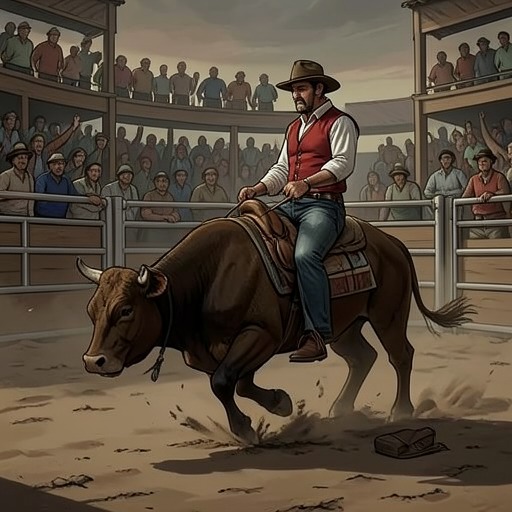
Mike has never seen a cockfight before and promises himself that he will never see another. The spectators’ admiration, rather than reassuring him, sharpens his response. He understands the praise as the same language of toughness he has heard across Texas, Oklahoma, Arizona, and Mexico: a word attached to contests in which one creature dominates another. His attention moves from the individual fight to the pattern of violence it represents, including the rodeo arenas in which he has spent his career.
The victory therefore produces a reversal beyond the ring. To the crowd, Macho has displayed the bravery worthy of his name. To Mike, the repeated praise exposes the ugliness hidden inside the ideal. He thinks about whether the desire to prove courage is driven by fear of being a coward, and whether domination and killing serve as attempts to confront death. He considers the possibility that people direct their rage at one another and at animals because they cannot retaliate against death itself. These reflections connect the match to the grief he has carried since Laurie died, when he recognizes that he could have wanted to kill in anger.
Mike’s response does not amount to a clean renunciation of the life he criticizes. He has given the first half of his life to arenas and admits that he would willingly give the last half as well. The scene leaves that contradiction intact: he recoils from the cruelty of the cockfight, yet still imagines breaking wild horses to earn enough money to leave. Macho’s Cockfight thus changes the meaning of macho for Mike without resolving his dependence on the world it names. The bird’s victory satisfies the crowd’s expectation; the same spectacle makes Mike see the distance between courage and cruelty, and how readily the two are made to look alike.