Macho·machismo
Cry MachoMacho/machismo names a shifting ideal of strength in Cry Macho, moving from the rooster Rafo rescues to the public identity Mike Milo has built in rodeo arenas. The word first joins toughness to care: Rafo nurses a vulnerable animal and celebrates its recovery. Later, Mike hears the same praise amid a cockfight and recognizes the cruelty that can hide inside the heroism he has pursued. When Rafo privately applies the word to Mike, it also becomes an expression of unexpected admiration. Its meanings do not settle into a simple rejection of strength; instead, the novel tests what strength serves, and what violence it excuses.
A name earned through care
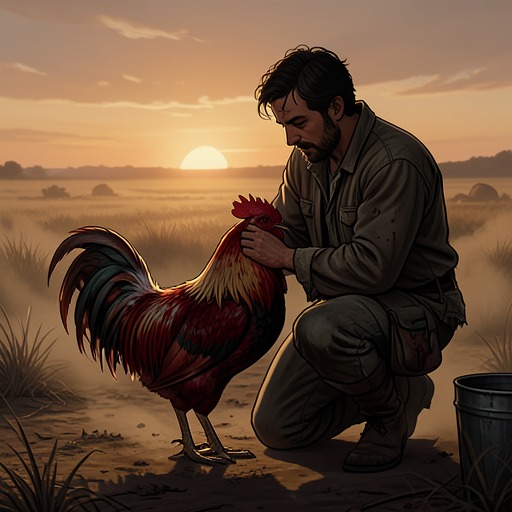
Rafo objects when Mike treats Macho as an ordinary chicken that cannot travel loose in a truck. For Rafo, the rooster’s name is inseparable from a history Mike does not initially know. When Rafo found the bird, it was frightened, injured, and unable to fight. He lifted it, looked after it, and urged it to stand and fight. After the rooster eventually defeated a larger black bird, Rafo named him Macho. Strength, in this account, is not simply a possession or a natural condition: it follows weakness, attention, and a struggle to recover.
Rafo’s insistence is also an act of protection. He refuses to treat the rooster as disposable cargo or put him in a dirty coop, and promises that the bird will not get loose. His attachment gives the name an intimacy that the word’s public associations do not carry by themselves. Macho means strong and champion-like to Rafo, but it also identifies a particular creature whose vulnerability he remembers and whose welfare he takes responsibility for. The care behind the name complicates the violence that later makes the rooster famous.
The arena’s public ideal
The novel sets this personal history against Mike’s established rodeo identity. Before his Ride-Out on Tabasco, the announcer presents him as a champion, listing three National Finals victories, the Dallas Buckle for bareback riding, and nine Cattlemen Trophies. The crowd applauds as Mike mounts the bronc. In his thoughts, the ride is at once familiar and newly dangerous: each time brings fear and exhilaration, the risk of a broken neck, and the wish to remain still on a violently moving animal. The arena turns that private fear into a public test of nerve.
Afterward, Mike performs a signature flourish for the spectators. He throws his white hat high, races Tabasco to where it falls, catches it, and waves it harder, while his arm no longer aches. The crowd answers with repeated cheers of his name, and bottles fly onto the field. The episode shows how the arena makes strength legible: risk, control, and an impressive gesture are converted into applause. Machismo here is not just physical ability; it is a performance recognized by an audience. Yet the ride’s fear remains inside the spectacle, beneath the champion’s composed display.
The cockfight and Mike’s recognition
At the cockfight, that celebratory meaning changes. Macho survives a brutal contest with a black rooster, and the onlookers praise Rafo’s bird as brave and macho. Mike, watching his first cockfight, hears the acclaim alongside the death of the other animal and comes to loathe the word. The contradiction is immediate: the quality being celebrated as valor is inseparable from a contest in which one animal is killed. What sounds like admiration to the spectators becomes, for Mike, a name that can make cruelty appear noble.
Mike connects the cockfight to the arenas he knows. Across rodeo, bullfighting, and fighting between men, he sees a recurring ideal of victory through domination: one body must overpower another, and the spectacle rewards the victor. He asks himself whether he rode to become a hero or to prove, especially to himself, that he was not a coward. His question shifts attention from the public image of courage to its possible source in fear. The arena may offer a way to face danger, but it can also turn the wish to master death into violence directed at other people and animals.
The reflection reaches beyond the contest. Mike considers whether cruelty produces loneliness, rather than merely arising from it, and recalls that after his daughter Laurie died he had wanted to retaliate against life. He wonders whether the impulse behind heroic defiance is really a wish to confront death—and whether that wish becomes destructive when rage is aimed at living creatures instead. The novel presents this as Mike’s troubled speculation, not as a settled explanation of every act of courage. Its force comes from his recognition that the language of the hero can conceal both grief and a fear of being exposed as cowardly.
Admiration, contradiction, and the word’s limits
After the fight, Mike hears Porfirio call the surviving white rooster brave and understands that the praise concerns the living bird. He reflects that the dead are denied the name macho: guilt and forgetfulness erase the possibility that they, too, were once considered strong. The word therefore depends on more than an act of courage. It also depends on who remains to receive recognition, and on how spectators remember a contest once its cost has become inconvenient to acknowledge.
Rafo’s later, private use of the word for Mike offers a different kind of recognition. Watching Mike ride a horse with apparent assurance, Rafo feels pride and finds himself thinking of the man as macho. He is surprised by his own response and repeats the word quietly, aware that Mike may not like him and that their paths will part. The compliment is not a public verdict or proof of reconciliation; Rafo intends Mike not to hear it. In this moment, the word expresses esteem born from observation, rather than applause demanded by performance.
The novel leaves these meanings in tension. Rafo’s rooster embodies strength made possible by care, while the fight reveals the violence that can be praised as valor. Mike’s career gives him the acclaim of the arena, but his reflections unsettle the idea that domination proves courage. His response does not amount to a simple renunciation: still grieving that he is no longer wanted, he thinks he may break wild horses to earn enough money to leave. Machismo remains both an ideal he recognizes as cruel and a role he is not ready to relinquish. The word’s changing force lies in that unresolved conflict between toughness, vulnerability, care, and the desire to stand against death.