Macho’s Cockfight Victory
Cry MachoMacho’s Cockfight Victory is a turning point in which Rafo’s rooster wins a brutal contest, but the victory quickly acquires a human cost. The fight tests Rafo’s resolve and Mike’s ability to protect him without taking every decision out of his hands; afterward, the winnings bring into view the livelihood behind the spectacle and complicate any simple celebration of triumph.
The Ruined Arcade and the Challenge
Mike and Rafo enter a dark arcade without initially noticing it. Macho, who is ahead of them, behaves in an unfamiliar, agitated way, responding to a crowing sound that the two humans soon hear as well. He moves toward it, and the passage draws the travelers into a ruined corridor of old stone columns and fallen rubble. What first seems a dead end proves to be a false one: beyond a turn, candles reveal a cockfight that has already ended. A large gray rooster lies dead, while the victorious black gamecock struts nearby.
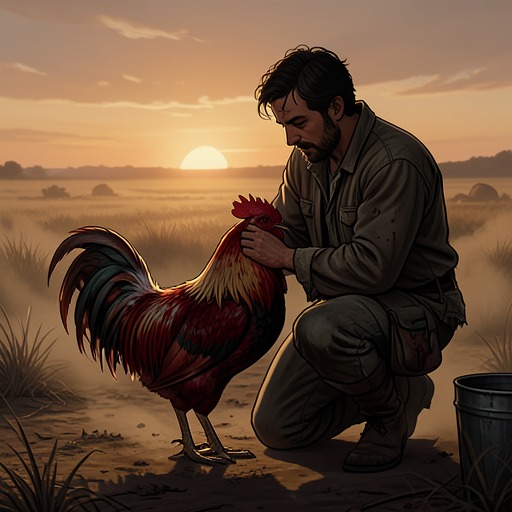
The spectators, roughly ten or twelve men, are occupied with dividing the betting proceeds and do not immediately notice the newcomers. When they do, Porfirio recognizes Mike and Rafo; he is the elderly man who had previously tried to sell them a mustang. Macho begins moving toward the black gamecock, and Rafo quickly scoops him up. Porfirio asks whether the white rooster is to fight. A woman with the defeated bird studies Macho, Rafo, and Mike before accepting the challenge. Her consideration makes the encounter more than an incidental test of the rooster: Rafo and Macho are about to enter a contest arranged by people who know its risks and its customs.
Choosing the Terms
The men place wagers with Porfirio, who serves as referee. The stakes are modest, consisting of pesos and centavos, but the spectators press to take part. Before the fight, each rooster is prepared separately, with its feathers smoothed and the bird kept from seeing its opponent so that its aggression is not spent prematurely. The preparation is communal and deliberate, contrasting with the sudden violence of the match itself.
The contest becomes uncertain when the other side’s rooster is found to have long spurs. Porfirio presents Rafo with a choice between long and short. Mike turns to the boy, learns that Macho has never fought with spurs, and tries to prevent the dangerous option by saying that Macho should fight without them. The black gamecock’s handlers will not agree to a fight without spurs. Rafo then chooses the long ones himself, speaking in Spanish as he makes the decision. Mike objects that this could get Macho killed, but Rafo’s choice stands. The moment marks a change in their roles: Mike can warn him, but he cannot make the decision in his place.
The Fight and Its Reversal
At Porfirio’s signal, Marta and Rafo bring the roosters close together before releasing them. The birds, previously handled and kept apart, become aggressive as soon as the fight begins. Their first attacks do not settle the contest. The black rooster gains an advantage, and Macho repeatedly turns away rather than meeting the attack. He begins to limp, and the spectators notice his retreat. Mike watches Rafo, wondering whether the boy will concede, but Rafo looks back toward the ring even as he struggles to keep watching.
The contest turns when one of Macho’s spurs comes loose. With only one remaining, he re-enters the fight, and the balance shifts. He begins using the spur effectively, and the two birds continue until the black gamecock is killed. Macho survives and wins, though he is limping and bloodied. Even after the contest ends, he tries to reach the defeated bird; when he is kept away, he crows again, driven by anger as well as victory. The change from apparent defeat to a win depends not on an easy advantage but on the sudden alteration in the fight’s terms and Macho’s renewed attack.
Winnings and the Cost of Victory
Mike has never seen a cockfight before and promises himself he will not see another. The spectators, by contrast, are familiar with the contest and congratulate Rafo on Macho’s courage and fighting ability. Their praise gives the rooster’s name an added resonance: the qualities they celebrate connect Macho with the ideal of toughness and aggression, even as Mike has just witnessed the suffering that such a display entails.
Porfirio gives Mike the betting proceeds. Mike takes only the hundred pesos he put into the pool and directs the rest to Rafo. Porfirio counts the coins down to the last centavo, establishing that he is handing over the full winnings. The amount is more than four hundred pesos, a meaningful sum to Rafo. Porfirio nevertheless refuses to take any of it for himself, calling it blood money. When Mike dismisses the objection as a matter of chicken blood, Porfirio explains that the dead rooster belonged to Marta, a widow with four children who come to depend on that animal. He says that she comes to the cockfight every Saturday night and that her family lives from the bird.
This revelation recasts the money Rafo has won. The contest has been a source of excitement and recognition for the boy, but its proceeds came at the expense of a family’s means of support. Marta leaves quickly with her dead rooster, while Rafo is left holding the winnings. The event thus ends with a tension that the victory itself cannot resolve: Macho has prevailed, Rafo has gained the money, and the loss is not merely that of the defeated fighter but of the household that depended on it.
Narrative Significance
The scene makes Rafo’s agency visible through a specific, consequential choice. He accepts the long spurs after Mike advises against them, remains present when Macho appears to be losing, and receives the proceeds in his own right. Mike’s warning and subsequent restraint show a developing boundary in their relationship: care does not mean that he can decide every risk for Rafo. At the same time, the scene does not present the boy’s choice as an uncomplicated triumph, since the outcome exposes what the wager means to Marta and her children.
The victory also brings together two different ways of reading the fight. The spectators see valor in Macho’s performance and celebrate the winning rooster; Mike sees a spectacle he does not wish to witness again. Porfirio’s refusal of the proceeds introduces a moral account alongside the bettors’ arithmetic. By ending on the disclosure of Marta’s dependence, the episode shifts attention from the winner’s prize to the human consequences concealed within the crowd’s ritual of betting and praise.