Marta
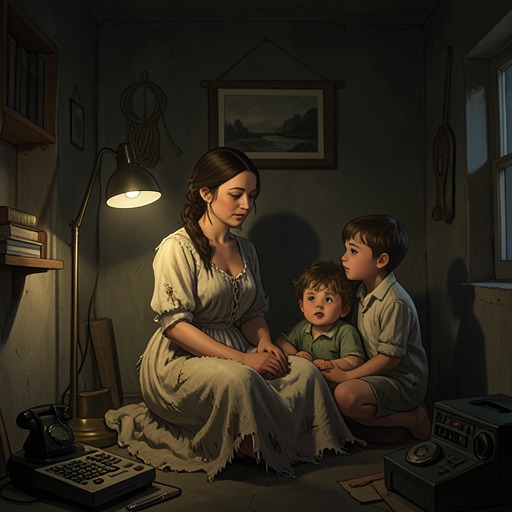
Cry MachoMarta is a widow and mother of four whose family’s livelihood depends on its animals. First seen as the owner of a black gamecock, she enters the story through a contest that links her precarious household to Mike and Rafo. Her later connection with Mike develops less through shared language than through gestures, patience, and practical acts of care; when illness and fire disrupt her home, that fragile closeness is tested by grief, danger, and her need to retain control over her own space.
Identity and First Appearance
Marta is introduced at a clandestine cockfight, where Porfirio identifies her as a widow and the owner of the black rooster. She wears black, but the narrator’s description complicates any simple image of mourning: her face seems both strong and vulnerable, and her eyes appear strikingly young. The impression suggests a woman who can protect herself, without making her self-sufficiency a denial of the hardships surrounding her.
When Porfirio explains the proposed match, Marta studies the white rooster, Rafo, and Mike before accepting the challenge with a nod. Her decision makes her an active participant rather than a spectator in the contest. During preparations, she holds the black rooster opposite Rafo, keeping the birds from seeing each other while their handlers rouse them. The scene places her within the local economy of the fight, where even small wagers draw the men into the event and the animals’ owners prepare their birds with care.
After the black rooster dies, Marta quickly gathers it and leaves. Her hurried departure appears almost guilty to Mike, who is left wondering what she will do with the animal. That brief, unsettled impression is later given a material context: Porfirio explains that Marta has four children and that the family lives from the animal. The rooster is therefore not simply a contestant or a source of gambling money; it belongs to the means by which the household gets by.
The Cockfight and Its Aftermath
The fight’s proceeds sharpen the difference between Mike’s view of the contest and its consequences for Marta’s family. Mike takes back only the hundred pesos he contributed and directs the remaining money to Rafo. Porfirio counts out the winnings down to the last centavo, presenting the payment as an honest accounting. Rafo, however, pauses while putting the coins into his pockets when Porfirio tells him about Marta and her children.
Mike reacts with suspicion and anger, fearing that he has been manipulated. He starts to leave, but Rafo does not immediately follow. The contrast matters for Marta’s place in the episode: she does not make a speech or directly ask Mike for help, yet her family’s dependence on the animals changes what the winnings mean to the boy. The money first appears as the reward for Rafo’s victory; through Porfirio’s explanation, it becomes an opportunity to respond to another household’s need.
Rafo later approaches Marta’s door with the pesos. He hesitates, struggles to explain himself, and finally extends the money without managing more than a few words. Marta thanks him but refuses the gift, and she closes the door. Her refusal preserves her agency in a situation where the boy’s generosity might otherwise reduce her to an object of pity. It also leaves the encounter unresolved: Rafo has tried to help, but neither his intention nor the money can by itself settle what the family needs.
Connection with Mike
Marta and Mike’s closeness grows through imperfect communication. At her house, Mike initially finds himself speaking English despite being more confident in Spanish; he stops, blushes, and starts again. When words fail, he offers the pesos and stammers out a request for her to accept them. The scene makes the language barrier visible as an embarrassment shared between them, rather than as a simple obstacle that one person can overcome for the other.
Later, a broken lamp gives them a smaller, more playful occasion to understand one another. Marta carefully repeats words for empty, trying to explain why the lamp will not light. When Mike realizes that it has no oil, she is delighted by his understanding and takes him outside to fill it from a five-gallon kerosene can. They leave the lamp burning in daylight and walk away together. The incident makes their rapport concrete: it rests on attention and shared action, not fluency.
Their walk through a broad meadow brings another kind of communication. Mike sees the field’s wild flowers as a spectacle, while he guesses that Marta’s sadness comes from remembering when the land was farmed and productive. She tells him about her late husband through words and gestures, describing his lung illness, his prayerfulness and strength, their fortunes with fields and animals, the children, and her love of purple poppies. She continues speaking even when she knows he may not understand everything. Her openness does not erase the language gap; it shows her willingness to keep reaching across it.
Their connection becomes personal as well as companionable. When Mike hears Marta trying not to cry, he approaches slowly and gives her room to respond. She reaches out, first touching him tentatively, and then comes closer; they embrace. The moment is narrated through gradual movement and mutual recognition, not through a declaration or an explanation. It marks a change in their relationship while leaving intact the differences in their circumstances and the limits of what they can say to each other.
Illness, Fire, and Recovery
A later visit to Marta’s home overturns the prospect of an ordinary family meal. Nita rushes from the animal shelter into the house and then throws a pail of milk onto the ground before beginning to tremble. Mike finds Marta beside a gravely ill cow. Recognizing the danger of anthrax, he urges her to take the risk to her children seriously. Marta initially shakes her head, and Rafo, who has been on her side, comes to share Mike’s insistence that she act. Her eventual response is communicated to Mike by Rafo, underscoring how much he depends on the boy to interpret a decision made in a language he cannot follow.
In the ensuing confusion, Marta breaks away and runs toward the shelter. An ember catches her kerosene-wet rebozo, and she runs toward the poppy field before falling and getting up again. Mike follows and calls for her to stop. The episode turns the field associated with her memories and attachment to purple poppies into the setting for immediate danger. Marta survives: on a later visit, she is already out of bed and feeding her children.
Recovery does not make her comfortable with being seen. The fire has left her hair uneven and changed in color, and she wears a borrowed, damaged rebozo with a dressing on her shoulder. When Mike arrives with food, Marta is mortified and tells him not to come in. Mike initially treats her embarrassment affectionately and starts toward her, but her distress sharpens into an emphatic refusal. The exchange reveals a limit in his care: affection does not entitle him to decide that her boundary is unimportant. Marta’s insistence restores her control over the encounter at a moment when her altered appearance has made her feel exposed.
Narrative Significance
Marta’s story connects several forms of dependence without reducing them to one another. The dead rooster and the sick cow are animals, but they are also tied to how her family survives. The money from the cockfight can be offered as help, yet she refuses it; Mike and Rafo’s concern cannot simply substitute for her judgment. Her household’s hardships become especially legible through concrete details—the milk thrown away, the children she feeds, and the unproductive field she remembers—rather than through an abstract account of poverty.
Her relationship with Mike is likewise defined by both contact and limits. Gestures, shared tasks, and an embrace create a real closeness across their linguistic difference, while the later refusal at her doorway shows that intimacy does not dissolve her autonomy. The return from danger to the work of feeding her children gives her recovery a practical measure: she is again caring for her family, even as the fire’s effects remain visible and her welcome to Mike cannot be assumed.