Mike Milo and Howard Polk’s employment and antagonism
Cry MachoMike Milo and Howard Polk’s employment and antagonism form a relationship in which neither man fully yields authority to the other. Howard controls the rodeo company and Mike’s livelihood, but Mike’s talent helps make Howard’s business succeed; their wary dependence survives open resistance, dismissal, and a later offer of work that is as morally compromised as it is generous.
The New Owner and the Salaried Rider
Eighteen months after Mike Milo became a salaried rider in the resident rodeo, the company collapsed and its stadium fell to the mortgage holder, Howard Polk. Howard was an unlikely figure to take charge of a Texas rodeo: New York-tailored and Ivy-educated, he initially lacked even its vocabulary, calling broncs broncos, riggin’ rigging, and cattle pens paddocks. Yet within two years he had turned the resident company into a nightly show, with performances every evening except Monday. His success did not win the men’s affection. Howard stripped away their preferred image of themselves as cowboy heroes, insisting that salaried performers who stayed at the stadium rather than enter the competitive circuit were actors. His language made the rodeo’s transformation into something like a Broadway production feel, to the cowboys, like an assault on their identity.
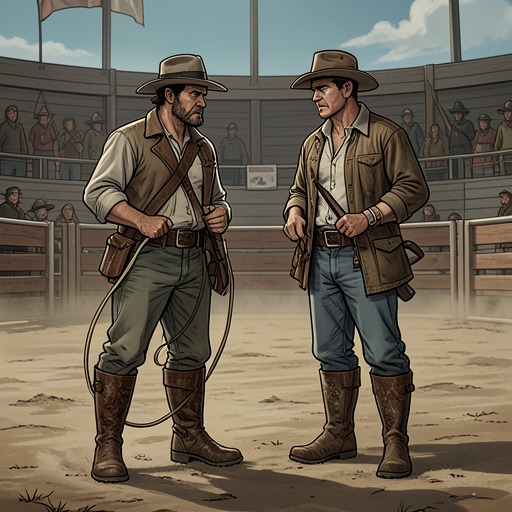
Mike and Howard’s conflict took shape inside that larger struggle over who controlled the company and what its performers were worth. Howard required the cowboys to sign an attendance ledger every half hour, ending their habit of lateness. Mike alone among the men did not object openly: he simply never signed. He expected Howard to retaliate sooner or later, and understood the silence between them not as permission but as a delay in the contest. When Howard imposed a twenty-five-percent salary cut on everyone, Mike stayed. Going back to competition worried him more than the cut, while Howard seemed to regard him as a wayward horse, unevenly broken. Neither fired the first decisive shot: Howard kept Mike on, and Mike accepted less pay. Each interpreted the other’s restraint as weakness.
Talent, Dependence, and Distrust
Their professional connection was not reducible to defiance. When the rodeo needed a more arresting attraction, Mike proposed a new event: instead of riding a bucking horse for the established eight-second bareback or ten-second saddle-bronc limit, a cowboy would stay on until he was thrown or the horse quieted. Howard heard the idea, and the Ride-Out became an immediate success. It drew newspaper coverage and crowds, and audiences left the show shouting. Mike, in turn, became a star again. The event bound his value to Howard’s enterprise: Mike supplied the distinctive spectacle, while Howard placed it in the program and profited from its appeal.
That reliance also gave the relationship a sharp edge. Howard later added a second Ride-Out near the beginning of the program and began supplying Mike with fresh bucking stock. The new horses were not the relatively mild animals Mike had first proposed. The show’s demand for greater excitement thus exposed Mike to increased danger, even as the Ride-Out kept him professionally valuable. Howard’s business success and Mike’s continued place in it were linked, but not on equal terms: Howard set the conditions, while Mike bore the physical risk.
Mike could not settle on a single judgment of his employer. At times Howard seemed to him a dilettante treating the rodeo as a parlor game; at others, a driven and dangerous man determined to succeed against the odds. Mike could recognize Howard’s imagination and competence and then feel repelled by him. He also distrusted Howard’s use of frankness, which could become a means of cutting people down. The tension was not simply between a good worker and a bad boss: Mike saw ability in Howard while doubting the character behind it, and Howard’s management depended on a performer he did not wholly control.
Dismissal and the End of the Rodeo Contract
After Mike was injured and spent weeks in a cast, he told Howard he expected to return the next day. Howard let the statement pass and replied, “You’re through, Michael.” Mike initially treated the announcement as though it might be a joke, pointing out that he had ridden in plaster before and had won the Dallas Buckle that way. Howard answered that Mike had been ten years younger then. The exchange reduces their long employment to a question of future usefulness: Howard regards Mike’s age and injury as evidence of decline, while Mike argues from his history of riding through pain.
Mike tried to negotiate rather than leave immediately, offering to work a whole month without salary. Howard rejected the bargain and made clear that he did not regret firing him and did not want him hanging around. He explained that he had kept Mike because of the Ride-Out; while Mike was away, Frank Sherett had performed it twice. Howard conceded that Sherett had not done it well, but judged that he could improve, whereas Mike could only get worse. The explanation makes the event that restored Mike’s stardom the same thing that defined the limit of his employment. Howard’s decision was not a denial that Mike had mattered; it was a calculation that the attraction could outlast the rider who created it.
A New Offer Built on Old Antagonism
The relationship resumed in a different form when Howard proposed sending Mike to Mexico to bring back Howard’s son. Mike understood that the request was not an ordinary assignment. Howard stated the objective plainly: “I want you to kidnap him.” Mike challenged the contradiction between the job and their history, pointing out that Howard hated him. Howard answered that their past work together mattered, then argued that Mike’s frank dislike made him more trustworthy than someone who claimed to be fond of him. The choice depends on a difficult kind of confidence: Howard does not ask Mike to be loyal or affectionate; he treats Mike’s honesty, even when directed against him, as useful.
Howard also presented the job as more than payment for a dangerous errand. He had bought a panel truck for Mike to drive south, describing the trip as a vacation, and offered fifty thousand dollars as a stake. When Mike threatened him, Howard warned that without money or a direction forward he could return to the downward course he had experienced before. He framed the sum as a chance for Mike to get through a hard period, enter a business of his own, and find a new place for himself. Mike’s face did not move as Howard spoke; after Howard went downstairs, Mike remained still and shut the door. The scene supplies no simple reconciliation. Howard again uses money and employment to exert leverage, but his offer also recognizes Mike’s precarious position and proposes a future beyond the rodeo.
The Shape of Their Bond
Across these episodes, Howard and Mike repeatedly turn antagonism into a working arrangement without resolving its underlying distrust. Mike refuses the attendance rule yet stays after the salary cut; Howard dismisses him once he believes the Ride-Out can continue without him; later, Howard returns with a job that requires Mike precisely because he is neither a friend nor a compliant subordinate. Their connection moves from employer and star performer to former employer and dismissed rider, then to recruiter and reluctant agent. At each stage, professional usefulness opens the door to cooperation, while unequal power and personal resentment keep that cooperation uneasy.