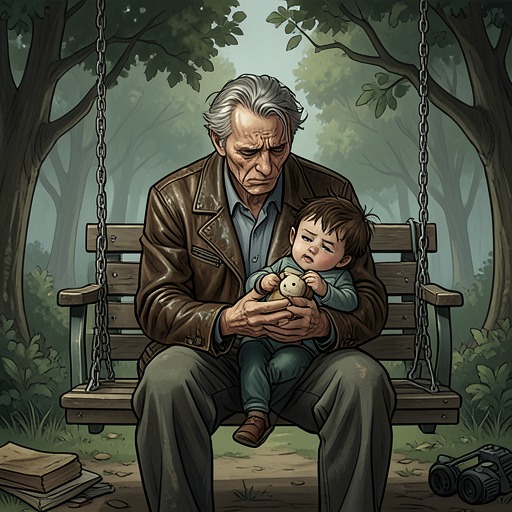
Mike Milo and Laurie’s father-daughter bond
Cry MachoMike Milo and Laurie’s father-daughter bond changes Mike’s understanding of love: for the first time, he gives without treating affection as a bargain, and Laurie begins to return that care. Her sudden death ends their relationship while leaving its meaning unresolved in him; at her funeral, his grief is present but cannot find expression in tears.
The First Unbargained Love
Before Laurie’s birth, Mike was uncertain that he had ever loved anyone. He understood his relationships as exchanges: even with his grandparents, he remembered himself as the one who received while they gave. His affairs with women had felt like contests, and his marriage to Donna involved continual negotiation, sometimes gentle and affectionate but still shaped by bargaining. The arrival of Laurie changed the terms. Mike recognized in his feeling for her a goodness he had not previously known how to trust in himself.
He made giving to Laurie a deliberate, celebratory practice. The care was not a means of securing something in return; the act of giving itself became central to his happiness. Fatherhood, as Mike first understood it, was a one-way gift, and he was content to be the giver. That arrangement did not make the bond one-sided in the long run. As Laurie approached six, she began to love him back, making the relationship reciprocal without turning it into the negotiation he had known elsewhere.
A Child Attuned to Her Father
Laurie is described as gallant, grave, and decent, qualities associated with both parents. Her manner is also distinctive: she seems to express herself incompletely, as if she were touching on something she might return to later. The narration presents this quality alongside her unusually precise understanding of Mike. She can find her way through his changing moods and, when he is troubled, goes directly to the place where he needs comfort.
This attentiveness reverses the expected direction of care without erasing the father’s role. Mike had been glad to give without expecting repayment; what surprises and moves him is Laurie’s desire to offer him the same kind of generosity. Her perception makes love between them an active exchange of attention, though not a bargain. She knows how to comfort him, while he understands himself as the adult who has made giving the defining ritual of their life together. The bond’s tenderness lies in that combination: his devotion and her growing ability to answer it.
Laurie’s Illness and Death
In early May of Laurie’s seventh year, Mike came home on a spring night to find her feverish and speaking of unusual sensations involving her eyes and head. The doctor considered it likely to be a childhood illness that might be identified by morning. Until then, the instructions were to keep Laurie in bed and give her aspirin at four-hour intervals. Mike stayed awake beside her. He gave her one dose; when he tried to give her the next, she had died.
The death makes the ordinary acts of fatherly care painfully final. Mike had remained with Laurie through the night, following the doctor’s instructions, but vigilance could not preserve the future he had expected. The account gives no gradual farewell or extended exchange between father and daughter: the turn comes at the second attempt to give her medicine. That abruptness contrasts with the accumulated tenderness of their life together and leaves Mike with no chance to make the relationship’s last moment another act of reciprocal comfort.
Grief Without Tears
At Laurie’s funeral, people cried, including Donna; Mike did not. He also did not weep when he turned the key and locked Laurie’s room. His grief is not represented as an absence of feeling. Instead, it remains held inside him, vividly present but unable to emerge as tears. The contrast between the outward stillness and the force of what remains unexpressed makes his silence part of the relationship’s aftermath.
Laurie’s death also alters the marriage around her. Rather than bringing Mike and Donna closer, the loss draws Donna further away from him. The novel thus distinguishes their responses: Donna’s sorrow is visible at the funeral, while Mike’s is contained. This difference does not diminish the depth of his attachment; it shows that the love which had taught him to give so freely has left him unable to display grief in the expected way. Laurie’s room, locked by her father, becomes a concrete boundary between their shared life and its irreversible end.
The Bond’s Place in Mike’s Later Life
Later scenes show Mike attending to other people’s vulnerability, but the narrative does not state that these acts are caused by Laurie’s death or present them as a replacement for her. When he is concerned that Cissy may not understand how often she needs to wash, he speaks gently and considers whether she can manage on her own or whether he should contact the Welfare Department. In another encounter, he comes to see whether Rafo is safe and tries to tell Marta that he was wrong and is sorry. His concern is sometimes difficult to communicate, but it takes the form of attention to another person’s immediate need.
The same distinction between care and control appears in the crisis involving Marta and the sick animal. Mike initially tells Rafo to go away, but Rafo explains that Marta needs to know what to do. When she decides the animal must be killed but does not want it burned, Mike answers her question about whether he has a gun; he has none. Later, when Marta catches fire, Mike runs after her, extinguishes the flames by rolling her on the ground, and carries her back to the house. These episodes do not recreate the father-daughter bond, and the text does not equate the people involved. They do, however, place Mike’s practical attention to others alongside the earlier account of Laurie, whose love first revealed to him how much giving could mean. Her importance remains decisive not because later relationships duplicate theirs, but because the novel has established her as the person through whom Mike first recognized his capacity for unselfish love.