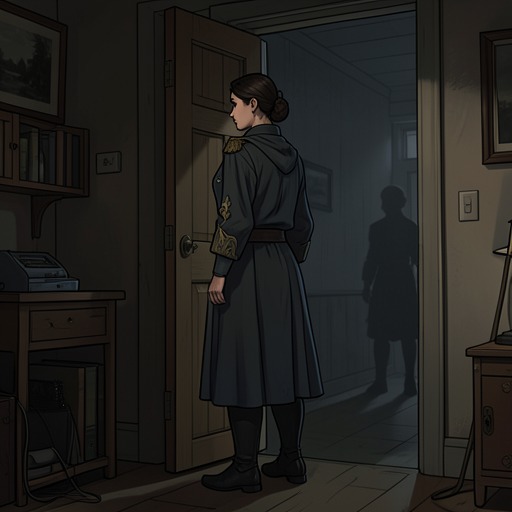
Mike Milo and Lexa Polk’s attraction and conflict
Cry MachoMike Milo and Lexa Polk’s attraction and conflict begin under conditions that make intimacy difficult to separate from danger. He is disoriented when he recognizes her, and she permits him to stay and talk even as she tests his purpose. Their exchange over Rafo briefly turns Mike’s attempted collection into an authorized one, but Lexa’s later violence makes the limits of that permission unmistakable: she will not accept another person taking her son, even though she describes him with furious contempt.
Recognition and Mutual Scrutiny
Mike’s first perception of Lexa comes through confusion. He hears a woman’s voice but cannot tell whether she is speaking to him or humming; faces emerge indistinctly, and his effort to focus on one woman shifts between incompatible impressions of her age and beauty. Only then does he recognize Lexa. The scene establishes an encounter in which his perception is impaired, while the woman he is trying to understand remains difficult to read.
Lexa speaks Spanish to two other people, and Mike cannot understand her words. He infers that she is telling them she can handle him and that they can leave; they appear to resist leaving her alone with someone they regard as a criminal. Lexa’s irritation rises until she drives them away with a startling exclamation. Mike notices not only that she has taken charge of the situation, but that even a small sound can carry menace. The exchange gives her immediate control over who remains present, while leaving Mike dependent on gestures and inference.
That imbalance continues when Lexa lays out the contents of Mike’s pockets. His tools, money, identification, and the photograph of Rafo become an exhibit that exposes both his intended purpose and his carelessness. Mike reads the display as a humiliating inventory of an amateur’s mistakes: he has carried the evidence that links him to the job. Lexa turns that practical oversight into an interrogation, asking why a man who works for her ex-husband has a photograph of her son. Each object that might have helped Mike act instead gives Lexa grounds to question him.
Permission to Collect Rafo
Lexa asks what use Rafo would be to her ex-husband if Mike kidnapped him. Mike refuses to explain the larger arrangement, saying only that it is between her and her former husband. She narrows the question to Mike’s role: he has been hired to collect the boy and will be paid when he delivers him. Once Mike confirms this, Lexa tells him to collect Rafo and makes clear that he need not sneak in through the back door.
Her authorization is blunt, not reassuring. The exchange changes Mike’s position from an intruder acting without the mother’s knowledge to a man who has been explicitly told he may take the boy. But Lexa’s words do not resolve the moral or emotional tension around the task. Her question about what her ex-husband wants with Rafo remains unanswered, and Mike keeps that purpose at a distance. Permission settles the immediate question of access without creating trust between them.
Lexa’s account of Rafo further unsettles the apparent simplicity of her consent. Pointing to the photograph of the well-dressed eleven-year-old, she rejects the image of a polite, protected child from a respectable family and calls her son a monster. The narration reads the intensity of her rage as containing heartbreak, but notes that she reveals no corresponding vulnerability. Her contempt and her decision to let Mike collect Rafo coexist; neither cancels the other. The scene makes her permission look less like maternal indifference than a choice made amid feelings she will not openly disclose.
Attraction Under Pressure
Mike’s return to Lexa’s house keeps the practical mission in view: he asks where he should look next for Rafo. Lexa reacts as though this is the sole reason he has come back. Mike answers that it is not the only reason, bringing their personal tension into the conversation without explaining it away. Their exchanges repeatedly put an explicit task beside an unspoken possibility, but the text does not turn that possibility into a settled romance.
Lexa’s physical composure falters while her voice remains controlled. Her hand trembles; she drinks, pours another drink, and turns away from Mike before facing him again with an expression the narration likens to a mask. Mike registers the contradiction between her visible agitation and her steady speech. He knows she may be dangerous and feels repelled by her, yet he is also fascinated and wants to touch her. He asks to finish his drink rather than leave. Lexa says that she wants him to stay for it and watches him closely. The moment permits proximity, but its watchfulness and strain prevent it from reading as uncomplicated welcome.
Possession, Violence, and the Boundary of Trust
The fragile possibility of closeness ends in a direct assertion of control. After Lexa shouts at Mike, Pacas hits him; Mike strikes back, and Alma attacks him from behind. Pacas and Alma overpower him with coordinated blows, leaving him bleeding on the floor while Lexa stands over him. The violence converts the earlier interrogation of Mike’s intentions into physical enforcement: his presence near Rafo is now treated as a threat that Lexa’s household will answer collectively.
Lexa says she hates both Mike and her son, but insists that Rafo is hers and that nobody takes what belongs to her. The contradiction is central to their relationship. Her hostility toward Rafo does not loosen her claim over him; instead, she presents possession as the limit that Mike must not cross. She orders Mike to get up, then warns that he will be watched wherever he goes and demands that he acknowledge the warning. Her earlier permission to collect Rafo therefore proves conditional and unstable. Attraction has brought Mike to remain in her company, but it has not displaced Lexa’s suspicion or softened her determination to control what happens to her son.