Mike Milo’s leg injury and recovery
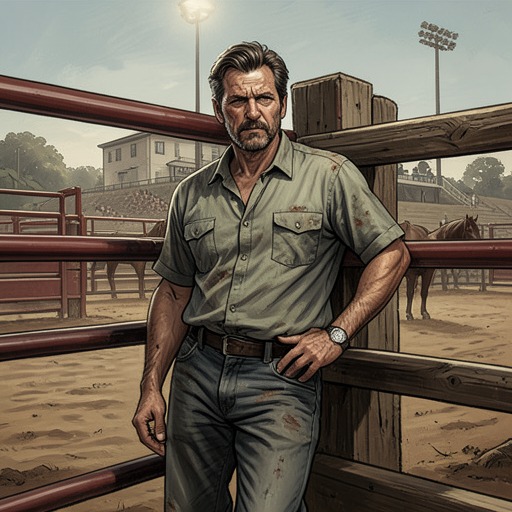
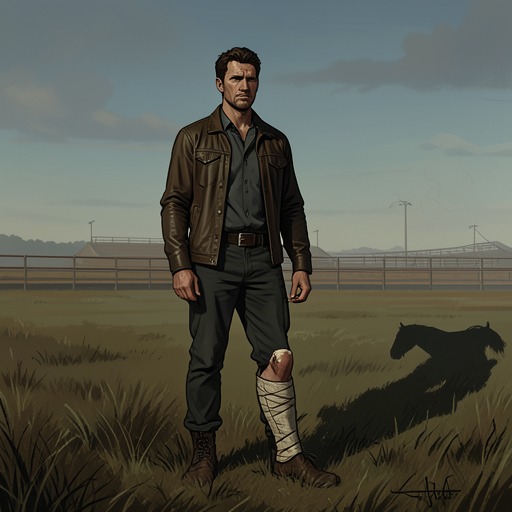
Cry MachoMike Milo’s leg injury and recovery turn a rodeo champion’s practiced display of toughness into a test of what his body can actually endure. After Tabasco throws and tramples him during the Ride-Out, Mike Milo lies in the hospital with a cast on his leg and pain through his body. Weeks later he is walking again, but still limping; his return to Polk’s Cow Stadium ends in dismissal rather than a return to competition. The injury is both a physical setback and a reversal of the image that has made him valuable: a rider who appears able to rise, wave his hat, and reassure the crowd even when he cannot keep standing.
Injury and Its Precedent
The Ride-Out is presented as a special attraction built around Mike Milo’s established standing in the arena: the announcer introduces a champion with three National Finals victories and a Dallas Buckle, riding Tabasco. At the end of the performance, as Mike Milo turns toward the exit, Tabasco throws him. Mike Milo tries to rise but is unable to do so at first; after managing to stand, he retrieves and waves his hat for the audience. The crowd reads the gesture as proof that he is all right. Then Mike Milo falls again and does not get up. That second fall makes plain what the earlier display of composure had temporarily concealed: will and reputation cannot restore the injured body on demand.
This is not his first serious leg injury. A photograph of Mike Milo on a rearing bronc, displayed above the stadium entrance, was taken during his final year of competition, when he had little success and sustained both a fractured leg and a broken kneecap. Those injuries belonged to a period of mounting exhaustion and fear, when horses seemed increasingly dangerous and travel between rodeo towns became harder. The photograph, with its raised hat and fixed cowboy grin, preserves a heroic image from before his arrival at the stadium; Mike Milo has trained himself not to notice it. The later injury thus repeats an older bodily cost while making the contrast between the celebrated image and the rider’s present condition harder to ignore.
Hospital and the Returning Limp
In the hospital, Mike Milo’s leg is encased in a hard cast, and as the anesthesia wears off he feels pain throughout his body but little sensation in the injured leg. His thoughts turn to the prospect of being treated like a crippled horse, a fear that reveals how readily he understands physical incapacity through the terms of the rodeo world. He also tries to sort the present cast from the several casts he has worn before, including ones on his wrist, arm, and leg. The body’s accumulated injuries complicate any clean division between a single accident and a career built around repeated exposure to danger.
After leaving the hospital, Mike Milo returns to the stadium four weeks after the cast has been removed. The leg has not finished healing: he can walk only with a limp, and he expects that it will take at least another four weeks before he can walk straight. He intends to hide the limp on the way to Howard Polk’s office, even though doing so makes each step hurt. At nineteen, after breaking his leg, he had wanted his limp to be conspicuous, because it could be read as evidence of courage. Now he fears that the same sign will be taken as proof that he is too old to ride. The change is not simply in the leg; it lies in how an injured body is judged at different stages of a working life.
Dismissal and the Cost of Concealment
Mike Milo’s recovery is uneven rather than complete. By the time he reaches Howard Polk’s office, the pain in his elbow has also eased after two injections, though the dizziness remains. These other symptoms make clear that the leg is only one part of a body still negotiating the effects of injury. Mike Milo tells Howard Polk that he expects to return the following day, but Howard Polk tells him he is through. When Mike Milo points out that he has ridden in a cast before and won the Dallas Buckle that way, Howard Polk answers that he was ten years younger. The exchange makes age, not simply the presence of a cast, the decisive measure in his employer’s judgment.
Mike Milo leaves the office without showing a limp. In the parking lot, the ache worsens and he gives up the effort to conceal it, hobbling once there is no longer a workplace audience to persuade. The contrast exposes the labor involved in appearing fit: at the stadium, a straight walk is part of his case for continued employment; outside, the pain dictates his movement. When he gets home, the shock of being fired catches up with him. He briefly understands himself as a man without a future, then rejects that verdict as Howard Polk’s appraisal rather than a final truth about his own prospects. The injury has cost him his place in the rodeo, but he does not yet accept that it has ended every possibility of work.
Physical Risk Beyond the Arena
Later, Mike Milo again acts with his body rather than relying on the image of effortless strength: he jumps onto a white wild horse and holds on as it tries to throw off its burden. The episode does not establish that his injured leg has fully recovered, but it shows that the dismissal has not erased his willingness to take physical risks. That persistence carries an ambiguity. The skill that once made him a celebrated performer remains available, yet the earlier arena injury has demonstrated that courage cannot guarantee safety or employment.
His changing view of arena spectacle sharpens that ambiguity. After seeing a cockfight, Mike Milo connects the praise of a rooster’s courage with the kind of acclaim he once sought in rodeos. He recognizes that the word macho can honor a fighter while also excusing cruelty, and reflects that he gave the first half of his life to arenas and would still gladly give the second half to them. His wish to break wild horses and earn enough money to leave is therefore both a practical response to hardship and evidence of how difficult it is to imagine a life outside the performances that have shaped him. The injury’s significance extends beyond recovery: it interrupts the equation between toughness and worth, while showing how strongly Mike Milo remains bound to the work and arena culture that have already damaged him.