Mike Milo’s unexplained vertigo
Cry MachoMike Milo’s unexplained vertigo is the persistent exception to a recovery he wants to regard as complete. It recurs despite his insistence that he can overcome it, interrupts ordinary decisions, and turns the possibility of falling into a practical and professional concern. Because its cause and outcome remain unresolved in these episodes, the dizziness registers both as a physical condition and as a challenge to Mike’s confidence in his own endurance.
A symptom amid recovery
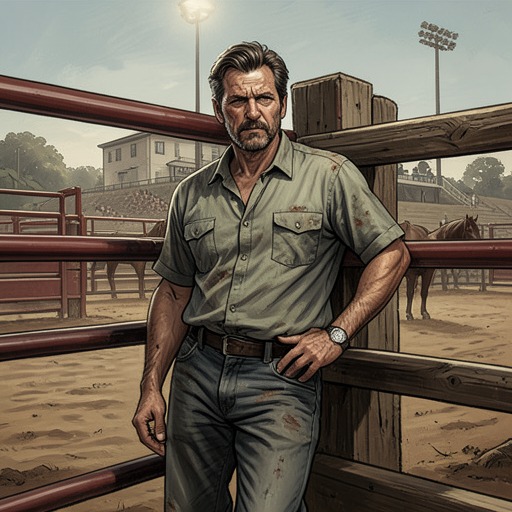
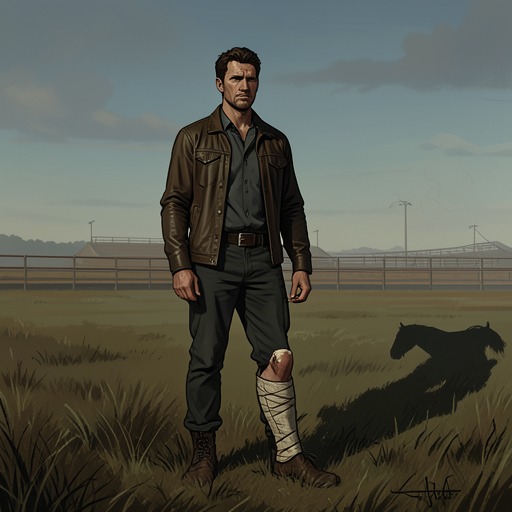
At first, the dizziness appears against the background of improvement. Mike recalls that when he was nineteen and had a broken leg, he made his limp conspicuous so that his boss and the other punchers would see him as courageous for continuing to work. Now he imagines that a limp would be read differently: as evidence that an older man’s body no longer heals as it once did. His determination to defy that judgment accompanies a genuine sense of recovery. His leg is nearly mended, and after two injections the pain in his elbow has almost disappeared; forty-eight hours after the second injection, he can scarcely remember the ache. He feels better than he has in years, except for the dizziness.
That exception matters because it prevents improvement in one part of his body from becoming proof that he is well altogether. Mike can point to the leg and arm as signs that pain and impaired movement may pass, but the vertigo persists outside that reassuring pattern. His comparison with his younger self also gives the symptom an age-conscious pressure: he does not want an involuntary physical limitation to define him as finished. The narrative sets his memory of a deliberately displayed limp beside a present condition he cannot simply perform away.
Recurrence and the effort to control it
The dizziness is not a single passing sensation. When Mike loses his composure, he takes an unsteady step and reaches for his head. Someone notes that he has been experiencing spells. He resents the circulation of a confidential report and interrupts Howard as Howard searches for it, objecting to the disclosure rather than accepting the report as the final word on his condition. Mike insists that he will recover from this as he recovered from his limp. He declares that the dizziness has gone, and his equilibrium does return almost immediately.
That brief restoration does not settle the matter. Later, as evening darkens, Mike pours himself a strong drink but decides not to risk drinking it when the dizziness returns. The moment shows the symptom altering a small, concrete choice: he does not know whether the episode will continue, so he avoids adding a risk. His confidence and caution coexist. He can announce that the spell has passed, yet he also changes his behavior when it comes back.
In another episode, Mike goes outdoors and remains still until the dizziness subsides. He believes movement could make him fall, and the setting changes what falling would mean: in the arena it would constitute failure, while in the street it could bring disaster. The need to wait in place is a sharp contrast with the working identity he values, one associated with riding and enduring physical hardship. Here, persistence does not mean pressing forward; it means recognizing that he must stop until his balance returns.
The fall and its aftermath
After a further challenge, the vertigo returns with greater force. Mike feels himself falling, hears glass crash, and then loses awareness of what follows. The episode marks a change in scale: earlier spells interrupt composure, drinking, or movement, but this one ends in a fall and a gap in his perception. When asked, Mike confirms that he has been dizzy. He is also told that the fall was from seven thousand feet, a detail that gives the incident a stark measure without explaining what caused the vertigo or establishing that it has ended.
The sequence makes the condition difficult to dismiss as a mere inconvenience. Mike’s earlier assertion that he can get over it is followed by a recurrence that exceeds the brief spell he managed to declare finished. At the same time, the evidence does not provide a diagnosis or a lasting resolution. The height associated with the fall clarifies the seriousness of the episode, but it does not identify its medical cause. The uncertainty remains part of the condition’s role in the story.
Limits, denial, and narrative significance
The dizziness also enters Mike’s private reasoning. After an evening with a woman he finds attractive, he wonders why he did not stay with her. He settles on his physical condition as an explanation, telling himself that he was weakened by vertigo and that the problem is temporary. The passage does not confirm that this is the reason for his decision; instead, it shows Mike using the symptom to make an uncomfortable question easier to avoid. His uncertainty about his body becomes entangled with his uncertainty about his own choices.
Across these episodes, the vertigo repeatedly interrupts Mike’s attempt to measure himself by recovery and toughness. The improvement in his arm and leg is real, but it cannot guarantee control over balance; an emphatic claim that a spell has passed cannot prevent its return. The condition therefore works neither as a fully explained illness nor as a simple emblem of age. It is presented through its immediate consequences: an unsteady step, a decision not to drink, a pause outdoors, a serious fall, and a later effort to explain a personal choice. Its unresolved recurrence keeps bodily vulnerability present even when Mike would rather regard it as temporary.