Mike is fired by Howard Polk
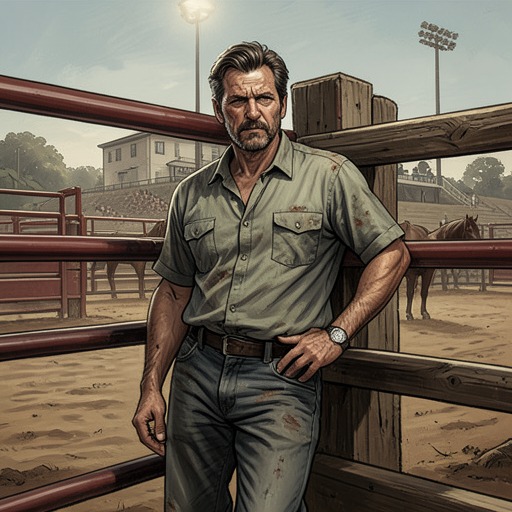
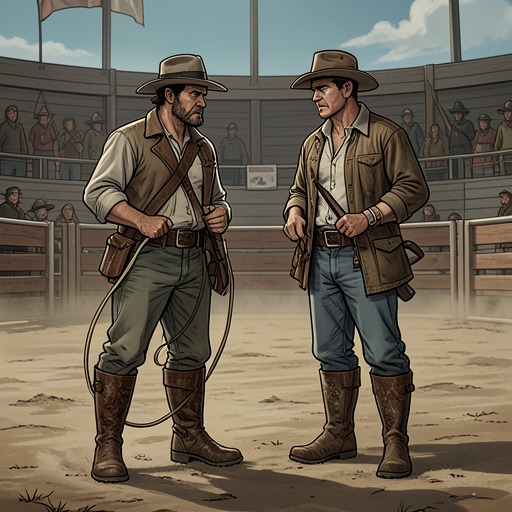
Cry MachoMike is fired by Howard Polk after returning to Polk’s Cow Stadium with his leg still healing. The encounter turns on a sharp contrast between Mike’s effort to conceal his physical limitation and Howard’s unambiguous decision to end their working relationship. Mike leaves the office maintaining the appearance he has chosen, but the dismissal catches up with him outside it, where he no longer has to hide either his limp or his shock.
Return to the stadium
Mike has been discharged from the hospital and his cast has been removed, but he is not yet walking normally. The plaster came off only four weeks earlier, and he expects to need at least another four weeks before he can walk straight. Even so, as he heads toward the stadium and Howard’s office, he plans to hide the limp and keep his stride even. The effort is painful, but he treats concealment as necessary for this meeting.
That decision makes his arrival a performance of recovery. The difference between how he appears and how he is actually walking is already established before he sees Howard: the gait that seems unhalting in the stadium corridor is deliberately maintained, not evidence that his leg has healed. His effort to control what Howard can see cannot, however, control the conversation that follows.
Howard's decision
Howard remains seated behind his desk, a posture consistent with his usual manner, and greets Mike by referring to his apparent recovery. Mike’s concealed limp has succeeded as a visible impression, but Howard quickly makes clear that it has not changed the outcome of the meeting. He tells Mike that he is through. The firing is delivered as a settled decision rather than as the start of a negotiation.
Mike tries to respond, but Howard lets his sentence disappear before answering. The exchange gives little space to Mike’s account of himself: Howard controls both the decision and the conversation’s terms. When Mike objects to the danger involved in the work, Howard describes the distinction he sees between an accident and a rider who takes risks deliberately to excite the crowd. In Howard’s view, that kind of purposeful risk is not something Mike will undertake. His explanation therefore concerns not only Mike’s physical capacity, but also his willingness to perform for the audience in the way Howard expects.
Howard later makes the finality personal. He says that he does not regret firing Mike and that he does not want him hanging around. The dismissal is consequently more than a change in work status: Howard explicitly rejects Mike’s continued presence. The office scene closes off the possibility that Mike might remain near the stadium while waiting for another role or for his recovery to progress.
Leaving the office
Mike leaves without showing a limp. The concealment continues through the office door, as if his appearance can still be kept separate from the decision he has just heard. In the parking lot, however, the ache in his leg worsens, and he gives up the effort to walk normally. He hobbles there because there is no longer a reason to hide the injury from Howard.
The change in his gait marks a small but consequential shift in the scene. In the corridor and office, an even stride is part of Mike’s attempt to present himself as capable; outside, he allows his actual condition to show. This is not a recovery or a victory over the injury. His leg remains painful, and the firing has not been reversed. What changes is only the audience for his performance: once away from Howard, concealment is no longer required.
Consequences and significance
Mike does not fully absorb the news while he is still at the stadium. The shock arrives at home, as he walks up the outdoor stairway to his apartment and recognizes that he has been fired. He understands the loss in unusually absolute terms: for the first time in his life, he feels that he has no future and is washed up. The narration thus distinguishes the formal event, Howard’s decision in the office, from its delayed personal effect, which becomes clear only after Mike has left.
The scene binds physical recovery to professional judgment without treating them as the same thing. Mike’s cast is gone, yet he is still limping; Howard notices only the apparently straight walk and nevertheless ends the employment. Nor does Mike’s effort to conceal his condition earn him another chance. The contrast between his controlled entrance and unguarded hobble outside gives the dismissal a visible aftermath, while his realization at home reveals its deeper consequence: the loss of work becomes, in that moment, a collapse in his sense of what lies ahead.