Mike's grandfather
Cry MachoMike's grandfather is remembered as the forceful, resourceful center of Mike's childhood world: a saddler who knew horses and their equipment intimately, a blunt adviser who helped shape Mike's education, and a man whose affection emerged more readily through teasing and practical counsel than through tenderness. His death in a fire while Mike was away at college gives those memories their lasting ache: the relationship was loving, argumentative, and unfinished.
Identity and Background
Mike's grandfather was a saddler, but his sense of his own trade reached well beyond making saddles. He boasted that he had a hand in anything connected with a horse—bridles, stirrups, bits, hardware, and leather—and could nurse a sick animal back to health if someone called him early enough. In Mike's clearest childhood memories, the old man and horses belonged together. His work joined skilled craft to practical knowledge of animal care, the same world that would later draw Mike toward veterinary study.
That connection also shaped the grandfather's advice. He urged Mike to become a veterinarian, linking the profession to the boy's aptitude for reading and to his circumstances as an orphan. The phrase “orphan boy” had been repeated so long that Mike remembered once thinking it was his name, Michael Orphanboy. The advice therefore carried more than a career suggestion: it placed Mike's vulnerability and abilities within the grandfather's matter-of-fact account of what might be useful to him.
A Rough and Affectionate Household
Mike loved his grandfather and horses, but love did not make their relationship placid. The old man shouted at the boy when he found him on a stallion that was not theirs, warning him to get off before he injured himself. Mike, in turn, once spat licorice in his grandfather's face and on another occasion kicked him in the groin. The grandfather laughed at the attack, answering with vulgar humor rather than punishment. Their bond is conveyed through this combination of danger, provocation, and ease: the boy could defy him, and the old man could turn the defiance into a joke.
The household's apparent hierarchy was not always what it seemed. Mike's grandmother acted frightened by her husband's temper, vulgarity, and booming voice, and presented herself as demure, absentminded, and not entirely responsible. Mike only recognized when he was graduating from high school that this manner had misled him. His grandmother was better educated than her husband and kept up with her reading. She described the difference between them by saying that she scratched thoughts when she put a hand to her head, while he scratched rust. The grandfather's roughness was thus part of a family dynamic whose wit and intelligence were not confined to him.
Education and the Cost of Growing Up
When the question of college brought Mike and his grandmother into disagreement, she warned that a horse would charge into a stone wall if it trusted its rider. Mike answered that he trusted her but would not let her push him into college. His grandfather found a compromise: Mike could study while remaining connected to horses. He dismissed animal husbandry as knowledge a stable could teach, but saw value in the qualification as a credential that could be framed and used to charge more. The advice was practical and irreverent, not a rejection of education itself.
Mike went to an agrarian college a thousand miles away, where he took premedical courses as well as farriery and hippiatry. He returned at Christmas unhappy, lonely, and confused, but by the end of his first year he had earned excellent grades. When he came home that June, he suggested that the saddlery might be too small for its workload and proposed electrifying the forge. He objected to the labor of continually stoking it and argued that the business should modernize. The suggestion turned a practical conversation about equipment into a painful encounter with change: Mike had begun to imagine improvements to the world his grandfather had built.
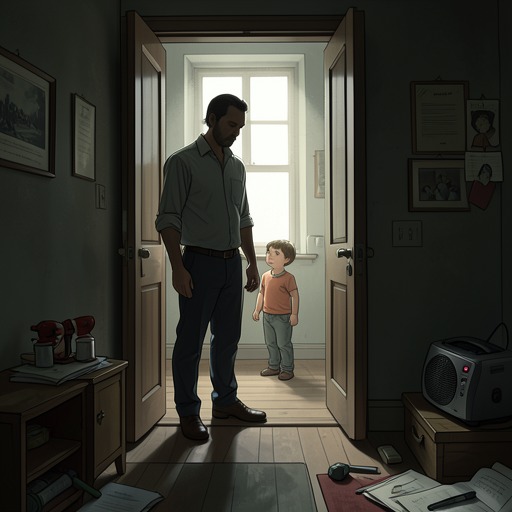
The old man spent the rest of that day treating him hatefully, then rose from the dinner table and burst out, “You got your goddamn nerve, growin’ up so fast! Was you so unhappy as a child?” The narration identifies this as the nearest he had ever come to saying he loved Mike. The outburst does not resolve their differences or make the grandfather suddenly demonstrative. Instead, it lets affection break through in the form their relationship has established: a complaint, an accusation, and an unwilling acknowledgment that Mike's childhood and growth matter to him.
Death and Lasting Significance
At the end of Mike's second year, just before his final examination, he received word that his grandfather's smithy had caught fire during the night. The house had burned down, and both the old people were dead. The loss ended the possibility of returning to the same home, continuing the argument about the forge, or hearing the grandfather's unfinished responses to Mike's plans. Their deaths came while Mike was pursuing the education his grandfather had helped make possible.
Mike remembers the aftermath not only as bereavement but as the ache of what had remained unsaid: arguments left unresolved, half-sentences still hanging, and touches that had not happened. That emphasis makes the grandfather's earlier outburst newly consequential. It had been an indirect declaration of love, but not a substitute for all the words or gestures Mike later wished they had shared. Through the contrast between a man who could mend tack and tend animals and one who could not easily speak tenderness, the grandfather becomes central to Mike's memories of both practical inheritance and irreversible loss.