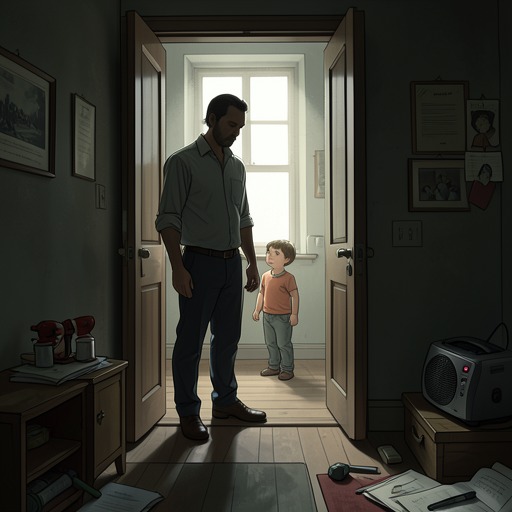
Mike's grandmother
Cry MachoMike's grandmother is both the most capable reader in her household and its most effective deceiver: she lets Mike mistake her for a timid, absentminded old woman while quietly shaping his education. Her campaign to draw him into books turns a few supposedly indecent volumes into bait for Dickens and Thackeray; her death, before their disagreements can be settled, makes the household's comic sparring part of Mike's lasting grief.
Identity and Household Performance
Mike's grandmother presents herself as frightened of her husband, whose temper, vulgarity, and bellowing voice seem to dominate the house. She also acts demure and absentminded, as though she cannot be held entirely responsible for what happens around her. Mike accepts this performance for years. Only when he is graduating from high school does he recognize that she has deluded him: her apparent helplessness is a role, not a reliable measure of her intelligence or influence.
The contrast is made explicit in her description of the couple's minds. She says that she “kept up on her reading,” and jokes that when she puts her hand to her head she scratches thoughts, whereas her husband scratches rust. The quip reverses the household's apparent hierarchy. Her husband may be louder, but she claims the intellectual distinction, and her joke shows that she can answer his bluster with a considered, comic judgment of her own. The evidence does not make her a simple antagonist to him; it shows her controlling how others read her, including her grandson.
Reading as a Campaign
For much of Mike's childhood, his devotion to horses and indifference to books do not seem to bother her. That changes as he approaches adolescence and becomes preoccupied with the signs of growing up: chin fuzz, daily clean shirts, and damp bedsheets. She recognizes an opportunity and begins a campaign built around the very curiosity she has noticed. She denounces the new style in writing as “lechery and soilacity” and throws supposedly dirty books into the wastebasket, knowing Mike will retrieve them.
The books offer little genuine scandal. Mike searches for the indecency she has invoked and finds only tame scenes: a boy's sexual awakening, a husband's kiss, and a girl trying to urinate standing up into a tomato juice can and getting most of it on her Mary Janes. The important consequence is not that the books satisfy his curiosity, but that he must read through them to locate the promised material. By seventeen, Mike understands the trick: his grandmother has used a few foolishly naughty books as bait to lead him into Dickens and Thackeray. Her method is indirect and teasing rather than openly instructional; she makes the reading he resists into a pursuit he chooses to continue.
The joke also complicates the labels the family gives Mike. His grandfather calls him bookish, while his grandmother calls him ignorant; the narration says he is neither. Her tactic does not simply prove that she can make him read, nor does it convert him into a would-be scholar. It reveals a difference between her judgment of his capacities and his own priorities: she can draw him toward literature, but she cannot make him want the future she associates with formal education.
Horses, Trust, and College
Mike's grandmother's campaign meets its limit in his attachment to horses. He decides that, whatever she wants, he will have nothing to do with college; he wants horses, not professors. When she calls horses the dumbest creatures to walk the earth, he answers that they are beautiful. She accepts their beauty only to insist on their stupidity, imagining a horse that would run its head into a stone wall if it trusted its rider.
That image turns a dispute about animals into a pointed argument about trust and authority. Mike answers that he trusts her, but will not let her smash his head into college. His reply recognizes her influence while refusing to follow where she wants to lead him. The exchange is affectionate in its teasing, but the refusal is real: she can disguise her intentions and guide his reading, yet his vocational choice remains contested rather than won over. Her confidence in education and his insistence on horses do not resolve into a shared outlook.
Mike's grandfather supplies a compromise that neither side has produced alone: college alongside horses, with veterinary study as the practical bridge. The suggestion is framed in the grandfather's irreverent terms, as a way to gain a credential and charge more, rather than as an argument for academic life in itself. It matters that the compromise comes from him: Mike's grandmother's educational pressure helps define the conflict, but the available account does not show her persuading Mike to embrace college on her own terms.
Death and Lasting Significance
At the end of Mike's second year, as he is about to sit his final examination, a message arrives that his grandfather's smithy caught fire the previous night. The house has burned down, and both old people are dead. The abruptness of the news cuts across the still-unfinished business of Mike's education and family life; there is no further exchange in which he and his grandmother can revisit her campaign, his resistance, or the affection beneath their quarrels.
Mike's response to the loss is organized around what remains unsaid: unresolved arguments, unfinished half-sentences, and physical tenderness that never happened. That grief gives the earlier comic scenes a sharper edge. His grandmother's cleverness had made disagreement lively and personal, while her concealed influence kept her from being easily understood; after her death, those same qualities cannot be questioned or answered. She endures in the story not as an educator who simply succeeds or fails, but as a complicated presence whose efforts to shape Mike coexist with his independence and whose absence leaves their relationship unfinished.