Pacas
Cry MachoPacas is Lexa’s chauffeur and a watchful member of her household whose brief appearances shape Mike’s sense of danger around her. He first appears as a quiet, suspicious presence at the edge of Mike’s encounter with Lexa; after Mike leaves her house, Pacas accompanies him to the gates, and later he joins Alma in confronting him. The narrative never gives Pacas an independent account of his motives. Instead, his role is filtered through Mike’s uncertain readings of his appearance, loyalties, and possible presence elsewhere in the city.
Identity and Position in Lexa’s Household
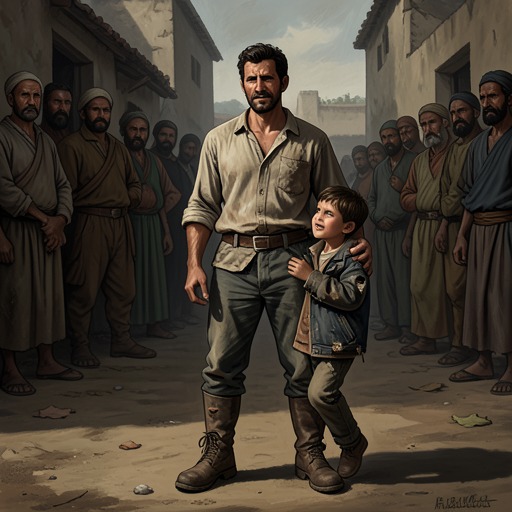
When Mike first sees Pacas, he initially groups him with the two people accompanying Lexa, then tries to make sense of him through images from travel folders. Mike thinks Pacas is an Indian, but notices that the welcoming figure suggested by those pictures does not fit the quiet, hard-looking man before him. The contrast tells as much about Mike’s ready-made expectations as it does about Pacas: the reader receives no fuller history or account of Pacas’s identity beyond what Mike observes and infers.
Lexa identifies Pacas as her chauffeur, alongside Alma, her housekeeper. Her explanation establishes him as part of the household’s working structure, but Mike’s attention quickly turns to the protective role Pacas seems to occupy. Alma and Pacas have resisted leaving Lexa alone with Mike, whom they regard as potentially unsafe. Pacas’s position is therefore both practical and personal: he is introduced through a job, yet his presence also registers as a form of scrutiny over who approaches Lexa.
The Departure from Lexa’s House
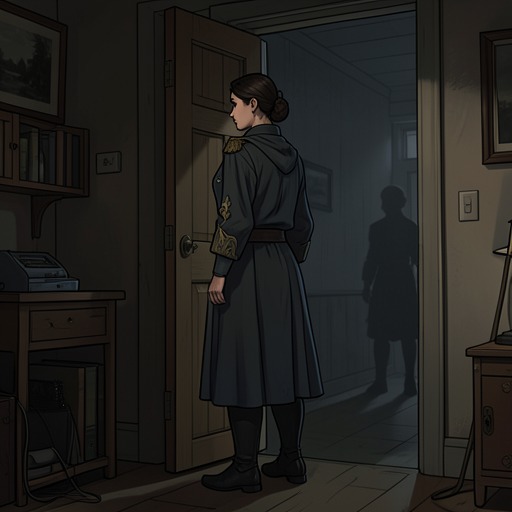
After Mike declines to continue his evening with Lexa and leaves her room, he finds Pacas waiting in the corridor. Pacas offers to accompany him to the gates, explaining that otherwise the dogs may pose a problem. He speaks English better than Mike expected. The exchange is brief, but it puts Pacas in control of the passage between the house and its grounds: Mike accepts an escort from someone whose welcome he cannot assume.
Mike experiences the walk down the staircase and across the grounds as charged with the possibility of violence. That impression belongs to Mike’s perception, not to an account of Pacas acting against him during the departure. Mike privately imagines that Pacas knows the dogs well and suspects that Pacas may have a claim on Lexa that could make him hostile to rivals. The narrative offers these thoughts as Mike’s conjectures, not confirmed facts about Pacas. Their uncertainty is important: Mike is physically unsteady and unable to settle on a clear explanation for why he left Lexa, so his reading of Pacas forms part of a wider unease about his own judgment and confidence.
The Confrontation with Mike
Pacas’s guardedness becomes direct conflict after Lexa and Mike quarrel. As Mike leaves the bedroom and heads for the door, Lexa calls for Alma and Pacas. Pacas appears immediately, as if he had been waiting nearby, and joins Alma in attacking Mike. Mike strikes back, but the two overwhelm him; the scene ends with him on the floor while Lexa continues to berate him. The confrontation makes Pacas an active defender of Lexa’s household rather than merely an observer at its threshold.
The episode also shows how quickly his position shifts from escort to antagonist. Earlier, he had accompanied Mike out of the house; now, after Lexa summons him during a heated dispute, he acts alongside Alma against Mike. The account does not explain what Pacas believes happened between Lexa and Mike or give him a separate reason for intervening. His actions are presented within the immediate household conflict, where Lexa’s call brings both attendants into the confrontation. That limited viewpoint preserves the uncertainty that marks Pacas throughout these scenes.
Pacas as a Continuing Threat in Mike’s Search
In the following chapter, Mike keeps imagining Pacas nearby, though each time he turns, he does not see him. Mike’s sense that Pacas is at his heels is therefore not proof that Pacas is following him; it records the persistence of Mike’s apprehension after their encounters. The possibility of meeting him again gathers force because Lexa has told Mike that Rafo is connected to cockfights. Mike expects that a search through the city’s illegal cockfighting world could bring him into contact with both the boy and Pacas.
Cockfights are Mike’s last lead to Rafo, so he divides the city’s underworld into six areas and searches them systematically, asking questions and offering small gratuities for information about fighting roosters. When those rounds produce no immediate result, he turns on a hunch to the city’s wholesale poultry district and finds a lead. Pacas remains part of the danger Mike anticipates along this route, but the evidence does not show him actually appearing at a cockfight or participating in the search. His narrative function is instead to make the lead feel contested: every step toward Rafo may also bring Mike back within reach of the household conflict he has left behind.
Narrative Perspective and Significance
Pacas is characterized through a sequence of thresholds: first among the people accompanying Lexa, then at the door and on the way to the gates, then summoned into a confrontation, and finally imagined just beyond Mike’s sight. These settings give his limited appearances a continuing effect. He does not need to be physically present in the search chapter for Mike to feel watched or to anticipate renewed conflict.
Because Mike’s impressions are explicitly uncertain, Pacas cannot be reduced to the threatening figure Mike imagines. The text establishes his employment, his guardedness toward Mike, his escort to the gates, and his participation in the confrontation; claims about jealousy, rivalry, or his unseen movements remain Mike’s interpretations. That distinction keeps Pacas at once a concrete member of Lexa’s household and a figure shaped by Mike’s anxious, incomplete knowledge. His importance in this stretch lies in that double role: he is part of the immediate danger Mike encounters, and a persistent possibility in the search that follows.