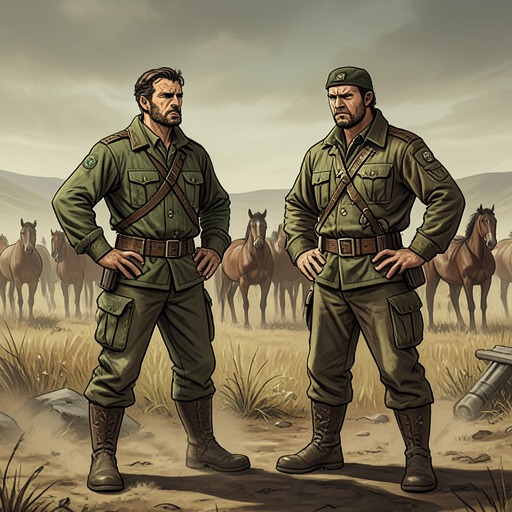
Porfirio
Cry MachoPorfirio is an elderly horse-breaker and cockfight referee in Janasco, a man whose intimidating reserve coexists with kindness and practical care. He first appears offering a wounded chestnut stallion for sale, but soon becomes more than a local trader: he challenges Mike’s dealings in wild horses, stands up for Marta and her family, and makes clear that the town’s animals and people are not simply available to outsiders. His authority rests on experience and judgment rather than spectacle, making him a counterweight to the story’s recurring images of masculine bravado.
Identity and Introduction
Porfirio approaches Mike and Rafo while leading a chestnut stallion. The horse is wide-eyed and wayward, and Porfirio identifies it as a wild mustang from Janasco. When Mike gently touches its mane and asks where it came from, Porfirio asks whether he has money. Mike shakes his head, and Porfirio leads the horse away. His backward glance is narrow and distrustful, establishing that his initial friendliness does not make him naïve about a stranger’s intentions.
The narrative presents Porfirio as an old man, about sixty, with a broad, high-cheekboned face whose severe appearance contrasts with a kind smile. He carries both a spiritual inwardness and the physical strength of a working horse-breaker. Mike initially finds him frightening and foreboding, then recognizes his kindness; that mixed impression persists. Porfirio can be silent and difficult to read, but his reserve is not passivity. He observes, judges, and acts when he believes a boundary has been crossed.
Work, Knowledge, and Local Authority
Porfirio’s knowledge of horses is grounded in long practice. He tells Mike that he has sold horses to Jiménez for years, spending three or four weeks making them tame enough for someone to ride. In his view, Mike’s horses are not ready for that purpose: they remain too wild, and a buyer who resells them could lose money. Porfirio therefore warns Jiménez against buying Mike’s animals. The dispute is not simply about whose horses are better; it concerns what a seller owes a buyer and what happens when animals are passed on before they can be safely ridden.
His standing extends beyond horse trading. At the clandestine cockfight, Porfirio is the referee, not the owner of the victorious black gamecock. He examines Rafo’s white rooster and points out that its comb and feathers make it unsuitable for fighting. When Mike proposes a wager, Porfirio says the black bird belongs to someone else and goes to ask its owner. He calls for Marta, revealing that his role is to oversee the contest rather than claim its winnings. The distinction matters: even in a setting organized around betting, Porfirio is careful about ownership and responsibility.
Defending Janasco’s People and Animals
Porfirio explains that Marta is a widow with four children and that the family depends on the cockfight held each Saturday night. Mike, angry at what he takes to be an attempt to manipulate him, starts to leave with Rafo. But Rafo stays to speak with Porfirio, and the exchange makes the family’s dependence visible to Mike. Porfirio’s intervention gives the wager a human consequence: the money is not merely a stake in a game but part of a household’s means of support.
That concern also shapes Porfirio’s conflict with Mike over the mustangs. After Mike and Rafo bring another horse to Jiménez and Jiménez refuses to buy it, Porfirio admits that he caused the refusal by telling the trader that Mike’s horses were too wild to sell responsibly. Mike protests that Porfirio knows he has ridden them with bits in their mouths. Porfirio’s account instead emphasizes the danger of selling animals that a buyer cannot ride. The disagreement turns on competing claims of expertise, but Porfirio’s choice is unmistakably protective of Jiménez and the people who might otherwise bear the cost of a bad purchase.
When Mike and Rafo later collect two hundred pesos for a horse, Porfirio is waiting. He raises six fingers and explains that the number of mustangs is dwindling each winter: they have too little to eat, and some die after eating black cactus. Mike says he and Rafo will leave the next day and take no more horses. Porfirio rejects a vague promise of departure, objecting that outsiders are taking the town’s horses and its woman. His words bring together two disputes that Mike has kept separate: the sale of the animals and his involvement with Marta. Mike feels the accusation on Marta’s behalf and answers that tomorrow means tomorrow to him. He promises not to take more horses or anything else.
Conduct, Relationships, and Judgment
Porfirio’s relationship with Mike develops through confrontation, but it is not reduced to hostility. He distrusts Mike’s first approach to the horse, contests his business with Jiménez, and challenges his intention to leave with both horses and Marta. Yet Mike recognizes a dignity in Porfirio that he does not want to violate. After the argument over the chestnut horse, Mike avoids further battle even though he believes he and Rafo have won that day’s engagement. Their wary respect rests on a shared recognition that the other will not easily yield.
Porfirio’s connection to Marta is conveyed through protective action rather than a stated explanation of their relationship. After a fire, neighbors gather and leave, but Porfirio remains for hours at the edge of conversations, silent and watchful. He later stands over Marta as she sleeps. He bends toward her, but instead of kissing her, he touches the blanket covering her. Mike knows the blanket is his, brought from the truck, and that Porfirio knows it is not Marta’s. The small gesture links Porfirio’s watchfulness to the practical care surrounding Marta, without resolving the nature of their bond. When he passes Mike, he quietly asks how Mike came to be there; Mike interprets the question as asking why he has stayed after the others departed.
Character and Narrative Significance
Porfirio’s authority is shown through a combination of inwardness and labor. At the fire, he watches without joining the discussion, and Mike senses that his power comes not only from a spiritual reserve but also from the strength of a man who still breaks mustangs. The townspeople have chosen him as referee, and Mike wonders whether the role also makes him a judge: Porfirio’s eyes seem to hold a severe assessment. His judgment is not abstract. It becomes legible in the decisions to protect a buyer from unrideable horses, to recognize Marta’s household’s dependence on the cockfight, and to insist that the dwindling mustangs not be treated as an inexhaustible resource.
In a story that examines the attraction and cost of heroic toughness, Porfirio offers a different kind of strength. The arena’s performance depends on control, risk, and public acclaim; Porfirio’s consequential actions occur in negotiations, watchful silences, and disputes over what can be taken from a community. He does not simply oppose Mike: he forces Mike to reckon with the consequences of his choices. His final insistence that Mike leave no later than the promised tomorrow gives their conflict a clear boundary, while his continued presence beside Marta suggests that care, like judgment, is most visible in what a person does.