Rafo Gives the Winnings to Marta
Cry MachoRafo Gives the Winnings to Marta is the episode in which Rafo chooses to give away the money earned by Macho’s cockfight victory. The choice sets his instinct for compassion against Mike’s suspicion and reluctance, then brings Rafo face to face with the difficult difference between helping a poor family and making its poverty feel like humiliation. Marta refuses the money, but Rafo leaves it inside her home; the scene’s quiet consequence is a first, tentative connection with her children.
The winnings and the decision
After the fight, Rafo is putting the money into both trouser pockets when Porfirio interrupts. Asked what people he means, Porfirio identifies Marta as a widow with four children who comes on Saturday nights for the cockfight. The family, he says, lives from that animal. The winnings therefore acquire a human consequence: they are not only the reward for Macho’s victory but money that might help a household with four children.
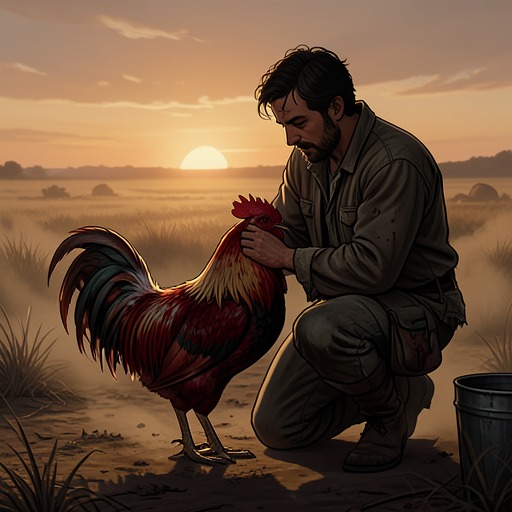
Mike reacts as though Porfirio may be trying to cheat them. He is angry at the prospect of being taken in and tells Rafo to come along. Rafo does not follow. Without another word, he picks Macho up and runs past Mike, carrying the rooster as he heads out of the cul-de-sac. Mike chases him through the colonnade and catches him halfway down the hill. When Mike asks where he is going, Rafo answers, “To give her back her money.”
Mike insists the money is Rafo’s because his rooster won it. Rafo answers that Marta is poor, and, when Mike points out that they are poor too, repeats that she is a widow with four children. His decision is not based on an argument that the winnings do not belong to him; he knows they do. He acts because he sees another claim on them as more urgent. The exchange makes the gift a conflict between two immediate readings of the money: Mike sees earned property that should be kept, while Rafo sees a chance to relieve someone else’s need.
A difficult approach
Walking downhill in the dark, Rafo realizes that he should have reached Marta’s house already. He admits to himself that he is not in a hurry. Part of him wants to turn back, apologize to Mike for the argument, and return to the familiar company he has just left. Still, he resolves to do what feels right and give the money to the widow.
The house complicates that resolve. Porfirio had described a poor family, but the white adobe house has a clean, unadorned appearance, blackberry and gooseberry vines, a purple-grape arbor, and a separate jacal. These details make Rafo doubt his first judgment. He wonders whether Mike was right and Porfirio might be working with Marta to cheat them. Rather than approach with certainty, Rafo reaches her door carrying his doubts alongside the money.
When Marta opens the door, the kerosene lamp behind her keeps Rafo from seeing her face clearly. Neither speaks at first. Although he is surer in Spanish and this is Marta’s language, he begins in English, stops in embarrassment, and tries again in Spanish. He cannot finish explaining what he wants to give her. He extends his hand with the pesos and manages only, “Aquí—por favor—aquí.” The halting offer makes the exchange more than a transfer of money: Rafo is trying to communicate care across uncertainty, with neither fluent words nor confidence that his judgment is right.
Refusal and proof of need
Marta thanks Rafo but rejects the gift. He pleads with her, yet she closes the door. At first, he takes her refusal as evidence that he had been right to trust her: she has not taken the money, so Porfirio’s account of her must also be true. That conclusion leads him back inside, where the material conditions of the family’s life are unmistakable.
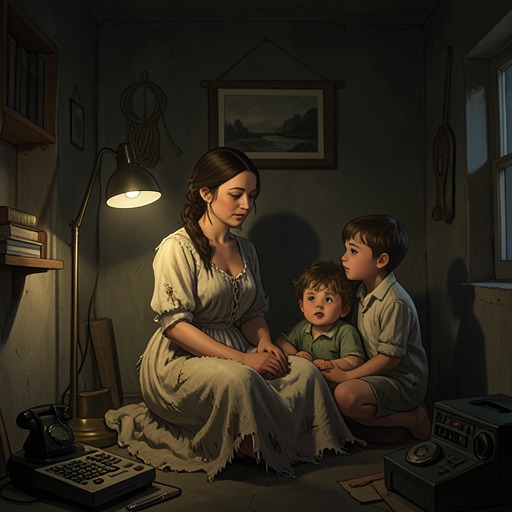
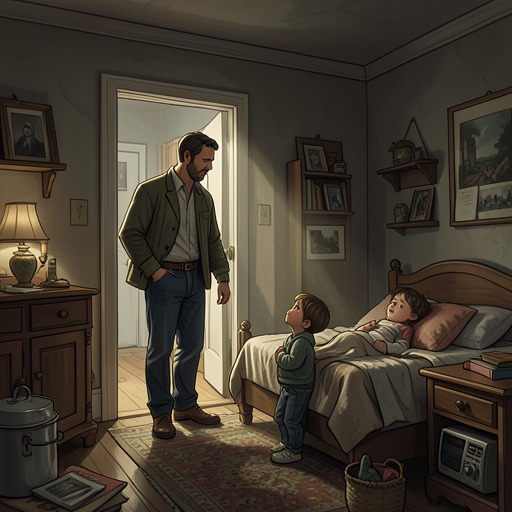
The furniture is sparse, and all four children sleep in a single room. The baby, perhaps two years old, lies on a mat of cornhusks; the two middle children, a boy and a girl, sleep on hard slats raised only a few inches above the dirt floor. The oldest daughter, about nine or ten, is awake and restless. The contrast between the house’s tidy exterior and the crowded sleeping arrangements explains why Rafo had doubted the story, then confirms why he felt compelled to help.
Marta’s refusal is not presented as proof that she does not need the money. Standing by the kerosene lamp, she touches her hands together and draws them apart, caught between pride and poverty: she is unwilling to accept charity, yet unable to escape the degradation of need. She interrupts Rafo and tells him to go away, accusing him of making matters worse rather than helping. Rafo answers with careful reasons instead of another impulsive gesture. His calm persuasion unsettles her; she begins speaking in half sentences, trembles, and runs outside. He follows only to the threshold, watches her disappear around the jacal, and resists the impulse to pursue her.
The money left behind
Alone in the stuffy room, with the windows tightly shut, Rafo does not know whether to leave or wait. He looks at the money and decides to leave it. At the table, he arranges the pesos together and the centavos together, then heads for the door without realizing that Marta’s oldest daughter is watching. The gesture preserves the purpose of his visit while avoiding another attempt to force Marta to accept the gift face to face.
The girl thanks him. Rafo answers, “De nada.” She thanks him again, this time demanding a response, and then orders him to give his name. Her directness changes the encounter’s scale: the gift has not resolved Marta’s discomfort or erased the family’s hardship, but it has been seen and acknowledged by one of the children. Rafo’s attention also shifts from the money to the people in the room.
Soon afterward, he picks up the crying baby. He holds the child close, then cradles and rocks him; the baby screams, quiets while Rafo rocks, and cries again when the motion stops. Rafo keeps rocking, and eventually the baby remains still even when he does. The older girl watches with wonder, and Rafo catches the same bashful light in her eyes. Remembering his earlier insult about country people, he wishes he had not said it. The sequence ends not with a declaration that the money has been accepted, but with Rafo physically caring for one of the children. His gift has moved from an argument about who owns the winnings to a fragile, immediate act of human closeness.