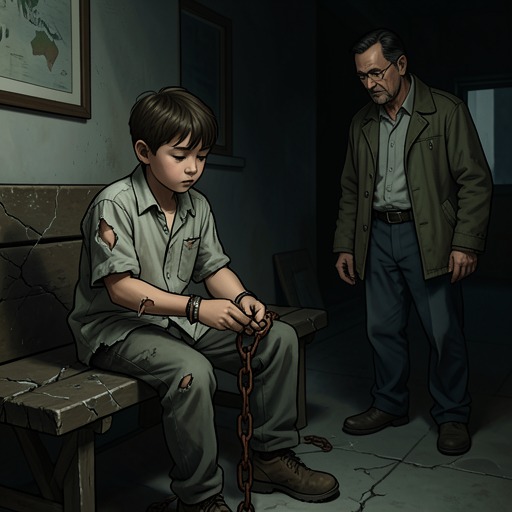
Rafo’s hostility toward gringos
Cry MachoRafo’s hostility toward gringos is both a street-survival strategy and a personal grievance, sharpened by his father’s failures. He turns contempt into a practical way of earning money, treating gringos as easy marks, while his resentment toward Howard Polk gives that generalization an intimate source. His encounter with Mike Milo puts the attitude under pressure: Rafo initially reads Mike through the same hostile stereotype, yet Mike’s trust becomes an exception Rafo cannot easily dismiss.
Street Survival and Learned Performance
Living alone in the city’s alleys, Rafo has learned to make money through small schemes and to regard gringos as especially easy to manipulate. When hungry, he can shine shoes outside the Hilton, using a carefully timed story of family hardship to encourage a larger tip. He has worked out the details as a performance: he begins with one shoe, leaving time to build the tale before the customer has finished the other. In one instance, a more elaborate version earns him two hundred pesos from a sober customer. A separate appeal to a drunk, with a bandage as part of the act, brings him five hundred pesos. These examples show not only his ability to improvise but also how deliberately he calibrates a story to its audience.
Rafo’s speech is part of the same performance. He had spoken English very well as a young child, but found that fluent English undermined the role of an uneducated, poor boy he used to solicit money from gringos. He therefore began to alter his speech, mixing Mexican and Texan forms with the language of the street. What started as a conscious tactic became his habitual way of speaking, and he came to take pleasure in it. His mother disapproved when she heard it during one of his rare visits home. For Rafo, however, the invented jargon is effective precisely because it lets him present himself differently to the people he means to deceive. He believes this strategy works on gringos, not on Mexicans, whom he does not consider susceptible to the same act.
The money is only part of the reward. Rafo takes satisfaction in getting the better of gringos because it also serves as revenge. His contempt is therefore not a passing judgment based on one encounter: he has made it into a repeatable practice, with a role to play, a story to tell, and an opponent he expects to outwit.
His Father as the Personal Source of Resentment
Rafo’s broad hatred has a particularly charged focus in Howard Polk, whom he regards as the quintessential gringo. His memory of his father is precise and admiring as well as resentful. He recalls Howard as handsome and clean, marked by light-colored eyes, hair, suits, and fingernails. Yet the father’s very polish is joined in Rafo’s imagination to distance: Howard seems unattainable, like a sacred fire that draws a person close but cannot be touched without harm. The image conveys how awe and hostility coexist in Rafo’s view of him.
The resentment has concrete grounds in Howard’s repeated failures to keep promises. Howard said he would return by Saturday but did not come home until Tuesday; he promised Rafo a Texas sheriff’s badge and never brought it. Most important to the boy was Howard’s promise to take him north to the rodeo after leaving Rafo’s mother. Rafo loved animals, especially horses, and had been riding before he learned to read. His eagerness at his first visit to the Hipodromo—where he ran onto the field after a race and had to be restrained—helps explain why the promised trip mattered so much. Howard’s failure was not simply another disappointment: it struck at an ambition Rafo had tied to his love of horses and his image of his father.
That attachment makes Rafo’s hatred difficult for him to keep uncomplicated. He wonders whether he can hate his father without wanting to see him again, and whether anyone can be hated without some love remaining mixed in. The questions expose the limit of the hard, contemptuous posture he adopts toward gringos. His anger is not evidence that the bond has vanished; it is bound up with the hope and admiration that the broken promises left behind.
Mike Milo as Target and Exception
Rafo initially brings his general distrust of gringos into his relationship with Mike Milo. After losing a fight to him, Rafo is especially aggrieved: he has been able to handle himself in fights and believes his speed and quick thinking usually protect him. He grudgingly recognizes that Mike’s close-grip method prevented him from using those advantages, but does not accept that this makes Mike superior. Instead, he keeps faith in his own combination of speed and intelligence and treats the loss as something to reconsider rather than a settled defeat.
Mike’s identity as a gringo makes that defeat more galling. Rafo assumes gringos are stupid, even more so than police officers, and at first regards Mike as no exception. He calls Mike’s caution about bringing Macho along a sign of cowardice and interprets Mike’s decision to rely on Rafo’s promise to return as foolishness: Rafo believes promises have force among people who know one another, but not between a Yankee and a Mexican. He looks forward to further fights and expects that, by the time they reach Texas, he will defeat Mike. The confidence preserves Rafo’s sense of superiority even when the first encounter has disproved his expectation that Mike would be easy to beat.
A later exchange shows how the contest extends beyond physical strength. After Mike rejects an arrangement involving a girl, Rafo taunts his manhood. Mike understands the insult as an effort to recover status after the fight, to present the gringo as less powerful than Rafo had first imagined. The scene does not establish what Rafo intended by the proposed arrangement; Mike himself questions whether his initial suspicions were justified. What it does establish is that Rafo uses humiliation as another way to challenge the authority he associates with an adult gringo. For Mike, the taunt also touches his own fears about aging and failure, which remain with him through a restless night. The episode thus shows the collision between Rafo’s performance of defiance and the vulnerabilities Mike brings to their relationship.
A Hostility Tested by Trust
Rafo’s distrust is forceful but not fixed. Although he insists that a stranger’s promise is not reliable, Mike has trusted Rafo to return after only one meeting. Rafo calls that trust stupid, yet its very presence complicates his rule: Mike has taken a risk on him without the familiarity Rafo says should be required. Rafo continues to imagine future fights and to promise himself victory, but the possibility of trust has entered a relationship he first frames as a contest between a clever Mexican boy and a foolish gringo.
The rodeo imagery surrounding Mike offers a related contrast without erasing their differences. At Polk’s Cow Stadium, Mike is publicly presented as a champion, his image displayed on a large poster and his Ride-Out announced as a special attraction. The rodeo manager, Howard, has also recast the cowboys as paid performers rather than the heroic competitors they might wish to imagine themselves to be. Later, Mike reflects on the word macho across arenas in Texas and Mexico, where displays of courage can be tied to harm. These episodes do not describe Rafo’s own view of the stadium, but they frame the world in which he measures men: public claims of heroic strength coexist with commercial performance, caution, and vulnerability. Rafo’s hostility makes Mike’s status as a gringo a reason for suspicion; Mike’s conduct, especially his decision to trust Rafo, makes that identity insufficient to explain him.
Rafo’s contempt therefore works on two levels. It helps him survive by turning social prejudice into a profitable act, and it protects him from the continuing disappointment attached to Howard. Yet the anger cannot entirely cancel his attachment to his father, while Mike’s unexpected trust unsettles Rafo’s belief that all gringos can be safely dismissed. The hostility remains a real force in their encounters, but it also marks the point at which Rafo’s certainty begins to meet evidence it cannot comfortably absorb.