Texas
Cry MachoTexas is linked to the rodeo arenas that made Mike Milo a celebrated rider and to the northbound journey on which he tries to return Rafo to his father. The state is more than a point on a route: it represents the professional world Mike has lost, the authority Howard Polk exercises within that world, and the uncertain homeward direction of a trip that begins in Mexico.
Texas and the rodeo circuit
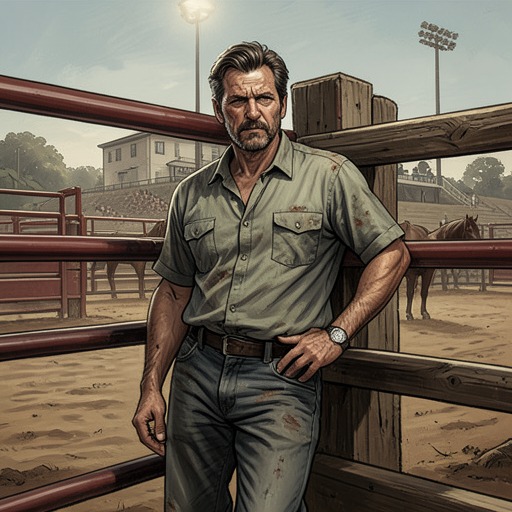
Mike’s history is measured through the circuits and arenas in which he competed. Looking back on his career, he recalls riding in Texas, Oklahoma, and Arizona, as well as in Mexico; across these places, rodeo repeatedly offered the same public test of bravery and physical command. Mike had won the National Finals and received the Dallas Buckle for bareback riding and nine Cattlemen Trophies. His reputation was made in a circuit where such distinctions could turn a rider into a public figure, even as the work brought injuries, fear, sleeplessness, and dependence on bourbon.
The connection between Texas and this professional identity is also present in the image displayed at Polk’s Cow Stadium. A large photograph showed Mike on a rearing bronc, his hat raised and his expression fixed into a showman’s grin. He had learned not to look at it. The image came from his final year of competition, a period when he won little money or recognition and was hurt twice. For him, the arena portrait preserved the cowboy hero that spectators could see, while the remembered season behind it was marked by exhaustion and growing apprehension.
The arena and its changing work
The Macmillan Brothers’ stadium was built around a rodeo business that was struggling to draw audiences. They hired Donna to promote it to women’s clubs, asking her to make the animals and performances feel personally inviting to that audience. Mike and Donna first met in this professional setting, before Howard took control of the stadium. Her work helped frame the rodeo as entertainment, while Mike’s trophies and reputation belonged to the older image of the cowboy as a competitive hero.
After the resident rodeo company had operated for eighteen months, it collapsed, and the stadium fell into the hands of its mortgage holder, Howard. His takeover changed the arena’s schedule and the terms on which its riders worked. Though unfamiliar with rodeo vocabulary and initially dismissed as an outsider, he built the resident company into an attraction that performed on weekends and every night except Monday. He imposed an attendance ledger and insisted that the riders be treated as performers rather than as major-circuit champions. The men resented the distinction, but it exposed the gap between the heroic image associated with the Texas rodeo world and the salaried, theatrical work of this particular company.
Mike’s own place in that transformation remained uneasy. He did not object openly to the sign-in rule; he simply never signed the ledger, anticipating that Howard would eventually retaliate. The stadium could display his image and announce him as a star, but Howard controlled the institution that employed him. Texas therefore belongs not only to Mike’s history of competitive achievement but also to a wider conflict over who defines a cowboy’s status: the rider, the audience, or the manager who organizes the show.
The journey north from Mexico
Texas acquires a different function when Howard hires Mike to bring Rafo back from Mexico. Howard says he has a legal right to have his son with him during two months of school vacation, although his former wife has not reliably honored their agreement. Mike accepts the task, but recognizes that carrying out the plan could involve coercion and harm to a child. At the border, he has prepared his papers carefully and worries over a small can of household oil left behind in the truck. His anxiety about the overlooked object becomes a test of his own willingness to proceed: he turns back to find it rather than treating a possible failure as permission to abandon responsibility.
The northbound route is concrete. Mike crosses from Laredo into Nuevo Laredo, later passes through Monterrey and Linares, and reaches Mexico City three days after leaving Laredo. He takes care not to let the Hotel Fifth Avenue know that he has arrived in his own truck. The direction of travel matters because the intended return is across the border to Texas, but the journey does not begin as a straightforward homeward drive. Mike must first locate Rafo, persuade or force him to leave, and contend with the reasons the boy has for resisting his father.
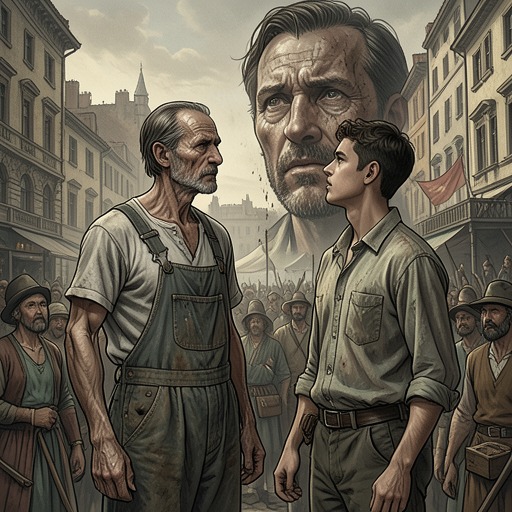
When Mike tells Rafo that he can put him in the back of the truck and drive him across the border, the threat makes Texas the destination of a contested return rather than a neutral endpoint. Rafo’s reluctance is tied to a remembered promise: as a small child, he had been told that his father would take him to the rodeo, but the promise was never kept. The Texas-bound plan therefore carries a family history with it. Mike is hired to deliver a son to his father, yet the boy’s account complicates the employer’s claim to that reunion.
A destination and a measure of distance
On the road, Texas can also function as a blunt, comic answer rather than a carefully plotted location. Asked where the nearest town is, Mike says he does not know and answers, “Texas.” Rafo is appalled at the prospect of walking there. The exchange does not establish Texas as the nearest town; instead, it shows how the state has become a general northward destination in their conversation, large enough in Mike’s mind to stand in for the way out.
The contrast between that casual answer and the carefully managed route gives Texas its shifting narrative force. Mike has driven from the border toward Mexico City, hidden his truck at a public garage, and guarded his plans from strangers. Yet the return he imagines remains difficult to reduce to miles. The goal depends on a father-son relationship that is already strained and on Mike’s decision to carry through a job he recognizes as morally troubling.
The rodeo’s language further complicates the idea of Texas as a simple homecoming. Mike sees the same culture of spectacle in arenas across Texas, Oklahoma, Arizona, and Mexico, and comes to question the heroic meaning attached to the word macho. The arena can call a rider a champion while making him feel disposable when his career ends. In that sense, Texas stands at once for Mike’s former arena life and for the wider culture he is beginning to judge. Its significance lies in this double role: it is where the cowboy’s legend is performed, and the destination toward which a troubled family errand points.