The Truck Hijacking
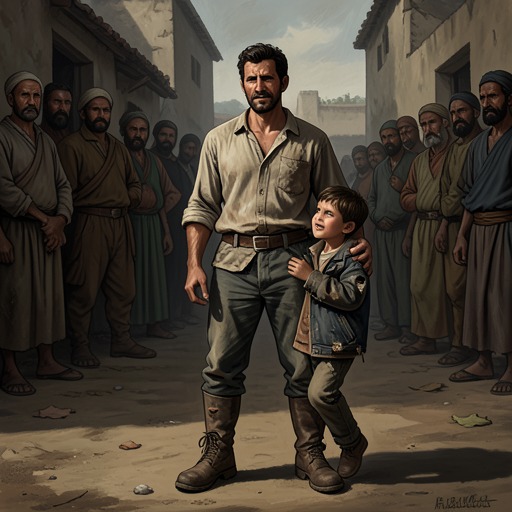
Cry MachoThe Truck Hijacking strips Mike and Rafo of their transportation and most of their money in a sudden roadside theft. The men’s failure to stop the truck matters as much as the theft itself: they return to camp with Macho, stranded, and discover that their remaining provisions offer little security. Against the public image of Mike as a rodeo champion, the episode reduces the pair’s immediate prospects to a few cans, fruit, water, and a handful of coins.
The theft at the camp
Mike and Rafo are near the road when they see one of three men trying to capture Macho with a sombrero. Rafo calls out, interrupting the attempt to take the rooster. The man stops pursuing Macho and shouts toward his companions; Mike then sees the others, including one mounted beside the truck and another inside it, trying to start the engine. The man pursuing Macho addresses the driver as Carlos. The evidence presents the theft as unfolding around them, not as a confrontation they have prepared for.
The truck starts moving. The man with the sombrero gets onto one of the horses, and the three horses depart with two riders while the truck gathers speed behind them. The horses are already far ahead when the vehicle begins to pull away. Mike and Rafo run after the group, shouting, but the distance grows rather than closes. Their pursuit ends without recovering the truck or intercepting the thieves. The attempted capture of Macho and the theft of the vehicle thus converge in one brief sequence: Rafo’s shout draws the men’s attention, but it cannot prevent their escape with the truck.
Stranded and counting the loss
After the chase, Rafo runs out of breath and stops; Mike, who has run farther ahead, eventually slows and stops as well. They walk back to camp to collect Macho, and only then confront what the theft means: they have no truck and are stranded. Rafo allows for the possibility that they might get the vehicle back, but the suggestion of calling the police exposes their lack of an easy remedy. He reflects on the contradiction of needing the police in some situations while wanting to reject them in others. Mike answers lightly, but his attention is elsewhere: he is looking around for his coat.
Remembering that the coat was in the truck changes the scale of the loss. Mike’s money was in its pocket, and when Rafo asks whether he means all of it, Mike confirms that he does. He searches his trousers and finds only one peso and fifty centavos, a total worth twelve cents. Rafo has nothing left from the money he collected from Zafiro; he spent it on cigarettes the day before. The theft has therefore taken more than a means of transport: it has carried away Mike’s cash and left both travelers with almost no money available to them.
What remains
Their supplies make the consequence tangible. Once packed, they have an unopened can of refried beans, a can of tacos, two cherimoyas, half a gallon of spring water that may not be purified, and one and a half pesos. The list does not turn their predicament into a catastrophe beyond what the episode states, but it does show how little margin they have while stranded. Even the water’s uncertain quality is part of the inventory, rather than a dependable resource. The balance between what they have lost and what they can carry is stark: the truck and Mike’s money are gone, while the remaining provisions can be counted item by item.
The exchange about cigarettes briefly restores their familiar teasing without changing their circumstances. Rafo acknowledges that Mike outran him, then attributes the difference to Mike’s longer legs rather than to smoking. He puts a cigarette in his mouth but does not light it, leaving it dry and dangling. His earlier spending has already helped reduce his cash to nothing, and the unlit cigarette becomes a small, visible counterpoint to that loss. Rafo also says that his hat is too big, although he is wearing no hat and apparently owns none. The remark sits beside the careful reckoning of food, water, and coins: humor persists, but it cannot make their supplies or money stretch further.
Significance
The theft reverses the scale on which Mike’s life has often been measured. At Polk’s Cow Stadium, his photograph showed him on a rearing bronc, and the announcer presented him as a champion with major rodeo honors. Howard Polk, meanwhile, dismissed the company’s self-image as cowboy heroism and called its performers actors. Those details make the contrast legible without making the hijacking itself a staged test: here, Mike cannot turn reputation into transport, retrieve the coat, or protect the money in it. He and Rafo are left with the practical consequences of a failed pursuit.
The episode also places the language of toughness beside material vulnerability. Mike’s later reflection on the word macho connects rodeo and cockfighting to spectacles in which people and animals are made to hurt one another; he recognizes that the hero’s pose can conceal cruelty and loss. That broader judgment does not change the immediate outcome of the hijacking, but it sharpens the contrast between public bravado and dependence on ordinary resources. After the truck disappears, what counts is not the arena image but the small remainder they can carry away from camp.