The impermanence of love and loss
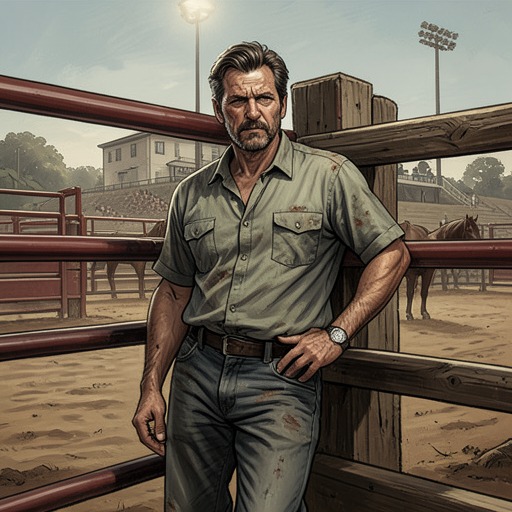
Cry MachoThe impermanence of love and loss becomes a decisive truth for Mike Milo: love does not promise that a relationship, a home, or a life will endure, but the possibility of loss does not make present happiness unreal. His time with Marta brings that tension into intimate focus. Later, as he considers whether to return to Janasco, he recognizes that fear of losing what he loves has become more painful than the knowledge that it cannot last. The insight does not spare him grief; it changes what he is willing to do in the face of it.
Intimacy and the Anticipation of Farewell
At dawn, Mike Milo lies close to Marta, reluctant to leave the warmth of her. His practical concern is that her children will wake and be frightened if she is gone, or find the two adults naked. But the prospect of getting up carries a more difficult possibility: Marta may awaken, and the morning may require a goodbye. The scene makes separation present before either character has left. Even in shared intimacy, Mike Milo is already imagining its end.
His uncertainty about what kind of goodbye this would be exposes a distinction in his past conduct. With a woman he does not want to love again, goodbye leaves him feeling guilty, and he promises to return without meaning it. With a woman he does want to love again, the word carries a different fear: she may not be there when he comes back. He cannot decide which kind of farewell he faces with Marta. His sadness is real, but he cannot treat it as proof of a secure future; he wonders whether the beauty of their previous night can happen again, then allows that there need not be another time.
Their intimacy has offered an unusual reprieve from distance. Mike Milo experiences lovemaking with Marta as communication without double meanings or betrayal, and he feels that neither needs spoken language to understand the other. They talk and chatter throughout the day as if language presents no barrier. Yet their closeness does not cancel the circumstances that separate them. Marta’s sadness comes from knowing, as he does, that this is only one day, that there will not be many such days, and that Mike Milo will be gone. Acceptance does not prevent lament: she can understand the limit and still grieve it.
Loving Marta Without Claiming Permanence
Mike Milo recognizes that he loves Marta, while also believing that loving her cannot become a permanent arrangement. He feels that he is wrong for this place and will remain so. The relationship is therefore neither dismissed as a passing illusion nor converted into a promise the story cannot support. For these few days, he loves her; a few days must be enough. That formulation preserves both the intensity of the attachment and its acknowledged limit.
The difficulty is not simply choosing between affection and indifference. Mike Milo’s tenderness with Marta makes him want to give and to stay, but he cannot make those desires equivalent to a workable future. When he later asks himself whether he loves her enough to remain in Janasco, he is confronting the gap between love as a feeling and life as a lasting decision. The question unsettles him because the place and the woman have become deeply precious without becoming a home he believes he can inhabit.
Janasco and the Limits of Home
Mike Milo’s conflict about Janasco rests on a concrete contrast, not on an uncomplicated judgment that one place is good and the other bad. He sees the beauty of the mesa, its sky and sunsets, Marta’s poppy-filled meadow, and the clean stream. He thinks of Marta’s gentle children, the strength of Jiménez and Porfirio, and the friendliness of people in the morning and evening. The landscape and community have become sources of attachment; leaving them would mean leaving more than a romantic possibility.
But beauty does not erase hardship. Mike Milo also sees poverty in a bowl of chick-pea soup between life and starvation, children earning a mean centavo by tying bits of string, and a meadow that cannot be tilled. Janasco has illness, cruel gossip, alley violence, and the possibility of people like Croag. He refuses to make it a paradise simply because he loves Marta and values the people around her. Nor can he claim that Texas contains no misery. His decisive distinction is that Texas is home and Janasco is not: he is a Texan, not a Mexican, and knows he cannot live there. He believes he would have to leave even if he loved Marta too much to do so. By the time he understands this, he has already, in his mind, departed; that imagined departure is part of why he is miserable.
Loss as a Condition of Choosing
When Mike Milo thinks of returning to Texas, he sees that nothing there has changed: Donna, Rachel, Cissy, and Laurie are absent, and there is no arena in which to ride. He has returned to old failures carrying another one. Janasco offers no guarantee against the same pattern. Rafo will grow up and may no longer need him; a life with Marta, even a marriage, could not be assumed to preserve its present sweetness. The mustangs, too, will die, leaving their bones in the sun and the mesa as a reminder of their former wildness. Love, family, work, and landscape all belong to time.
Mike Milo concludes that loss cannot be avoided any more than death can. What has ended is his illusion of permanence: the dream that love and life might remain durable. He locates the deepest tragedy not solely in losing someone or something, but in fearing farewells, departures, and the memories they leave. His fear of going back to Janasco is, in part, fear of having to leave it again. That recognition clarifies his choice without making the choice easy.
Temporary Joy and the Decision to Return
Mike Milo ultimately turns south toward Janasco, toward Rafo, Marta, the horses, and the mesa, for as long as they can last. He accepts whatever love he can have for a short time and whatever love he can give for as long as it is wanted. This is not a claim that brief happiness can defeat loss. It is a refusal to demand a lifetime guarantee before allowing happiness to matter. His thought that "Compared to never, sometimes was a long time" gives that refusal its compact expression: limited duration is still duration, and an experience need not last forever to be worth choosing.
The ending makes the choice bodily as well as philosophical. Mike Milo returns down into the ravine, going south, with a wound that is still bleeding but less than before; when he emerges, the bleeding seems to have stopped, though the pain remains. He expects damage to recur and heal, and knows it will not always heal. The image does not promise recovery from every loss. Instead, it joins pain and joy as temporary experiences he must bear without mistaking their passing for meaninglessness. Returning to Janasco means consenting to attachment despite the likelihood of grief, not discovering a way to escape grief altogether.