Carbon de Castel-Jaloux
Cyrano de BergeracCarbon de Castel-Jaloux is the captain of the Gascon cadets in the siege scenes of Cyrano de Bergerac. The play defines him chiefly through visible command: he appears in uniform, is addressed as captain, gives orders to his men, and returns to the rampart with pikemen drawn up in line. His final report is not a triumphal announcement but a wounded officer’s warning that the defense is breaking, a moment that joins military duty to its immediate human cost.
Identity and Command
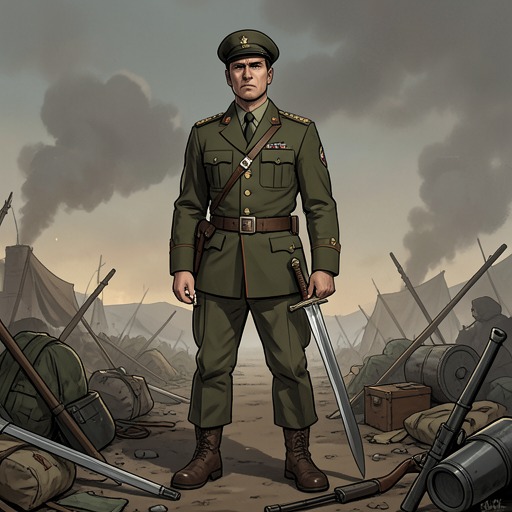
Carbon’s rank is made legible before the siege reaches its final crisis. When he enters during a gathering at Ragueneau’s, he wears a captain’s uniform and reacts with surprise on seeing Cyrano de Bergerac. Soon afterward, he calls Cyrano de Bergerac by name. These brief gestures establish him as part of the same company of fighters while keeping his own position distinct: he is not merely one of the cadets, but an officer among them.
The play gives Carbon little private history or interior monologue. Instead, it characterizes him through presence and responsibility. At the siege, Count de Guiche summons him as captain to give an order; later, Carbon reports the arrangement of his pikemen. His identity is therefore bound to the work of command—to receive information, place men, and remain accountable when danger becomes immediate.
Command Under Siege
The military conditions around Carbon’s command are severe. The French are not only besieging Arras but are themselves trapped and besieged by the Cardinal Infante of Spain. Carbon voices the indignity of that reversal: “It is disgraceful that we should starve while we're besieging!” The line makes hunger part of the military predicament rather than a distant hardship. The besiegers lack food even as they maintain their position, and the siege’s complications expose the limits of their control.
The danger is sharpened by news that half the army is absent from camp. Count de Guiche reports that the Marshal made a final attempt to bring provisions, secretly taking a substantial force with him. Carbon’s response connects the missing troops to the risk of attack: if the Spaniards knew how diminished the camp was, the French would be in serious danger. His brief assessment shows a commander thinking in terms of the enemy’s possible knowledge as well as his own men’s immediate needs.
Roxane’s arrival changes the material atmosphere of the camp, though not the military danger. She says that the camp air has made her hungry and orders pasties, cold fricassee, and old wines. The cadets’ hunger makes the food more than a social detail: it answers, for a moment, the deprivation Carbon has protested. Yet the contrast is temporary. Food can sustain the men, but it does not remove the encirclement or the shortage of troops.
Orders and the Defense
Count de Guiche gives Carbon a concrete resource for the defense: he says that he has one cannon left and has had it carried to a corner, where Carbon’s men can use it if necessary. The order underscores the precariousness of the position; the cannon is described as the last one available, and its use is conditional on the need. Carbon’s role is to turn limited resources into a working defense, not to command abundance.
Later, Carbon reappears on the ridge after drawing his pikemen up in line. He describes them as resolute. The stage action gives that report visible form: the captain has placed his men and returns to show the line ready. The emphasis falls on discipline maintained under pressure. His words do not claim that the position is secure; they establish the resolve with which the cadets hold it despite hunger and the threat of attack.
Wounding and Narrative Significance
Carbon’s final appearance reverses the confidence of that earlier report. Cyrano de Bergerac is rushing toward the battle when Carbon, streaming with blood, stops him and announces, “We are breaking! I am wounded--wounded twice!” The repetition makes the injury unmistakable, while the first sentence carries news about the whole defense. Carbon’s wound is personal, but his report concerns the line and the men whose resistance he has helped organize.
Cyrano de Bergerac supports the wounded captain and calls to the Gascons not to turn their backs. Carbon’s condition thus becomes the immediate circumstance for another appeal to the cadets: the defense is under strain, its captain has been hit twice, and the men must still face the fight. The play gives Carbon no recovery or later account in the supplied scenes. It leaves him at the point where command has become bodily exposure, and where his earlier resolve is measured against the breaking position he can no longer conceal.
Carbon’s dramatic function rests on this contrast between authority and vulnerability. Uniform, orders, the cannon, and the drawn-up pikemen mark the structures of military command; hunger, missing troops, and his bloodied return show how little those structures can shield their participants. He is not presented through a separate heroic speech or personal backstory. Instead, the successive duties assigned to him make the siege tangible: he assesses danger, positions men, receives the means of defense, and finally reports both his own wounds and the collapse threatening the company.