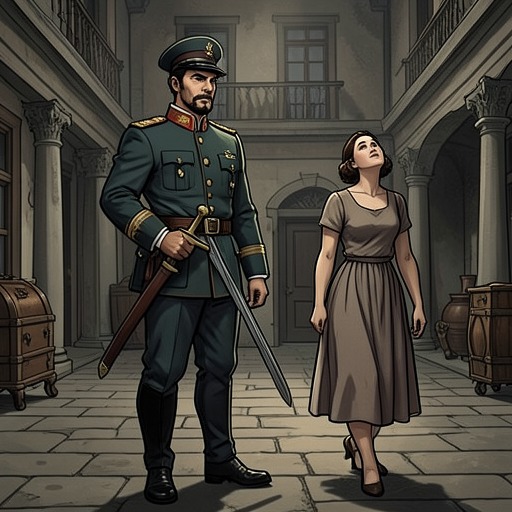
Cyrano’s moonfall ruse delays De Guiche
Cyrano de BergeracCyrano de Bergerac’s moonfall ruse delays Count de Guiche at the crucial moment when the Count is about to enter the house. Cyrano converts the route from balcony to doorway into a theatrical interruption: he drops into the Count’s path, pretends to have fallen from a great height, and keeps him occupied until the couple have plighted troth. The stunt’s significance lies in its practical success as well as its characteristic theatricality: Cyrano makes his body the instrument of a deception that protects another couple’s marriage.
Purpose and Circumstances
The action begins with Cyrano considering how to detain Count de Guiche. The question establishes that the fall is not an accident but a timed intervention, devised to keep the Count away from the house. The immediate objective is specific: prevent him from entering for long enough to allow the unseen business inside to be completed.
The stage directions place the two men on opposite sides of a threshold. Count de Guiche enters masked and feels his way through the darkness; looking toward the house, he identifies it as his destination and is about to go in. His mask hinders his sight, and the darkness makes his approach tentative, but neither circumstance turns him aside. Cyrano has to intervene at precisely this moment, before the Count crosses the doorway.
The Staged Fall
Cyrano first reaches the balcony by climbing from a bench along the wall. When Count de Guiche is about to enter, Cyrano leaps from the balcony while holding onto a branch. The branch bends beneath him, lowering him between the door and the Count. He then pretends to fall heavily from a great height and lies flat on the ground. The movement is carefully staged: Cyrano chooses a visible, physical spectacle that blocks the Count’s direct approach and demands his attention.
The apparent fall depends on a contradiction between what the audience sees and what Count de Guiche is invited to believe. The stage directions disclose Cyrano’s deliberate use of the branch and his assumed collapse; the Count encounters the performance as a sudden interruption. The balcony, branch, and doorway therefore do more than locate the action. They form the apparatus of the ruse, turning an attempted entrance into a scene that the Count must stop to interpret.
Delay and Disclosure
Count de Guiche responds to the performance with amusement, calling the apparent fool comical. That reaction marks a change in the encounter: instead of entering the house, he is drawn into conversation with the person lying in his path. Cyrano sustains the diversion long enough for the purpose announced at the outset to be achieved. When he finally returns to his natural voice, he says that the quarter has passed and that he will hinder the Count no more. The timing confirms that delay, rather than injury or escape, was the stunt’s measure of success.
Cyrano then bows and identifies himself. The reveal changes the meaning of the fall retrospectively: it was a calculated performance by the very man who had kept the Count outside, not an unknown stranger’s mishap. Cyrano adds that, while the two men were chatting, the couple had plighted troth. Count de Guiche’s immediate question—who?—makes plain that he has been detained without knowing what his diversion enabled. The scene links Cyrano’s successful deception directly to the couple’s commitment, while leaving the Count to learn that consequence only after the allotted time has passed.
The Ruse’s Dramatic Function
The episode makes theatrical skill serve a concrete objective. Cyrano does not merely tell a story or offer an excuse; he supplies a body, a fall, and a conversation that hold Count de Guiche at the threshold. The apparent accident gains force from its physical staging, while Cyrano’s eventual return to his natural voice exposes the performance as intentional. The contrast between the false collapse and the controlled timing captures the ruse’s central irony: apparent helplessness is what allows Cyrano to control the encounter.
The delay also places Cyrano’s resourcefulness in the service of another couple’s marriage. He takes the risk and attention of the scene upon himself, then releases Count de Guiche only after the couple have plighted troth. The ruse thus joins comic spectacle to consequential action: the Count may find the supposed fall amusing, but his laughter and conversation are precisely what keep him from the door. Cyrano’s performance succeeds not by defeating the Count in open conflict, but by making him a participant in a diversion whose purpose he understands only when it is too late to prevent the commitment.