Ragueneau
Cyrano de BergeracRagueneau is a famous tavern-keeper and poet whose appearances carry a lively, literary presence from his establishment into the later scenes at Arras and the play’s tragic close. First welcomed by an audience delighted to see him, he is later shown writing among papers, recognized by the Gascon cadets at a military camp, and present when news arrives that Cyrano de Bergerac has been struck down. His movement between these settings makes him a witness to both the play’s convivial world and its final grief.
Identity and Literary Work
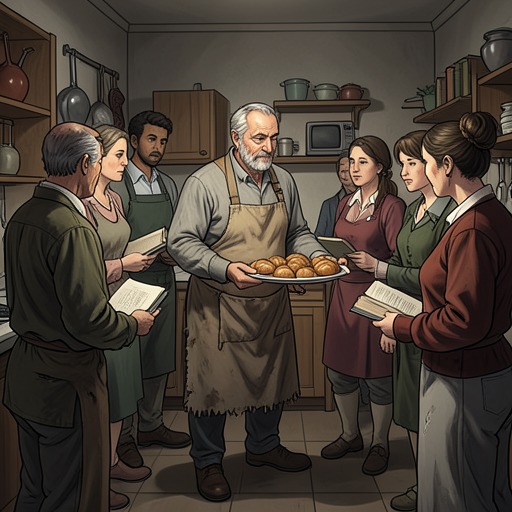
Ragueneau is introduced to Christian de Neuvillette as a famous tavern-keeper. The audience’s joyful response to his entrance likewise gives his arrival the air of a familiar public event: he is not an anonymous tradesman but a figure known and welcomed by the people around him. The play thus establishes his social identity through others’ recognition before showing him at work.
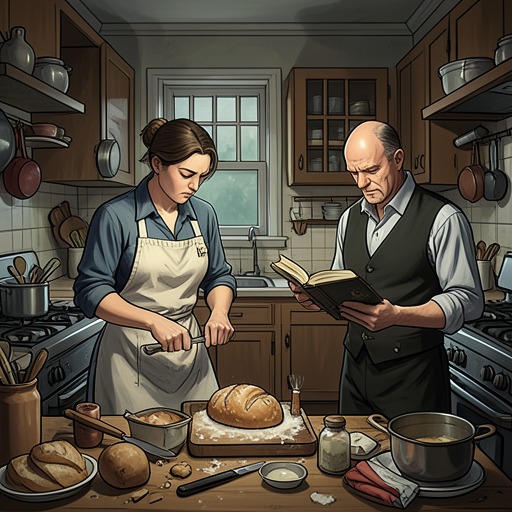
At his establishment, tables are laden with rolls and dishes, and other tables are arranged with chairs for customers. Apart from this provision for eating, a small corner table is covered with papers, where Ragueneau sits writing as the curtain rises. The staging places food and literary labor side by side: his tavern is both a place of consumption and a setting for composition. The papers make his writing visible, though the scene does not identify their contents or explain what he is working on.
A Voice That Turns Personal Misfortune into Performance
In a later scene, Ragueneau recounts an episode involving a woman who leaves with a musketeer, his abandonment and ruin, and his hanging himself. The account is cut off as he begins to describe his last breath. Its first-person phrasing gives the passage a dramatic, performed quality, but the available scene does not establish whether it should be read as a literal report of his own life or as material he is reciting. That uncertainty matters: the play presents a voice and a tale, not a confirmed biographical history.
The passage also connects Ragueneau’s literary identity with the vulnerability beneath his exuberant public image. The story turns desertion and ruin into material for speech, but it does not resolve the account before the scene shifts to other characters. His writing at the corner table and his later spoken narrative therefore frame him as a figure associated with words, while leaving the precise relation between composition and personal experience open.
Recognition at Arras
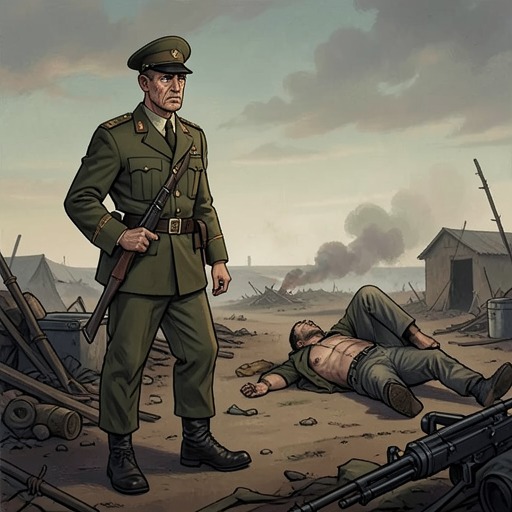
When a carriage arrives at the military camp, the Gascon cadets rush toward it and call out that Ragueneau is there. Their response recalls the audience’s earlier delight at his entrance: in both scenes, his appearance prompts collective recognition and excitement. The recurrence gives his presence a social warmth that contrasts with the hardship of the military setting.
Ragueneau stands on the carriage box and addresses the gathered men in the manner of a quack doctor performing at a fair. The detail turns the arrival into a public display, with him elevated above the crowd and speaking to an assembled audience. The scene does not provide the substance of his address, so its significance lies chiefly in the staging: even at the camp, he commands attention through an animated, performative presence.
Witness to Cyrano’s Final Ordeal
Near the end of the play, Ragueneau tells Le Bret that he saw their poet and friend struck to the ground, with a large wound in his head. His report makes him a witness to Cyrano’s violent injury and conveys its gravity through the concrete image of the wound. By calling Cyrano their friend, he joins Le Bret in a shared expression of attachment rather than speaking as a detached observer.
Ragueneau is also present when Cyrano, convinced that he has been thwarted even in death, speaks of his defeat. Ragueneau responds with a distressed appeal, and Cyrano holds out his hand to him. The brief gesture places Ragueneau among those who remain beside Cyrano at the end. Across the play, his role is not defined by a single decisive intervention, but by these recurring acts of presence: he writes, tells, performs, recognizes, reports, and grieves. The progression from a room filled with food and papers to the final exchange at Cyrano’s side gives his appearances a quiet structural weight.