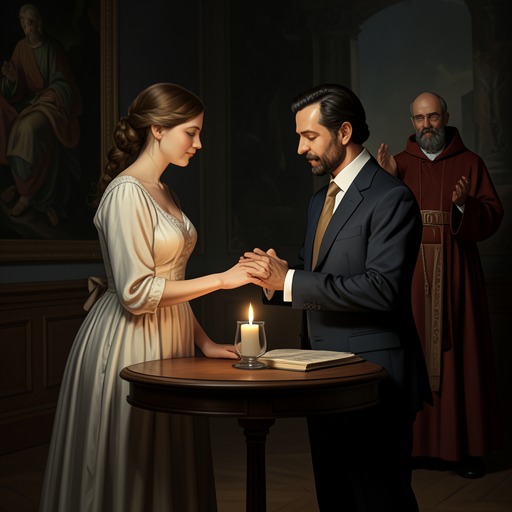
Roxane’s prolonged mourning for Christian
Cyrano de BergeracRoxane’s prolonged mourning for Christian is both a visible condition of widowhood and an enduring attachment that the passage presents as still emotionally present fourteen years after her cousin brought her to the convent. Her mourning persists through the play’s final scene, where an old letter becomes the material sign of a grief she describes as unhealed. At the end, Cyrano asks her to mourn for him in the same black garments she wears for Christian, joining his own approaching death to the loss she has carried for years.
The Fourteen-Year Vigil
Mother Marguerite dates Roxane’s arrival at the convent to fourteen years earlier, when her cousin brought her there. Since then, Roxane has remained in the worldly mourning of a widow’s veil. The contrast between that black veil and the convent’s pale coifs and doves makes her grief conspicuous within a community whose setting suggests withdrawal from ordinary life. Her widowhood is not presented as a brief observance that has run its course: the duration itself is evidence of how firmly Christian’s death continues to shape her life.
The passage also distinguishes the convent’s religious surroundings from Roxane’s personal mourning. She lives among the sisters, but her veil marks a continuing attachment to the man she lost. Its persistence gives her grief a public form, visible over the span of fourteen years, rather than leaving it as an inward state known only to herself.
Grief That Remains Present
When asked whether she still loves Christian, Roxane answers that at times he seems only partly dead and that his love still surrounds her as though it were living. The language does not undo his death; instead, it describes the way love continues to be felt after it. Her mourning holds together two facts that might otherwise seem opposed: Christian is dead, yet the bond remains active in her experience.
Later, as twilight begins to fall, Roxane calls her grief a wound that has never healed. She puts a hand to her breast and locates the wound beneath an old letter. Its paper has browned with age and bears both tear stains and blood. The letter is therefore more than a surviving document in this moment: it is physically associated with the loss she continues to carry. Age has marked it, but the visible traces of grief keep it from seeming like a relic whose emotional force has faded.
The Letter and Its Material Traces
The scene brings together the letter, Roxane’s gesture, and her account of a persistent wound. The letter lies close to her heart, and its stains make accumulated grief visible on the page. Tears register mourning; blood adds another mark of suffering. The passage does not specify here who wrote the letter, so its force in this account rests on its age, its position beneath Roxane’s hand, and its stains rather than on an explanation of its authorship.
That restraint gives the object a particular role. Roxane does not merely speak of the past as something finished: she points to a document that has remained with her and connects it directly to the wound that has not healed. The letter binds memory to the present scene without resolving the loss. Its continued presence makes her mourning legible even as the passage leaves the object’s precise history unstated.
Cyrano’s Request and the Shared Mourning
When Cyrano is near death, Roxane’s sobs bring him back to awareness. He touches her veil and tells her he would not ask her to mourn Christian less faithfully. Instead, he asks that when his own body is in the earth, she wear the same black mourning clothes for two and mourn him while mourning Christian. The request does not displace Christian or demand that Roxane’s earlier grief be diminished; it asks that Cyrano’s loss be added to the observance she has sustained for fourteen years.
Roxane swears that she will do so. Her promise makes the ending a moment of acknowledged connection between the two men in her mourning, but it does not itself establish that she knows who wrote the old letter. The scene’s emphasis remains on the grief she has openly carried and on Cyrano’s request to be included in it. Her widow’s veil, once a sign of her enduring fidelity to Christian, is now asked to bear a second loss, while the letter beneath her hand preserves the unhealed history that made the request possible.