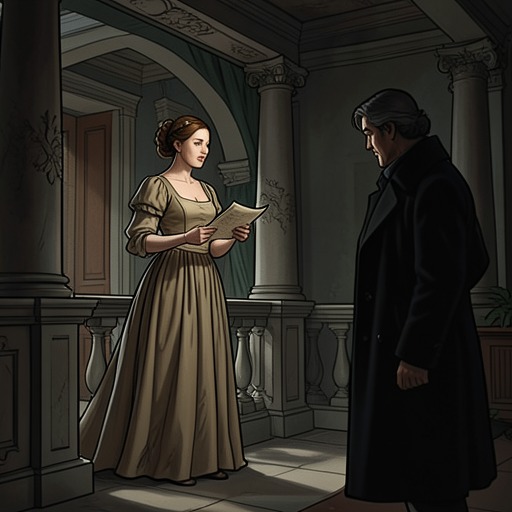
The balcony declaration and kiss
Cyrano de BergeracThe balcony declaration and kiss is a pivotal scene of divided speech and presence: Cyrano speaks beneath Roxane’s balcony in Christian’s place, while Christian ultimately climbs into view and receives Roxane’s kiss. The exchange lets Cyrano voice a love that he has kept concealed, but the physical union belongs to Christian. Its decisive turn is therefore double: Roxane recognizes the declaration as love, yet its eloquence comes from the man who cannot claim its reward.
The Substitution Beneath the Balcony
As the conversation becomes critical, Cyrano draws Christian away from the balcony and slips into his place. The stage direction makes the substitution a physical action, not merely a resemblance in language: Cyrano takes the speaking position, while Christian is moved aside. Cyrano urges him to make way, signaling that the scene has reached a point where Christian’s faltering words cannot carry the exchange forward. The arrangement that follows separates the lovers’ roles between the two men: Cyrano supplies the voice, and Christian remains the visible suitor.
That division is not hidden from the audience. Cyrano’s entry beneath the balcony is staged openly, so the dramatic tension comes from Roxane’s incomplete knowledge rather than a concealment from the viewer. The audience can follow both sides of the act at once: the speech issuing from Cyrano and the encounter that Roxane understands as a response from the man she addresses. The scene thus makes mistaken attribution part of its theatrical design, with position and voice doing different work.
A Voice Released by Dusk
Roxane notices that the voice has changed. Cyrano answers by acknowledging its new tone and connecting it to the tender, sheltering dusk: in that cover, he says, he can be himself at last. The dusk is therefore more than a setting for a private conversation. It provides the condition under which Cyrano can speak openly while remaining in a position that lets Roxane take the words as Christian’s. His candor and his concealment occur together.
The change matters because Cyrano’s speech is not simply a smoother version of Christian’s. In the new voice, the declaration becomes personal. Cyrano describes how, when he leaves Roxane’s radiance, his dazzled vision sees a blonde stain imprinted on everything. The image renders love as an effect that persists beyond the beloved’s immediate presence: her brightness marks the world the speaker sees. Roxane, agitated by the declaration, answers that this is love indeed. Her response confirms the emotional force of the words, even as she attributes them to the wrong man.
From Recognition to the Kiss
Roxane’s recognition is genuine but partial. She identifies the feeling expressed in the speech as love; she does not, in this exchange, identify Cyrano as its speaker. That distinction gives the declaration its particular dramatic force. The words succeed in making love legible to her, while the identity behind those words remains displaced. Cyrano’s admission that he can be himself in the dusk sharpens the irony: the speech is most truthful precisely when its authorship is obscured.
The staging then shifts from voice to movement. In the next scene, Cyrano is with Christian and a Capuchin friar; Cyrano addresses the friar as he pushes him onward. Christian springs forward and uses the bench, branches, and pillars to climb to the balcony, strides over it, and calls to Roxane. He takes her in his arms and bends over her lips. The route upward is concrete and effortful: the bench, branches, and pillars become the means by which Christian reaches the space that Cyrano’s voice has already entered.
The Cost of the Exchange
As Christian bends to kiss Roxane, Cyrano remains close enough to witness the moment. He describes a strange pain wringing his heart and the kiss as a feast that is near. His reaction gives the scene its emotional counterweight: the declaration has allowed him to express himself, but the kiss confirms that the visible romantic reward goes to Christian. The movement from Cyrano’s voice to Christian’s embrace makes the separation between expression and possession impossible to overlook.
The scene does not erase Cyrano’s contribution when the kiss occurs. Instead, it leaves his words active inside an outcome he cannot openly claim. Roxane has heard the declaration as love, Christian has reached her and kissed her, and Cyrano experiences the consequence at close range. Speech has brought the couple together, but the staging preserves the cost to the hidden speaker. The balcony exchange is consequently both a courtship success and a personal wound: its intimacy depends on Cyrano being present in the scene while remaining absent from Roxane’s understanding of who has spoken.