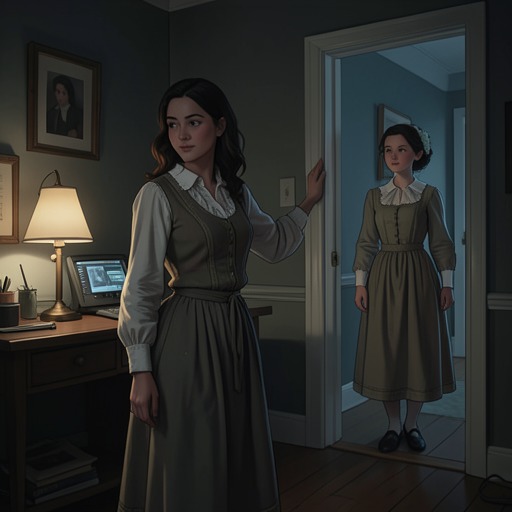
A Hope Like You
Daisy Jones & the SixA Hope Like You is one of Daisy Jones’s most personal songs, and its meaning changes with the people who hear it. Billy Dunne recognizes in it the ache of loving someone unavailable; Daisy later explains that she wrote about wanting a family and fearing she would be unfit for one. That difference is not resolved into a single definitive reading. Instead, the song becomes a meeting place for distinct kinds of longing—and, in Camila Dunne’s response to it, a reason for Daisy to imagine that her future is not already settled.
Writing and Meaning
Daisy wrote A Hope Like You soon after Eddie Loving suggested she would make a good aunt. She took the remark as evidence that people did not imagine her as a mother, a judgment that echoed her own conviction that she had no place thinking of motherhood. The song emerged from the tension between wanting a family and believing herself too much of a mess to deserve one. Its longing therefore reaches beyond romance: the hope in its title sits beside Daisy’s fear that the life she wants is unavailable to her.
Billy initially heard a sad love song about wanting someone who could not be had and continuing to want them anyway. When he asked how she heard the song, Daisy sang him a small part; he immediately understood how it should sound musically. He proposed that the recording belong to Daisy alone, accompanied only by piano. Karen Karen played the keys, making the finished arrangement a spare duet between Daisy’s voice and Karen’s instrument. Karen was proud of the recording, whose small scale gave Daisy’s vocal and the song’s emotional uncertainty the foreground.
The album’s sequencing gives the song a distinct place in a larger arc. It follows the harder, faster Regret Me and the sweeter Midnights, then leads toward the expansive, lush Aurora at the end. In that sequence, A Hope Like You becomes a pause: slow, tender, wistful, and spare before the album rises again. The placement supports its character as a vulnerable inward turn, rather than simply another declaration of conflict or desire.
A Different Arrangement on Saturday Night Live
For the band’s Saturday Night Live appearance, Billy proposed an unexpected live version. He wanted to play piano while Daisy sang, leaving the two of them alone onstage. Warren Rhodes agreed provided the rest of the band was comfortable with the idea. Karen understood the choice as a compelling television moment, though she felt that if someone were accompanying Daisy, it seemed as though that role should have been hers. The performance thus changed the song’s arrangement and its visible relationships: Karen had played on the recording, but Billy took the piano for this televised version.
The band watched from the sidelines as Billy faced Daisy at the piano and she stood opposite him with the microphone. Daisy caught his eye just before she began. With Niccolo Argento no longer distracting her and without keeping herself so drugged that she was mentally absent, she recognized that she loved Billy. She also understood that neither getting high, going to Thailand, nor marrying Niccolo would make that love disappear, just as Billy’s marriage to Camila would not make it disappear. The song did not create the feeling, but its stripped-down staging left Daisy with nowhere to turn her attention from it.
The performance’s intimacy was therefore both an artistic choice and a personal exposure. Billy wanted an unexpected moment worth remembering; Daisy thought the arrangement sounded exciting. Yet the same musical simplicity that made the scene legible on television also sharpened what it meant to stand opposite one another. The live version did not replace the recorded one: Karen’s keys and Daisy’s solo vocal remained the song’s established form, while Billy’s piano made the televised performance a conspicuous duet.
Competing Readings and Camila’s Response
Camila later told Daisy that A Hope Like You was her favorite song—not merely her favorite song by The Six, but her favorite song at all. It recalled her first love, Greg, and the heartbreak of caring more deeply than he did. The song brought her back to that earlier experience with its hurt, hope, and tenderness. Camila heard in Daisy’s writing an ability to make such a feeling immediate again, and connected that gift to Daisy’s struggle with a sense of being lost.
Daisy did not accept Billy’s interpretation as the song’s subject. She clarified to Camila that it was not about Billy, but about wanting a family and children while believing she would be a terrible mother and did not deserve them. This explanation places the song’s yearning in Daisy’s own imagined future rather than in her attraction to a married bandmate. At the same time, the song’s emotional truth made it available to Camila’s memory of Greg and to Billy’s reading of impossible love. The accounts differ in what they identify as the object of desire, while sharing the song’s central tension between wanting and expecting not to receive.
The book presents these meanings through a retrospective oral history assembled from interviews and other materials, and acknowledges that accounts of events can differ. Daisy’s later conversation with the author is explicitly presented as a verbatim transcript because the author is the only person able to corroborate this essential part of Daisy’s story. Daisy also says she understood Camila to regard the story as Daisy’s to tell. This framing makes the distinction between the song’s interpretations part of its significance: its meaning is not supplied by one outside authority but emerges through the memories and testimony of the people it reached.
Hope Beyond the Song
Daisy tells Camila that she had thought people merely liked her rather than cared about her. Camila answers by describing what she recognizes in Daisy: an extraordinary writer whose suffering resembles Billy’s, but whose work can make another person’s past love feel newly present. Daisy explains the song’s personal source, and Camila responds by urging her not to decide too early what she can become. For Daisy, this exchange gives the song a consequence beyond performance or interpretation. Camila’s belief that Daisy is worth saving helps her see that her identity is not entirely fixed by the person she has been.
A Hope Like You consequently holds several forms of longing without making them identical. Billy hears desire for an unavailable person; Camila recognizes the ache of her own first love; Daisy locates the song in her fear that motherhood and family lie beyond her reach. Its spare recorded arrangement, its more exposed piano performance with Billy, and its place between the darker drive of Regret Me and the ending lift of Aurora each give that longing a different context. The hope it offers is not a promise that every desire will be fulfilled. It is the possibility, affirmed by Camila, that Daisy may become more than she currently believes herself to be.