Aurora World Tour
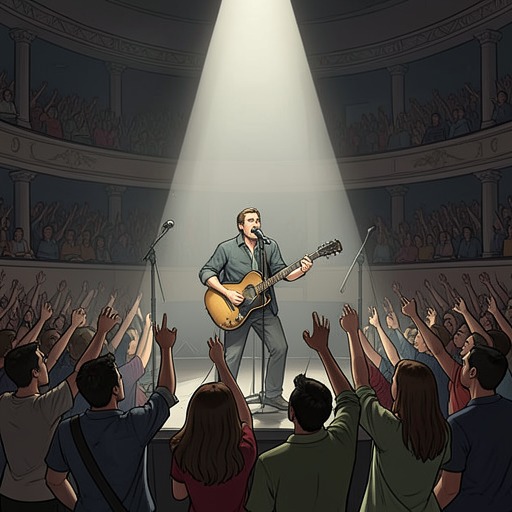
Daisy Jones & the SixThe Aurora World Tour carried Daisy Jones & The Six from a hit-making band into the scale of stadium headliners, while making the unresolved tension between Billy Dunne and Daisy Jones part of the spectacle. Its sold-out crowds and carefully staged performances offered the public a compelling image of the pair together; offstage, separate buses and carefully matched arrangements registered how difficult that closeness had become.
Commercial ascent and expectations
The tour followed a period of rapid success. By the end of 1976, “Honeycomb” had reached number three on the Billboard Hot 100, and the band had appeared with Daisy Jones on Don Kirshner’s Rock Concert and The Tonight Show Starring Johnny Carson. After the North American dates, the group prepared for a short European leg. The larger commercial crest came in the summer of 1978: “Turn It Off” spent four weeks at the top of the charts, while Aurora sold more than 200,000 units each week. Stadium dates sold out, and demand led to additional shows in major cities. The scale of that success changed the terms of the tour: Daisy Jones & The Six was no longer simply taking an album to its audience but sustaining an event that audiences expected to see in person.
The band’s public identity had already been sharpened by Rolling Stone’s cover story, whose headline, “The Six That Should Be Seven,” cast Daisy Jones’s presence as the answer to the group’s apparent incompleteness. The cover photograph showed Billy Dunne and Daisy Jones sharing a microphone, with the rest of the band arranged around them. That image suited a tour whose attraction depended partly on the musical force of the ensemble and partly on the question of what, exactly, was happening between its two most watched singers.
A divided road
The separation was visible before a performance began. The group traveled on two buses, both labeled Daisy Jones & The Six, but with different images behind the lettering: Billy Dunne’s denim shirt on one and Daisy Jones’s tank top on the other. Billy Dunne’s bus generally carried Graham Dunne, Karen Karen, Rod Reyes, and members of the crew. Daisy Jones’s bus carried Niccolo Argento, Eddie Loving, Pete Loving, and Warren Rhodes; Jenny Manes sometimes traveled with Pete Loving. The division was not just logistical. Karen Karen recalled that Billy Dunne and Daisy Jones did not want to have to look at one another.
Success also made the tour costly and unusually exacting. Opal Cunningham, the tour accountant, described an operation in which expenses kept rising and advice on restraint went unheeded. The band’s requests had to be matched so that Billy Dunne and Daisy Jones received identical provisions, down to small items as well as major comforts. The rider consequently grew longer than necessary; even two Ping-Pong tables became an expense that Rod Reyes approved because Runner Records could afford to indulge the act. Such details show the practical machinery of stardom: the public saw a unified name on two buses, while the people managing the tour had to preserve a fragile parity between its central figures.
The crowds made that celebrity impossible to ignore. In San Francisco, Warren Rhodes, Pete Loving, and Eddie Loving could walk from their bus into a hotel without incident. When Billy Dunne emerged, fans began screaming; when Daisy Jones followed, the noise intensified, and Rod Reyes and Niccolo Argento helped move people back so the two singers could enter. Their visibility also carried a different weight for the band. Billy Dunne had completed a sober tour before returning to the road and felt able to go back out; Camila Dunne sent him off with hope rather than certainty. The tour thus placed the stability he had worked to establish beside the pressures of renewed public life.
Performance and interpretation
Onstage, the divide never settled into a simple story of either hostility or intimacy. Rod Reyes remembered that the singers could deliver the songs powerfully together but were difficult to read: they rarely shared a microphone, and their occasional looks could leave an audience unsure what they meant. In Tennessee, during “Regret Me,” Daisy Jones turned toward Billy Dunne at the song’s close and sang directly to him. He held her gaze as he sang back. The moment ended with the song, not an explanation. Karen Karen remembered dirty looks between them, particularly during “Regret Me”; Rod Reyes could see evidence for the interpretation that they hated one another and for the suspicion that the hostility concealed something else.
The songs made that uncertainty part of the performance. Billy Dunne acknowledged that writing with someone, writing about someone, and then singing those songs together made it difficult not to feel drawn to that person. Daisy Jones described “Young Stars” as a song about two people drawn together but compelled to deny it, “Turn It Off” as one about trying to stop loving someone, and “This Could Get Ugly” as one about knowing another person more deeply than their partner did. Niccolo Argento was often jealous of what happened onstage. For Daisy Jones, tending to his comfort became part of the relationship, even as the material she performed with Billy Dunne repeatedly put their emotional connection before the audience.
The television performance of “Turn It Off” on Saturday Night Live made that tension visible to a national audience. Lisa Crowne introduced the band to an excited crowd. Daisy Jones performed barefoot in faded black jeans and a satin pink tank top, with her red hair, bracelets, and tambourine; Billy Dunne stood close to the microphone in denim. Warren Rhodes’s drumming anchored a performance that remained crisp despite the song’s familiarity. As its lyrics became more pointed, Billy Dunne and Daisy Jones moved to the same microphone and sang facing one another. They appeared transfixed by each other, but the performance’s emotional directness did not establish whether it was private feeling, stagecraft, or both. At the end, Billy Dunne took Daisy Jones’s hand and they bowed together.
Another performance reduced the stage picture to the two singers: Billy Dunne at a piano, Daisy Jones standing opposite him with a microphone, while the rest of the band watched from the sidelines. Without Niccolo Argento there to distract her, and no longer keeping herself too drugged to be mentally present, Daisy Jones recognized that she loved Billy Dunne. At a later performance before 20,000 people, she recalled that singing “Honeycomb” with him briefly made the surrounding audience, his family, and their band seem to disappear from her attention. Camila Dunne was standing to the side of the stage. These episodes show how the tour’s performances could intensify private recognition without resolving the choices it entailed.
Success and its cost
The tour’s public triumph existed alongside a private routine that was less celebratory. Warren Rhodes recalled packed houses and audiences singing along, followed by Billy Dunne returning to his hotel room while others stayed out partying. Daisy Jones and Niccolo Argento stayed out later than the rest. Daisy Jones later described the accumulating signs that her drug use had ceased to feel glamorous. The contrast matters: the same schedule that delivered a crowd’s shared excitement also carried the musicians into repeated nights whose consequences did not disappear when the show ended.
The tour therefore made the band’s contradictions larger rather than tidier. Its commercial success gave Daisy Jones & The Six the means to command stadiums, elaborate riders, and intense public attention. Its performances turned musical collaboration into a spectacle whose meaning audiences could debate, while its divided travel arrangements and strained relationships exposed the limits of that image. The singers could face one another beneath the lights, sometimes at the same microphone, without the tour supplying a clear answer about what those gestures meant away from it.