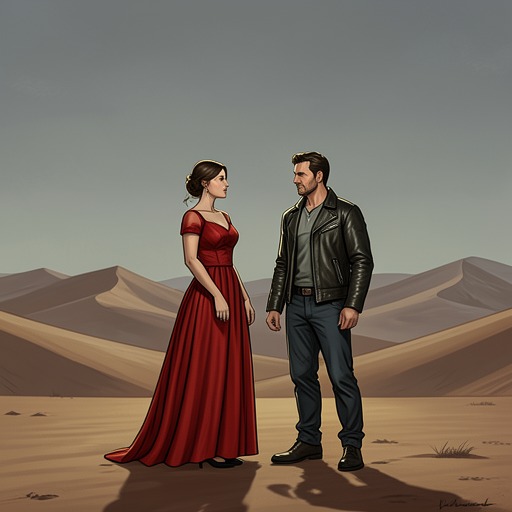
Aurora album cover
Daisy Jones & the SixThe Aurora album cover made the tensions within Daisy Jones & The Six visible without resolving them: its images place Billy Dunne and Daisy Jones in striking proximity while preserving the band as a group. Made during a sunrise photo shoot in the Santa Monica Mountains, it became more than packaging for the album. Its front and back images offered complementary views of the band and its most closely watched creative partnership, and later audiences read Daisy’s presentation as an assertion of control over her own image.
Commission and Setting
As the band prepared to market Aurora, Rod Reyes arranged a shoot with photographer Freddie Mendoza and played him early tracks to convey the album’s direction. Mendoza imagined the desert mountains. The recollections of what the band itself wanted differ: Karen remembered Billy proposing a boat, while Billy recalled suggesting a sunrise. The finished setting brought the sunrise idea into the landscape Mendoza had envisioned.
Mendoza placed the group beside a road, against a guardrail separating the pavement from a steep drop. A large mountain rose behind them, and the shoot took place as the sun came up. The location gave the photographs a distinctly Californian landscape, with the Santa Monica Mountains’ mix of desert ground and scattered trees. The band had already spent an hour or two taking pictures in the hot sun when the shoot continued toward the top of the mountain, a detail that sits alongside the images’ polished, deliberate appearance.
Two Images, One Cover
The cover’s final design used two photographs rather than a single group portrait. On one side, the band stands along the guardrail, with Billy and Daisy looking toward one another. Mendoza had initially found them at opposite ends of the group and tried to rearrange the members. He kept shooting as Daisy leaned toward Billy; for a brief moment Billy turned to look back at her. The other band members faced the camera, making the exchanged look distinct within the larger composition.
The cover’s other image isolates Billy and Daisy from the group, framing their torsos rather than their faces. Billy wore denim, while Daisy’s shirt left more of her upper body visible. Mendoza recalled the contrast of their clothing and the clear blue sky between them, whose straight and curved contours made the composition read as both masculine and feminine. Daisy later confirmed that the object visible in her pocket was cocaine. The image therefore gathered the period’s rock-and-roll associations with summer, sexuality, drugs, and angst into a tightly bounded portrait, without showing the band performing or explaining its relationships.
Image and Interpretation
The two photographs work through contrast. The group image places Billy and Daisy within the band but records a moment of attention passing between them; the closer image removes their faces and makes clothing, bodies, and the pocket object carry the visual emphasis. The cover offers no explanatory caption within the images themselves. Viewers encounter a set of signs whose force depends on what they already know, or imagine, about the musicians.
That openness also helps explain why the image could signify both celebrity intimacy and individual agency. Biographer Elaine Chang emphasized that Daisy’s exposed body was not oriented toward Billy or the viewer as an invitation. She interpreted Daisy’s confident stance as self-possession: the image did not present her as acting to please a man or an audience. For Chang, this quality made the cover important to teenage girls in the late 1970s, and it shaped her own sense of Daisy as fearless. The photograph’s meaning, in this reading, does not depend on concealing Daisy’s sexuality; it depends on presenting her as the person who controls its terms.
Reception and Afterlife
The cover became inseparable from the record’s public identity. Chang recalled that for teenagers in the late seventies it seemed to encompass the period’s California rock image, while Greg McGuinness remembered the record becoming a topic of conversation once Turn It Off was released. Mendoza, who had initially considered the assignment simply a job, later found that people repeatedly asked him about the cover. His account marks the gap between the ordinary circumstances of making it and the iconic status it acquired afterward.
The cover’s durability also rests on its split construction: the back shows a band whose members share the frame, while the front reduces that collective identity to Billy and Daisy’s paired figures. These images do not establish what either musician intended the other to see, and the retrospective accounts preserve differences in memory rather than supplying one authoritative explanation. Their combination nevertheless gives the cover a lasting narrative charge. It records the band as a unit and, at the same time, leaves the viewer looking for meaning in the distance and attention between its two central figures.