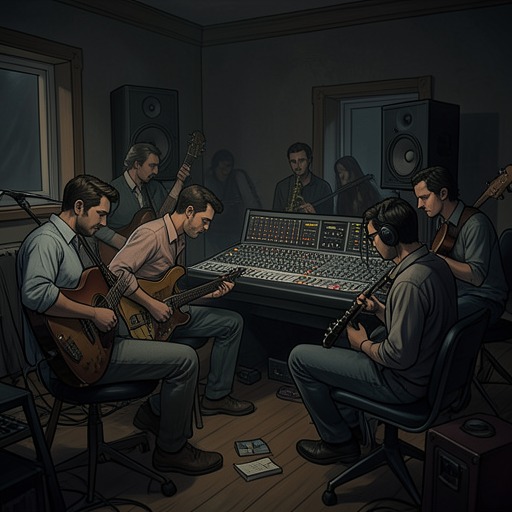
Billy and Daisy's first songwriting collaboration
Daisy Jones & the SixBilly and Daisy's first songwriting collaboration transforms a contest over creative control into a working partnership. At Teddy Price’s pool house, Billy arrives prepared to present songs he has already written; Daisy insists that the album must be written together. Their first breakthrough does not come from smoothing over that conflict, but from making it part of the work: a conversation about Billy’s fear of repeating his absent father’s example gives them a subject, and their contrasting musical ideas give the song its shape.
Choosing how to work together
Billy had a competing claim on his time. He did not want the band composing without him for a song he was developing, but he also did not want Daisy writing songs without him. He chose to go with Daisy and start writing, leaving the band’s work on the arrangement behind. The choice makes their collaboration consequential before either has written a line together: Billy is committing attention to a new partnership even as the band’s existing work continues without him.
He reached Teddy Price’s pool house first, made coffee, and looked through his notes to decide what to show Daisy. When she arrived, his notebook was ready; his opening move was to present the material rather than begin with a greeting. Billy explained that he had already written much of the album and proposed that they review it together, adjust what needed changing, and fill gaps with new material or songs Daisy had already written. His offer contained a practical route to collaboration, but it also placed his existing work at its center.
Daisy resisted that imbalance. She took a bottle of wine from the counter, opened it, settled on the sofa, and told Billy that she had written songs too: they were writing the album together. Billy, seeing her drink before noon and bristling at what he heard as a lecture before she had read his songs, handed over his work and insisted that she read it before telling him to discard it. Daisy answered by putting her own notebook in front of him. She could see he did not want to read it, but knew he had to. Each had arrived with a claim to authorship; exchanging notebooks made the claim reciprocal.
Finding the song’s subject
Their conversation about the pills shifted the work from a negotiation over pages to an exchange about what had shaped them. Billy asked when Daisy would stop taking them; she challenged his fixation on the question. In response, he explained that his father had been a drunk and had been absent from Billy and Graham. Billy had feared becoming that kind of father, yet, after his daughter was born, he had become entangled in the same substances as Daisy, including heroin, and had missed the birth. He credited Camila with helping him change course and described the possibility that he would otherwise have made his worst fears come true.
Daisy recognized a song in the pattern Billy had described: some people, she observed, pursue their nightmares as others pursue their dreams. Billy immediately heard the line as material for a song. The connection is not simply that they share a subject; their conversation brings together his account of inherited fear and her ability to give that fear a concise, singable form. When Daisy said she would not change for anybody, she did not withdraw from the work. After finishing her burger and leaving money behind, she announced that they were going back to Teddy Price’s to write the song about chasing nightmares. Billy took his keys and followed her.
Combining their strengths
On the drive back, Billy sang a melody he had been carrying in his head, tapping the steering wheel and humming at a red light. At the pool house, Daisy took his pages and gave him hers. Billy noticed the darkness in her imagery, including the movement of running into and chasing darkness. Daisy, in turn, saw a useful difference between their drafts: Billy’s verse structures were stronger, while he did not yet have a chorus she liked. She showed him the part she thought worked best and sang it to him against his melody. His expression told her he recognized its promise.
The song took hours of discussion and repeated work with melodies on the guitar. Daisy later recalled that none of their original lines made it into the finished version, so their first contribution was not a set of words preserved intact. It was the process of testing, revising, and combining ideas until the initial material could become something else. Billy brought a melody and a stronger sense of verse structure; Daisy brought imagery and the chorus she believed the song needed. Their authorship emerged through exchange rather than through either writer simply accepting the other’s draft.
Recognition of a partnership
Billy continued to qualify what they had made, saying it was not final and that they had only just come up with it. Daisy stopped him: it was a good song, she said, and needed no disclaimers. The disagreement over how to regard the result echoed their opening dispute in a changed form. At first, each guarded the authority of a separate notebook; now Daisy was defending a piece of work they had made together from Billy’s impulse to discount it.
They played the song for Teddy Price. Afterward, he asked whether this was what they came up with when they were on the same team. Billy and Daisy looked at each other before answering. Teddy then joked that he was a genius and laughed, proud of himself. His response gives the collaboration an outside witness: the pair’s difficult start has produced something that sounds to him like evidence of their combined ability. The scene’s decisive change is not that their differences disappear, but that those differences become useful. A choice to work together, a dispute over whose songs should lead, and a conversation neither could have supplied alone converge in their first shared song.