Daisy Jones & The Six’s creative-democracy agreement
Daisy Jones & the SixDaisy Jones & The Six’s creative-democracy agreement is the working understanding that Daisy Jones would join The Six as a full member, share in shaping its music, and have a say equal to Billy Dunne’s. It changes the band from a group accustomed to Billy’s authority into one in which creative decisions can be contested and put to a vote. Its clearest test comes when the band votes to record Daisy’s Regret Me over Billy’s opposition: the agreement gives her a route to be heard, but does not make artistic disagreement disappear.
Background and Terms
Before joining The Six, Daisy had already made clear that she wanted to write and perform her own material rather than act as a singer for hire. She signed with Runner Records without reading the contract, absorbed in songwriting and getting high rather than in the obligations attached to the deal. By 1974, she had refused to attend recording sessions at the Record Plant in West Hollywood and was in breach of contract. Her debut album, First, appeared at the beginning of 1975, marketed as the work of a Dusty Springfield wannabe; its presentation and commercial framing sat uneasily beside the grit and edge later discernible in the music. That background makes the conditions she sets with The Six significant: she is not simply asking to sing on another project, but to have a hand in what the project is.
When Daisy is welcomed into the group during work on an album, she makes her terms explicit. She wants to be a member of the team, to have the album treated as hers as much as it is Graham Dunne’s, Warren Rhodes’s, Pete Loving’s, Eddie Loving’s, Karen Karen’s, or Billy’s, and to write it with Billy. She explains that she believes the group makes better music together than apart and wants a say in what it releases. The demand joins authorship to membership: being present as a vocalist is not enough if she has no influence over the songs or the album’s direction.
Daisy also distinguishes permanent membership from a temporary feature role. If the band commits to her as a member, she says, her name need not be specially featured; if her participation is temporary, billing must be discussed differently. The distinction gives the negotiation a practical hinge. She is not demanding top billing under every possible arrangement. She is asking the band to decide what her place is, and to make its public presentation match that decision.
Negotiating Membership and Billing
The band has not settled what Daisy’s arrival means. Karen Karen recalls that it was unclear whether Daisy was a permanent member, and that Daisy and even Billy seemed unsure. Billy proposes The Six featuring Daisy Jones, a formulation that keeps the established band name intact while marking Daisy as an addition. Daisy’s terms, however, require the group to choose between treating her as a member and treating her as a temporary contributor.
Teddy Price intervenes when the discussion becomes tense and proposes the name Daisy Jones & The Six. The compromise places Daisy prominently alongside the group without renaming The Six out of existence. No one is fully satisfied, but the solution reflects competing claims: Daisy’s visibility and leverage, the band’s existing identity, and Billy’s reluctance to promise her a place on equal terms. Daisy understands the prominence as recognition that her name draws attention; Billy understands Teddy’s move as an attempt to protect The Six from having to make the promise Daisy seeks.
The naming decision accompanies a deeper shift in authority. Daisy reads Billy’s resistance not as proof that her requests are unreasonable, but as discomfort with her knowing and using her influence. She identifies herself as the first person to tell him that his authority over her cannot exceed her authority over him. In her account, that challenge opens the way for Pete and Eddie, and then the others, to question a leadership pattern under which Billy had been allowed to do what he wanted. The agreement therefore reaches beyond Daisy’s own place: it makes the distribution of power within the group newly discussable.
From Autocracy to Collective Decisions
Graham describes the resulting change as a move from autocracy to democracy, while cautioning that bands are not countries. The distinction matters. Daisy has obtained an equal say, but the group has no guarantee that equal participation will produce consensus or that collective procedure will make working together easy. Billy says he gave Daisy equal say and billing to keep her and the others happy, while admitting uncertainty about whether it was the right decision. He also underestimates her, expecting that she will tire of trying to write an album. The agreement is thus both a structural change and a test of whether Billy can accept its consequences.
The deadline imposed by the record company gives the debate material urgency. Teddy tells the band that Runner Records wants the album toward the top of 1978; it is already August, and the group must return to work despite its creative differences and clashes of ego. The arrangement does not remove the commercial timetable or the pressures of making a record within it. Instead, the members have to negotiate authority while continuing the album under that deadline.
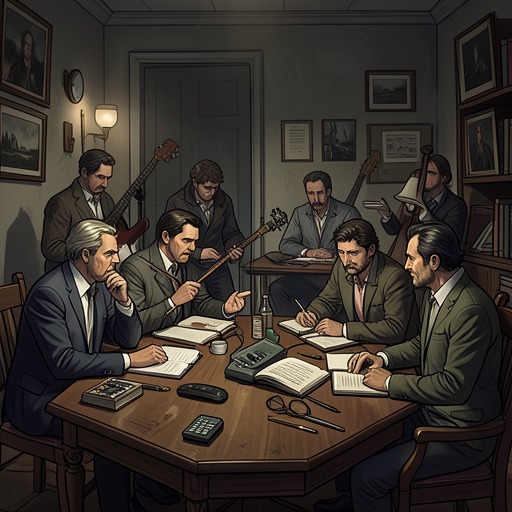
The principle becomes concrete when Daisy proposes that the band vote on whether one of her songs should be recorded. She sings it alone, without accompaniment, and then asks for a decision. Karen’s hand goes up immediately; Eddie and Pete also support the song, and Graham eventually joins them. Billy remains opposed. Daisy counts the result as six to one, and Billy acknowledges the outcome by nodding before walking away. The band records the song without him. This is the agreement at work in a consequential form: Daisy can bring a disputed song before the group, and Billy’s preference no longer settles the question by itself.
Consequences and Limits
The vote demonstrates that collective authority is not merely a courtesy extended to Daisy during her arrival. It can overrule Billy on a specific musical decision and produce a recording he does not support. At the same time, the scene does not present agreement as harmony. Billy leaves, and the band proceeds without him; the procedure determines what happens to the song, not whether every member accepts the result emotionally. Equal participation changes who can decide, while leaving the costs of disagreement in view.
The agreement also does not mean that every dispute is settled by a clearly defined, consistently applied voting system. The evidence shows Daisy’s insistence on equal creative authority, the band’s changed internal balance, and a decisive vote over Regret Me. It does not establish a complete constitution for the group. Its force lies instead in a change of expectation: Billy can no longer assume that his judgment alone governs the music, and Daisy need not accept a subordinate role in exchange for access to the band.
The album’s later commercial success makes the tension sharper rather than canceling it. In the summer of 1978, Aurora sells more than 200,000 units a week, while “Turn It Off” spends four weeks at the top of the charts and the tour sells out stadiums. Yet the touring band travels in two buses, both bearing the Daisy Jones & The Six name but displaying different images—Billy’s denim shirt on one, Daisy’s tank top on the other. The separation is attributed in part to the two stars not wanting to look at each other. The band’s shared name and democratic ambition coexist with visible division. The agreement matters because it gives Daisy standing and gives the group a way to act without Billy’s unilateral consent; it cannot, by itself, make that shared enterprise emotionally unified.