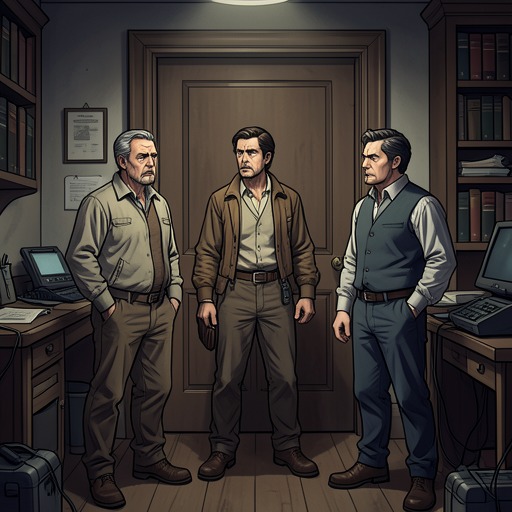
Daisy Jones and Rod Reyes
Daisy Jones & the SixDaisy Jones and Rod Reyes’s relationship is built around a shift in who manages Daisy’s career: as she breaks with Hank Allen, Rod offers a more protective and ambitious form of support. He helps bring her into opportunities associated with The Six, yet his concern does not give him an answer to how far a manager should intervene in her drug use. Their connection is therefore both practical and uneasy: Rod can help shape the conditions around Daisy’s career, but he cannot simply control what happens to her.
A Change in Management
Rod sees Hank as a manager taking advantage of Daisy and tells her that he is available if she needs help. Graham Dunne likewise urges Daisy to leave Hank and work with Rod, contrasting Rod’s attention to the band’s needs and ambitions with Hank’s intimacy with the musicians and the drugs that left them disoriented. The distinction is not just about professional competence: Rod presents himself as someone who wants the musicians to aim higher, rather than accept whatever they have been given.
Daisy’s decision becomes explicit in her hotel room. When Hank puts his arms around her, she is finished with the relationship and tells him that it is time for them to part ways. He repeatedly dismisses her decision, insisting that she does not know what she is saying; she makes it unmistakable by firing him and telling him to leave. Hank responds with anger and a degrading claim about her past. The scene makes the break a consequential act of self-determination, not a quiet handover arranged by one manager to another.
Advocacy in the Glasgow Crisis
Rod’s support is visible in the opportunities he tries to secure for Daisy. He arranges for Rolling Stone to send Jonah Berg to see the band perform in Glasgow and spend time with them afterward. The visit could lead to a cover story. Rod could have pitched the article as a feature on the band alone, but instead makes a point of including Daisy, extending the potential benefit to her as well as to The Six.
The day of Berg’s visit is also the day Daisy fires Hank, and the situation quickly becomes difficult. Daisy recalls that the band walked out, leaving her unsure what to do. Billy Dunne finds Rod already managing the damage and asks whether it would really be so bad if Daisy missed a night. As he asks, Billy realizes that Rod is probably Daisy’s manager now; from Rod’s position, her absence would matter. The incident shows how immediately Rod’s role changes from offering help to dealing with the professional consequences of a fractured night, with an important journalist in the audience.
Opportunity and the Limits of Care
Rod’s advocacy later brings Daisy news that The Six wants her to make a full album with them. He makes the offer by phone while Daisy is partying: she has champagne in hand, guests in the room, and cocaine being used nearby. She is ecstatic at the news and tells the people around her that she is joining The Six. The call makes the professional transition concrete, even as its setting shows that career opportunity and drug use are not separate parts of Daisy’s life.
Rod hears Daisy take a bump during the call. He admits that he has never settled the question of whether he should monitor his musicians’ drug use, whether their use is his business, or how much would be too much if intervention were his responsibility. His uncertainty does not erase his concern; it reveals the limit of the kind of help he can offer. Rod can advocate, make introductions, and support a career move, but he has no clear rule for converting that access into authority over Daisy’s choices.
From Career Support to Public Image
As The Six prepares to market the album, Rod arranges a session with his photographer friend Freddie Mendoza. He plays Mendoza early tracks to establish the direction of the music, and Mendoza imagines the images in desert mountains. At the shoot, Mendoza captures Daisy looking toward Billy as the rest of the band faces the camera, then catches Billy turning to meet her gaze. Rod’s arrangement places Daisy within the band’s visual campaign; the photograph’s charged moment, however, arises from what Mendoza observes between the two musicians.
Mendoza later describes a different striking image, framed around Billy and Daisy’s torsos, that conveys sexuality, drugs, summer, and rock ’n’ roll. Retrospective commentary gives Daisy’s presence in the cover imagery a significance beyond its commercial function: Elaine Chang recalls its impact on young listeners, especially girls, and reads Daisy’s exposed chest and confident stance as signs of self-possession rather than an attempt to please a man or viewer. Rod’s role belongs to the practical story of how the campaign was assembled, not to the claim that he authored that meaning. The distinction matters: his support helps make Daisy visible, while the image’s force rests in how she appears to possess her own image.
The Shape of Their Relationship
Rod’s support repeatedly takes the form of opening doors and making sure Daisy is included: he offers to help when he sees Hank’s treatment as exploitative, backs the move away from Hank, shares a high-profile press opportunity, and communicates the offer to record with The Six. These are concrete acts of professional advocacy, not evidence that he can resolve Daisy’s drug use or protect her from every consequence of the music business.
The relationship consequently resists a simple rescuer-and-dependent pattern. Rod recognizes a problem and tries to offer a better working arrangement, but his own account of the phone call preserves his uncertainty rather than presenting him as someone with a solution. Daisy’s career advances through opportunities he helps create, while her choices and the meaning of her public image remain her own. That balance is the defining feature of their connection: Rod can make room for Daisy, but he cannot take possession of her agency in the name of helping her.