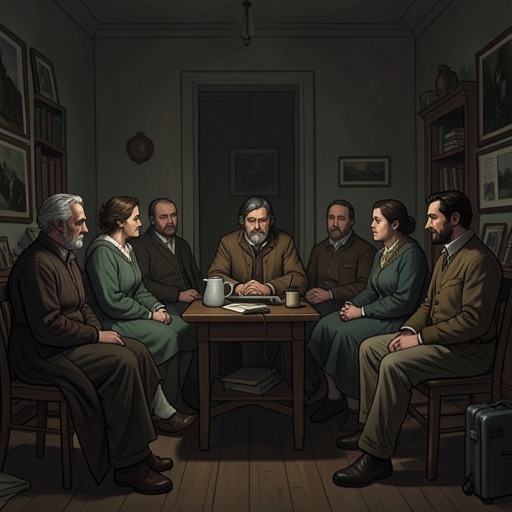
Daisy and Billy's first co-writing session
Daisy Jones & the SixDaisy Jones and Billy Dunne's first co-writing session transforms a dispute over creative control into a practical partnership. Daisy returns rather than surrendering her chance to write the album, and she and Billy agree to begin again; a melody Billy hums on the drive back to Teddy Price's pool house gives them a way into the work. Their exchange of pages reveals complementary strengths, while the session's eventual song—built through hours of revision—makes collaboration, rather than either writer's original draft, the decisive creative act.
From confrontation to agreement
Before the songwriting begins, Daisy is ready to leave Billy. On her way to her car, she realizes that if she goes, Billy will write the album himself. She turns back, enters the pool house, and makes clear that she will not give up her opportunity to write a great album because of him. Her proposal is to discard their existing material and start from nothing: each distrusts the other's songs, so neither should dictate the result.
Billy draws a boundary of his own. He will not give up the song “Aurora,” which he insists belongs on the album. Daisy accepts that condition but points to one of his other songs and refuses to include it. The exchange is not an uncomplicated reconciliation: each retains a claim, and their willingness to work together begins with disagreement still visible. Yet the bargain changes the immediate question from whose songs will prevail to what they might make together.
Billy later identifies this confrontation as the first time he understood how completely Daisy cared about the work. He recognizes that she is prepared to put her whole soul into it even when he has made the process difficult. He also remembers Teddy Price's prediction that Daisy could help the band sell out stadiums. Billy offers his hand, and they seal the agreement with a handshake. The gesture makes their decision concrete, but its basis is both artistic and strategic: Billy sees Daisy's commitment and her potential value to the band's future.
A melody on the drive
After the agreement, the work takes shape in transit. On the way back to Teddy Price's, Billy sings Daisy a melody he has been carrying in his head. At a red light, he taps the steering wheel and hums along; he describes the rhythmic idea as a Bo Diddley beat and asks whether she can work with it. The scene gives the collaboration a different starting point from the confrontation: instead of arguing over completed songs, the two begin with a musical possibility not yet fixed into a finished composition.
They exchange pages. Billy recalls that Daisy's writing was filled with images of darkness, of running into it and chasing it. Daisy, in turn, judges their material by function rather than authorship: Billy's verses have the stronger structure, but he does not yet have a chorus she finds enjoyable. She sings him the section she likes best, fitting it to the melody he has offered. She can see from his expression that he recognizes its potential. The first decisive connection between their contributions is thus specific: his melody and verse-writing strengths meet her preferred chorus.
Revision as collaboration
Neither writer treats the first promising combination as a finished product. Billy remembers going back and forth with Daisy for hours, talking through the song and trying out melodies on the guitar. Daisy later says that she does not think any of their original lines survived into the final version. That recollection sharpens the meaning of their agreement to start from nothing: the collaboration does not simply divide the song into pieces authored separately by each of them. The initial pages and lines are material to test, exchange, and change.
The session also alters how they respond to their own work. When Billy starts qualifying the result as unfinished and newly made, Daisy tells him to stop disclaiming it and accept that it is a good song. Her intervention is small but consequential within the process: rather than letting the song's provisional state diminish it, she insists that they recognize what they have achieved. The measure of success is no longer whether either writer can defend an original draft. It is whether their combined work holds together.
What the session establishes
When Daisy and Billy play the song for Teddy Price, he asks whether this is what they produce when they are on the same team. Billy and Daisy answer uncertainly, but Teddy's response is delighted: he calls himself a genius and laughs proudly. His reaction supplies an outside assessment of the creative change the session has made visible. A pair who had approached one another's material as rivals have produced something that Teddy hears as evidence of a functioning team.
The session does not erase their differences or prove that working together will always be easy. Billy remembers that it was not easy even to contemplate writing together after what they had said to each other. Its significance lies instead in the change from antagonism to a workable method: they negotiate what each will keep, begin with a melody, recognize distinct strengths, revise without protecting every original line, and let another listener respond to the result. Their first co-writing experience establishes the creative partnership as an exchange rather than a surrender of individual judgment.