Daisy marries Niccolo Argento
Daisy Jones & the SixDaisy marries Niccolo Argento after a sudden decision to travel from Thailand to Italy turns, in Florence, into a proposal and a wedding in Rome. The marriage initially promises Daisy the belonging and partnership she wants, but the distance between that promise and her later experience becomes central to how she understands the choice: she regrets the marriage, while continuing to cherish the dress she wore. Told retrospectively through Daisy’s account, the episode binds a romantic leap, a deliberately false claim to a priest, and an early glimpse of a relationship whose instability she initially misreads.
From Patong to Florence
The sequence begins at a disco in Patong, where Niccolo proposes that they leave for Italy so he can show Daisy his country. At some point, Daisy arranges two tickets to Florence; she recalls that they simply appeared at her door one morning. The practical gap between the suggestion and the booked trip is left indistinct, giving the departure the abrupt, impulsive quality of a decision made before its consequences have been fully considered.
That haste has an immediate consequence for Simone. Daisy is already halfway to Italy before she remembers that her friend is on her way to meet her. Simone eventually tracks her down by pretending to be Daisy while speaking to Daisy’s credit-card company. This parallel journey makes the marriage more than a private romantic episode: while Daisy moves toward Niccolo and a new life abroad, the friend who knows her best is left to find her after the plans have changed without warning.
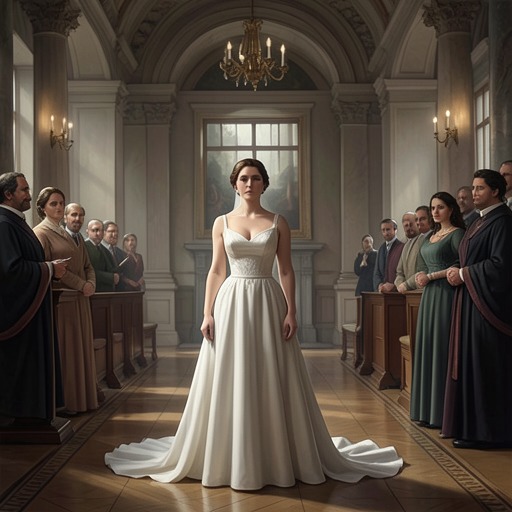
In the Boboli Gardens in Florence, Niccolo asks Daisy to marry him. The proposal leads quickly to another journey: they fly to Rome and marry there, with a family friend of Niccolo’s, a priest, performing the ceremony. Daisy says that she claimed to be Catholic, although she was lying. That detail places a small act of self-invention inside the wedding itself. The ceremony has religious form, but Daisy’s account emphasizes her false declaration rather than describing a shared religious commitment.
The Dress and the Promise
Daisy’s memory of the wedding divides its meaning into two parts. She regrets marrying Niccolo, but explicitly does not regret the dress. She recalls it as ivory, off-the-shoulder cotton lace, with huge bell sleeves. Her attachment to this specific object survives her rejection of the marriage, keeping the beauty of the occasion distinct from the consequences of the choice. The remembered dress is not evidence that the relationship succeeded; it is the part of the event she can still affirm without qualification.
The marriage also carries the appeal of a larger identity. Daisy observes that, technically, marrying Niccolo made her a princess, and acknowledges that she liked the idea of belonging to a huge royal family. But she immediately distinguishes that idea from the life she actually had with him. The imagined family offers an expansive promise of inclusion; the reality does not match the picture Niccolo’s proposal had encouraged her to expect. Daisy’s later warning about handsome men who tell people what they want to hear grows out of this contrast, not out of the wedding’s ceremony alone.
When Simone finally finds Daisy in Rome, the scale of the setting cannot disguise Daisy’s condition. Daisy is in a large hotel room overlooking Vatican City, heavily intoxicated and wearing only underwear; she has also cut her hair into a shaggy bob. Simone notices a large diamond ring, and Daisy introduces the shirtless Niccolo as her husband. These details reveal how quickly the wedding has become an established fact while Daisy’s circumstances remain precarious. Simone is surprised less by the ring itself than by how little Daisy seems surprised to see her after the journey Simone has made to find her.
Marriage in Practice
Later, Niccolo flies in from Rome and moves into Daisy’s place at the Chateau Marmont as she goes into rehearsals. Daisy even invites him to dinner with her parents at Chez Jay, although she says she almost never has dinner with them. Niccolo performs politeness in front of them, addressing them formally and sweetly enough to impress them. Afterward, once they are in Daisy’s car, he asks how she can stand her parents. Daisy recalls responding with a very wide smile. The contrast between his public manner and private remark supplies a concrete example of why the appearance of a charming, attentive husband does not settle what the marriage is like.
Daisy says that she liked being married: she liked the idea of being a team, tied to one person, and having someone who asked every day how her day had been. Simone recognizes the need beneath that hope. She describes Daisy as her best friend and understands that Daisy wanted someone to share her life, care for her, and notice when she was late. Simone wanted that for Daisy too, but concludes that Daisy chose the wrong person for the wrong reasons. Her account separates Daisy’s desire for stability and attention from Niccolo’s capacity to provide them.
The warning signs become harder to mistake. Daisy says Niccolo was more deeply involved with drugs than she was; she was the one telling him to slow down and turning down heroin. She also noticed how much they were charging to her credit cards. Niccolo was threatened by Billy and jealous of people Daisy had dated, had feelings for, or whom he thought she might sleep with. At the time, Daisy treated these behaviors as ordinary newlywed problems. Her retrospective account instead shows how her expectation of what marriage should feel like helped her explain away its strain.
Retrospective Meaning
Daisy’s later distinction between love as war and love as peace clarifies what she had been seeking and what she could not yet recognize. She thought love meant bombs, tears, blood, heartbreak, and a racing heart; she had not understood that love could make a person lighter, or that care need not feel like a fight. Even with that later understanding, she doubts she would then have welcomed or valued a quieter kind of love. She wanted drugs, sex, and angst, and imagined that peaceful love belonged to people unlike her—especially women like Camila.
The marriage therefore marks a mismatch between Daisy’s stated wish to belong and the kind of intensity she then pursued. Her hope for a team and for daily attention was real, as was her attraction to the grand idea of a royal family; neither made the relationship the stable refuge she imagined. The wedding’s lasting significance lies in that split between promise and lived experience. Daisy’s memory preserves the bell-sleeved dress, the ring, and the title of princess, but sets each beside her later recognition that the marriage was a wrong turn.