Daisy writes the chorus of Tiny Love
Daisy Jones & the SixDaisy writes the chorus of “Tiny Love” after recognizing that Wyatt Stone’s song about her describes her without understanding her. The exchange produces a chorus that becomes the Breeze’s biggest hit, but Wyatt takes credit for the whole song. For Daisy, the episode is both an early act of songwriting and an instance of a larger pattern: men turn what she offers into their own work, while she is expected to remain its inspiration rather than its author.
The Song and the Misunderstanding
At the time, Daisy was seeing several men, including Wyatt, the lead singer of the Breeze. She did not feel for him what he felt for her. One night, the two were smoking a joint on the roof of an apartment on Santa Monica when Wyatt told her that he loved her and could not understand why she did not love him. Daisy answered that she loved him as much as she was willing to love anybody. She explains that she was unwilling to make herself vulnerable to anyone then, having experienced too much vulnerability too young.
After Wyatt went to bed, Daisy could not sleep. She noticed a piece of paper bearing a song he was writing, plainly about her. Its details—a redhead and the hoop earrings she wore constantly—identified her, while its chorus described her as having a big heart but no love in it. Daisy kept looking at the words and concluded that Wyatt did not understand her. The song was recognizably about her, but recognition was not the same as insight: his account turned her guardedness into a simple lack of love.
Writing the Chorus
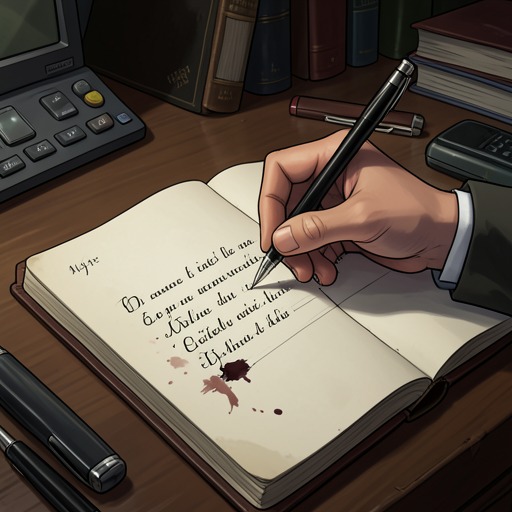
Daisy responded by taking out a pen and paper and writing her own version of the chorus. When Wyatt woke, she offered him the lines, “Big eyes, big soul/big heart, no control/but all she got to give is tiny love.” The revision keeps the image of a big heart but changes what it means: Daisy is not presented as having nothing to give, but as having only a limited amount she is prepared to offer. The lyric makes her guardedness part of the portrait without pretending that Wyatt’s original judgment had captured her.
Wyatt immediately reached for pen and paper and asked her to repeat the words. Daisy told him that it was only an example and that he should write his own song. That answer complicates the scene: she gives him a chorus precise enough to seize his attention, then refuses to treat that contribution as permission to claim her work or make her responsible for finishing his song. The moment does not show her pursuing credit for this particular lyric; it does show her recognizing, and pushing against, the assumption that her ideas are simply available for a man to use.
Credit and Consequence
Simone Jackson later identifies “Tiny Love” as the Breeze’s biggest hit and says Wyatt pretended to have written the entire song. The outcome makes the exchange more than an intimate disagreement about how Wyatt sees Daisy. Her words become part of a successful recording, while the public authorship Simone describes erases Daisy’s contribution. The remembered scene gives that erasure a concrete beginning: Wyatt’s song was already on the page, but Daisy supplied the chorus that redirected its central image.
Daisy recalls the incident as part of a pattern rather than as an isolated case of misattributed songwriting. At breakfast at Barney’s Beanery, she once explained her “Up and Down”—champagne and coffee ordered together because the champagne made her sleepy while pills left her too wired for coffee alone. A writer-director found the phrase funny, wrote it on a napkin, and later used it in a film. Daisy’s account connects that appropriation of an expression to the appropriation of her lyric: in each instance, a man takes something she has made or named and carries it into his own work.
From Muse to Author
Daisy states that she was supposed to be the inspiration for some man’s great idea, then rejects that role and says that this was why she began writing her own material. The chorus therefore matters beyond the single hit: it shows her talent operating before she has fully claimed authorship, and it helps explain why she refuses to be treated as merely a muse. Simone remembers herself as the one encouraging Daisy to make something of her talent, while others tried to make something for themselves out of what Daisy had. Daisy’s contribution to Wyatt’s song makes that distinction audible: she can supply the language, but she does not have to surrender the right to create on her own terms.