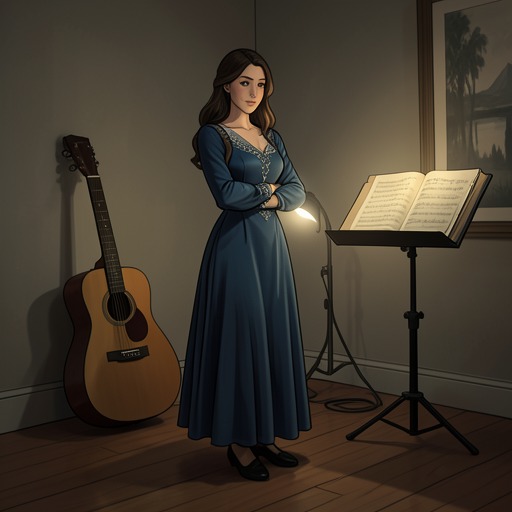
Daisy's first major stage appearance at Ash Grove
Daisy Jones & the SixDaisy’s first major stage appearance at the Ash Grove was a turning point between writing songs privately and discovering what her voice could do in front of an audience. Invited onstage during a Mi Vida show in the summer of 1972, she began uncertainly and ended with the crowd’s attention on her. The performance also exposed a tension that would follow her career: her talent was unmistakable, but the advice she received about becoming a singer tied that talent to the way people looked at her.
Background and Invitation
Daisy was already trying to establish herself beyond the Sunset Strip by writing her own material. With no musical training, she had been building a songbook from pen-and-paper sketches; it would eventually contain rough drafts of more than a hundred songs. She was dating Jim Blades, Mi Vida’s front man, and attended the band’s Ash Grove performance with Simone Jackson. Near the end of the set, Jim invited her up to sing a cover of “Son of a Preacher Man.”
The invitation did not produce an immediate yes. Simone recalled that she and Daisy were sitting at the back and that Daisy kept refusing as Jim returned to the idea through much of the evening. Her eventual decision mattered in part because it broke a pattern: Jim said he had often tried to persuade her to sing with him, and she had always declined before that night. The stage was not simply offered to a novice; it was a step Daisy had repeatedly held off taking.
A Tentative Start, Then Command
Daisy later described the experience as surreal: the audience was looking at her and waiting for something to happen. Simone remembered that Daisy began timidly, a response that surprised her, but gathered confidence as the song went on. Around the second chorus, Daisy opened up, smiling as she sang. The crowd’s attention shifted toward her, and near the end Jim stopped singing and let her carry the performance. Simone remembered the response as a triumph: Daisy brought the house down.
Jim’s account helps explain why the change in the room was not merely a matter of novelty. He heard a gritty voice that was neither scratchy nor predictable, with a roughness that made what she sang feel complex. He also described her as singing from deep in her belly naturally, whether she was performing or singing during ordinary activities. In his view, Daisy possessed the combination of voice and presence that made her distinctive. The evidence of the evening was therefore both immediate and practical: an audience watched her, but it also heard a singer whose sound could hold attention.
The Advice and Its Cost
Jim connected the invitation to Daisy’s ambition as a songwriter. He believed that her songs’ strongest asset might be that she herself could sing them, and urged her to use the fact that people could not take their eyes off her. Daisy heard a different emphasis. She felt he was suggesting that listeners did not care what she sang about so long as they could look at her, and his assessment made her angry. The disagreement reveals an early conflict between using public attention as a route to a musical career and resisting the reduction of her work to her appearance.
The exchange did not end with a simple rejection of his advice. Jim remembered Daisy throwing her lipstick at him, then, after she had calmed down, asking where she should try to play gigs. Her response preserves both sides of the encounter: she objected to the terms on which he framed her appeal, but continued to pursue the opportunity to perform. The appearance established neither an easy mentor relationship nor a settled view of the music business. It did leave Daisy asking how to take the next step.
A Pattern Repeated on Larger Stages
Later performances echoed the Ash Grove’s movement from hesitation into musical command, while changing the scale and the people sharing the stage. When Daisy joined Billy Dunne for “Honeycomb” at the Whisky, Billy said she forced his hand simply by being there; Karen Karen recalled the intensity of the two singers watching one another at the same microphone. Their harmonies at the end emerged spontaneously, and the crowd screamed. That moment developed a feature already visible at the Ash Grove: a performance could exceed its planned arrangement as the singers responded to one another and to the audience.
The pattern reappeared in a very different public setting on Saturday Night Live. By then, Daisy Jones & The Six were performing “Turn It Off,” a song familiar across the country. Daisy danced, sang, and played tambourine while Billy watched her; as the song became more pointed, the pair moved to the same microphone and faced one another. The television performance was carefully staged and nationally visible, unlike the spontaneous invitation at the Ash Grove, but both scenes show how Daisy’s presence could become the center of a performance without being separable from the music itself.
Image, Agency, and Significance
The Ash Grove episode also foreshadows the complicated public image later attached to Daisy. During the making of the Aurora cover, photographer Freddie Mendoza captured her looking toward Billy; in another image, her body and clothing became part of a striking composition. Biographer Elaine Chang later read the cover as an image of Daisy’s self-possession rather than an attempt to please a man or a viewer. That later interpretation resonates with the early dispute with Jim: being seen could help Daisy reach an audience, but it did not mean that she accepted other people’s claim to define what her visibility meant.
The performance’s importance lies less in treating one successful night as the sole cause of Daisy’s later career than in seeing what it made newly possible. She entered the Ash Grove as a songwriter who had not yet agreed to sing publicly with Jim; she left the episode having experienced an audience respond to her voice and having asked where she could perform next. In the years that followed, she would command stages, share microphones with Billy, and become a public figure whose image carried meanings beyond any single song. At the Ash Grove, the first change was simpler and more decisive: Daisy stopped refusing the stage and found that she could make it answer.