Eddie Loving
Daisy Jones & the SixEddie Loving is the rhythm guitarist who enters The Six as a temporary replacement and becomes one of the clearest witnesses to the band’s struggle over who gets to shape its music. His story is not simply about a guitarist disputing a part: it follows the accumulating cost of being asked to contribute while another person retains control over what that contribution may be.
Identity and Entry into The Six
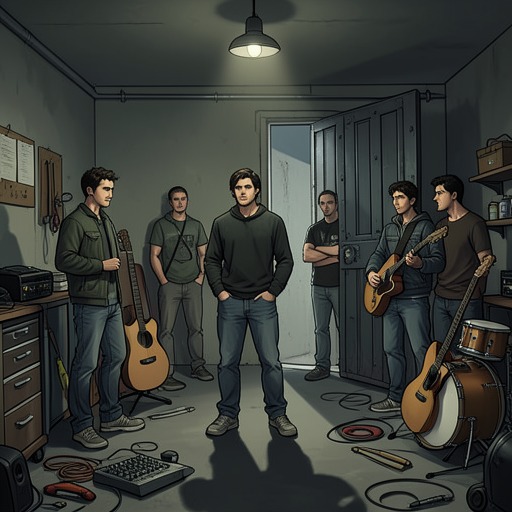
After Chuck Williams was drafted, Billy Dunne covered Chuck’s parts for a time. As the band began getting more shows, Billy no longer wanted to play rhythm guitar onstage, and The Six invited Eddie to audition. Eddie was Pete Loving’s younger brother and already considered capable on guitar. Billy described the invitation as a way for Eddie to pitch in temporarily, not as an announced change in the band’s hierarchy or creative arrangements.
Eddie says he got along well with the other members, but soon sensed that Billy and Graham Dunne wanted him to fit a mold they had already made for him: play what he was told and do what was assigned. That early impression establishes the tension that follows him into recording and performance. He has a place in the group, but membership does not automatically give him authority over his own parts.
A Band Built Around Billy’s Decisions
The imbalance was particularly plain during the making of the earlier album. Eddie recalls that Billy took substantial control and that Teddy Price allowed him to do so. Billy wrote songs and nearly everyone else’s parts, arriving with ideas for the guitars, keys, and drums. Pete had somewhat more freedom over his bass lines; Eddie says the rest of the band generally went along with Billy’s direction. When Eddie pushed back, Teddy backed Billy. Eddie’s sense that he alone was objecting thus arose within a working process that gave Billy’s preferences unusual weight.
That arrangement had support beyond Billy’s own authority. Artie Snyder recalls that Teddy singled Billy out, asked for his opinion when he did not ask the same of others, and looked toward him while addressing the whole band. Artie also remembered Teddy praising the other musicians, including Karen’s playing and Pete and Warren Rhodes as a prospective rhythm section. In his account, Teddy could believe in the whole group and still center Billy. The distinction helps explain why Eddie’s complaints were not merely about one guitar instruction: the studio’s patterns of attention reinforced an uneven distribution of influence.
The tension resurfaced when the band discussed its next album. Billy had already written about ten or twelve songs, though he did not want to announce that he had effectively prepared the record himself. Eddie, meanwhile, said he wanted a say in what he played and that he would write his own riffs from then on. Billy’s proposed process was to reserve the words for himself and Daisy Jones, while letting the band try arrangements and collectively narrow the songs. Yet Billy also said that somebody had to take charge of the writing process. The effort to present a more open method therefore coexisted with a firm boundary around who controlled the songs.
Claiming a Part of His Own
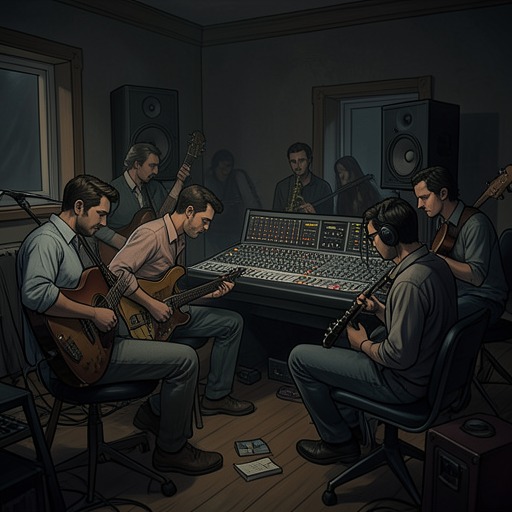
During the recording of Aurora, Eddie’s dispute with Billy became concrete in a guitar part. Billy said the rhythm-guitar part was already done, then invited Eddie to try something. Eddie remembers changing it because Billy did not have it exactly right, and insists there was more than one valid way to play the song. For Eddie, altering the riff was the practical meaning of being asked to take his own shot: he believed his change worked better and that musicians should be able to shape their own contributions.
Billy’s recollection stresses the limit of that permission. He says the recorded part ended up returning to what he had played, and describes the exchange as frustrating because he felt he had to act as though Eddie’s idea might prevail when he expected to use his own. Billy also acknowledged that he had told the band it was an equal-opportunity group when, in his view, such a system could not last. The two accounts do not settle exactly how much of Eddie’s change survived, but together they expose the conflict between nominal collaboration and Billy’s continuing control.
Eddie’s frustration was intensified by how he understood his position in the band. He says that the situation was turning him into someone he did not recognize: he felt like a second-class citizen at work, and believed the daily experience was changing him. He shared that judgment with Pete, using the contrast between being treated as second-class and staying at a first-class resort. Karen likewise recalled that Daisy and Billy had become a club apart, with the record company urging the band to keep the two of them happy and stable. Eddie’s grievance thus belonged to a broader shift in which the people most central to the album’s direction also received special institutional attention.
Performance and Position in the Group
Eddie’s conflict over authority also appeared onstage. At the Whisky a Go Go, Billy’s invitation to Daisy to sing with him placed the performance in Billy’s hands. When the rest of The Six came out, Eddie returned to find his guitar sitting to the side. He had to retrieve it himself, after Billy had taken his place onstage and controlled when the band came on. Eddie’s anger centered on this small but pointed circumstance: the instrument was his responsibility, yet the staging had left him to collect it after the moment had already been arranged around Billy and Daisy.
At another point, when Daisy needed an acoustic partner for a few songs, Graham was not paying attention to Rod Reyes’s suggestion that he go out with her. Eddie volunteered instead. Rod sent Eddie and Daisy to the microphone without knowing how the performance would turn out. Daisy remembers the songs as stripped down to his guitar and her voice; although the set did not make a strong impression, her decision to depart from the planned approach on the final song gave the appearance a different risk. Eddie’s willingness to step forward shows that his role was not limited to resisting Billy: he could also offer himself as a practical musical partner when an opening appeared.
Later, the band’s most visible performances continued to place Billy and Daisy at the center of the audience’s attention. At Saturday Night Live, the crowd’s response and the performance of “Turn It Off” were described through their stage presence and shared focus; during another performance, Billy and Daisy faced each other while the rest of the band watched from the sidelines. These accounts do not specify Eddie’s actions in those moments, but they frame the larger public hierarchy within which he played: the group performed together, while its most public image increasingly gathered around its two central figures.
Narrative Role and Unresolved Conflict
Eddie’s testimony supplies a counterweight to the story of Billy’s musical vision. The album’s sound could be shaped by Billy and Teddy’s close collaboration, including extensive work on arrangements and added layers after the band had left the studio; that accomplishment does not erase the unequal process Eddie describes. His insistence on writing his own riffs makes the cost of that process audible at the level of a single part, while his account of feeling diminished shows its effect on his sense of himself within the group.
The evidence does not provide a final resolution to Eddie’s conflict with Billy or say whether the band ultimately gave him the degree of independence he sought. Instead, his arc remains a record of assertion without a settled victory: he names the imbalance, volunteers when a performance needs a partner, and changes a guitar part despite Billy’s expectations. Through Eddie, The Six’s promise of shared work is measured against the daily distribution of decisions, attention, and permission.