Graham Dunne
Daisy Jones & the SixGraham Dunne is The Six’s lead guitarist and one of its founding musicians, but his story is not simply that of Billy Dunne’s younger brother. He begins by building songs with Billy and measuring himself against him; as the band grows and its creative center shifts, Graham starts to recognize how much of his own identity has depended on that relationship. His romance with Karen and his song “The Canyon” offer another measure of what he values: not the band’s prosperity, but a life shared with someone he loves.
Family and Musical Beginnings
Graham and Billy were raised by their single mother, Marlene Dunne, after their father, William Dunne Sr., left in 1954. Billy recalled being seven and Graham five when their father said he was moving to Georgia and refused Billy’s request to go with him. The brothers were left with an old Silvertone guitar, which they fought over and taught themselves to play. Billy also spent time experimenting on a piano after school, but the guitar became the object around which their shared musical life first took shape.
When their mother had saved enough to buy them an old Strat for Christmas, Graham wanted the Silvertone but recognized that it meant more to Billy. He took the Strat instead. The choice captures an early pattern of attention between the brothers: Graham understands Billy’s attachment and accommodates it, while their separate instruments make it possible for them to begin writing songs together. Billy gravitated toward lyrics and admired Bob Dylan and John Lennon; Graham was more drawn to Roy Orbison. They shared ambitions of becoming stars, but their different tastes already distinguished their musical instincts.
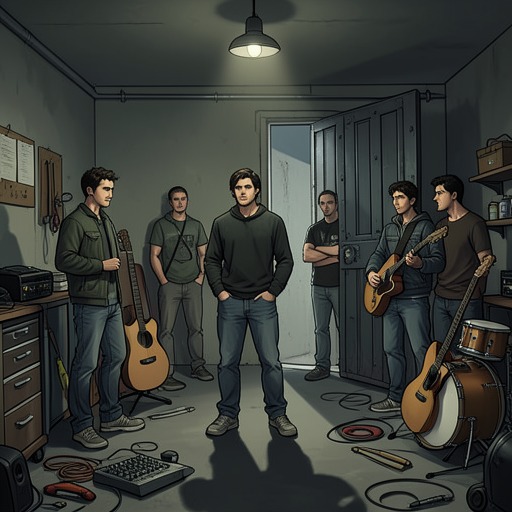
In 1967, the teenage brothers expanded their group by bringing in drummer Warren Rhodes, bassist Pete Loving, and rhythm guitarist Chuck Williams. Graham’s place as lead guitarist thus developed inside a band formed from the brothers’ collaboration, not apart from it. The Six’s wider lineup turned their private musical partnership into collective work, while leaving the brothers’ connection as an important reference point for Graham’s sense of himself.
Karen and “The Canyon”
Graham’s relationship with Karen gives him a life beyond that sibling and band identity. When he entered her room, shut the door, and kissed her, Karen had urged him to go for it. He later remembered that day with her as one of the most exciting of his life. The moment marks a decisive move from attraction to intimacy, though the relationship’s public appearance remained a concern: as they left Karen’s home for the studio, she did not want others to think they were sleeping together, and Graham pointed out that they were.
By the time the band’s money was coming in, Karen was making practical decisions about it. She spent a day with a realtor, found a home in Laurel Canyon, and bought it. Graham’s song “The Canyon,” however, turns away from the comfort and status that success could buy. He described it as the only set of lyrics he had written that he truly liked, while insisting that songwriting was usually Billy’s domain. The song imagines being content in a run-down house if Karen is there with him.
Its setting comes from the band’s earlier home in Topanga Canyon, where Pete and Eddie still lived. Graham recalled its failed comforts in concrete terms: the heat barely worked, hot water was scarce, and a window was broken. In the song, a leaking bathtub and an absent supply of water do not cancel the value of being together; they sharpen it. The contrast between that house and Karen’s later purchase gives Graham’s declaration its force. He is not celebrating deprivation for its own sake, but describing companionship as more valuable than the comforts their success might provide.
A Changing Place in The Six
During a period when Billy was with his family and Daisy was coming aboard, Graham found an opening to take a more central role in the band. He coordinated the group’s return to discussions about another album and worked out timelines with Rod and Teddy Price. He recalled the work as enjoyable, then qualified that judgment: he had been happy, and happiness made everything seem fun. The distinction suggests that his satisfaction came not only from the tasks themselves but from being able to contribute and take responsibility.
In August 1977, the band’s seven members entered Wally Heider’s Studio 3 to begin recording their third album. Graham and Karen left her home together that morning. His request that they drive over together met her concern about what people would assume; his reply treated their actual intimacy as already established. The small exchange places the relationship alongside the work of the band, showing how their private life and public setting overlapped without being identical.
As the band’s creative arrangements changed, Graham noticed that Billy no longer brought every idea to him. Billy was discussing work with Teddy, and, during the recording of Aurora, had Daisy as a songwriting partner. Graham did not frame this simply as resentment: he recognized that both brothers had built lives beyond the band, with Karen on his side and Camila and their daughters on Billy’s. Still, he wondered whether they remained a team in the way they once had. His observation marks a change in closeness as much as in musical authority.
Identity Beyond Billy
Graham’s clearest reckoning is that he had defined himself in relation to Billy for most of his life. He had always felt like Billy Dunne’s little brother; only later did he consider that Billy might never have defined himself as Graham Dunne’s older brother. The recognition exposes an asymmetry that their shared history could obscure. Their partnership had been real, and the songs they wrote together mattered, but the same relationship had not necessarily occupied the same place in each brother’s self-understanding.
The evidence does not turn this realization into a clean break or a final resolution. Instead, it places Graham at a threshold: he has built a romantic life with Karen, contributed to the band’s organization, and written a song of his own that expresses a value distinct from commercial success. Yet his account of these changes remains shadowed by the brotherhood through which he once understood himself. Graham’s significance lies in that coexistence: he is both a musician shaped by Billy and a person beginning to see the limits of making Billy the measure of who he is.