Karen Karen
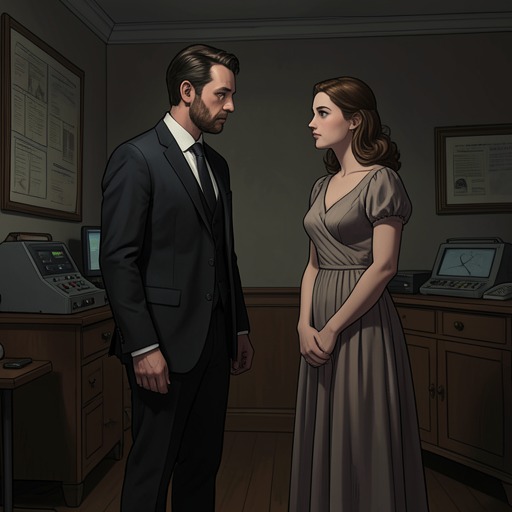
Daisy Jones & the SixKaren Karen enters the band’s history as a keyboardist whose musical contribution matters before she becomes one of its central personalities. The Dunne Brothers encounter her while opening for the Winters, and her presence changes what they imagine their own music could sound like. Her later story pairs that artistic influence with a clear demand for professional respect: she wants to be heard as a musician, not treated as an invitation to sexual attention.
Identity and Entry into the Band
At the end of 1970, the Dunne Brothers play at the Pint in Baltimore, where Rick Marks, lead singer of the Winters, hears them and offers them opening spots on several dates of the band’s northeastern tour. On the tour, the brothers become interested in the Winters’ sound and in Karen, their keyboardist. Their interest is not merely social. Billy Dunne hears the added fullness she gives the music and begins to imagine that his own band needs a keyboard player; Graham Dunne goes further, concluding that what they need is Karen herself.
The name by which she becomes known begins with a small misunderstanding. When Graham asks her surname, she answers Karen, and he repeats the name as a question: Karen Karen? The joke sticks, and the band and its circle call her Karen Karen thereafter. She identifies Sirko as her actual surname, but the doubled name becomes the one attached to her public identity as a musician. It originates in Graham’s teasing, yet it endures as a mark of the familiarity that develops between them and the band.
Musician and Professional Boundaries
Karen leaves the Winters because she is tired of bandmates trying to sleep with her. Her explanation is direct: she wants to be a musician. The distinction gives her decision its force. She is not described as rejecting the life of a touring performer or the music itself; she rejects a setting in which men’s sexual pursuit interferes with her ability to occupy her professional role. Her choice establishes a boundary that remains important to how she relates to the band and its surrounding circle.
Her musicianship is recognized in concrete terms. Billy recalls that Karen added a lush layer to the Winters’ sound, an effect that helped him see the value of a keyboardist. Later, Artie Snyder remembers Teddy Price using one of Karen’s tracks as an example for another keyboardist of what to play. That recognition sits beside the unequal distribution of attention in the studio: Teddy particularly sought Billy’s opinion and treated him as the band’s central talent, even while believing in the abilities of Karen and the other musicians. Karen’s track thus stands as evidence of individual craft within an environment where not every member receives the same authority or notice.
Relationship with Graham Dunne
Karen’s connection with Graham shifts from the band’s first encounter into a romantic relationship. On a phone call, after a quiet pause, she asks why he has never made a move on her. Graham answers that he does not take chances he expects to lose. Karen encourages him to try, and he goes into her room, closes the door, and kisses her. Graham later remembers the day as one of the most exciting of his life. The sequence gives Karen an active role in beginning the relationship: she names the question between them and makes clear that he has permission to act.
The scene also extends the story of her name. Graham’s early joke makes “Karen Karen” stick; later, she addresses him familiarly as Dunne while urging him forward. Their exchange is both playful and decisive, with the hesitation on the phone giving way to a physical choice. The accounts do not make the relationship a separate story from the band: Graham is both her romantic partner and a fellow musician whose first interest in her was bound up with what she brought to the group.
Place in The Six’s Creative Work
Karen’s position in the recording process is visible in the careful arrangement of the musicians during the first take of “Aurora.” Artie describes Karen and Graham placed to one side, Pete Loving and Warren Rhodes at the back, Eddie Loving toward the front, and Billy and Daisy Jones in isolation booths where they could still see everyone. This setup makes the band’s collaboration tangible: the musicians are separated by the demands of recording but arranged so that sightlines preserve a connection among them. Karen is part of the working ensemble, not simply a source of inspiration recalled from the Winters.
That collaborative presence does not mean creative power is evenly shared. During an earlier album, Billy takes control of the songs and dictates most of the other musicians’ parts, while Teddy supports him. Later, when Billy has already written ten or twelve songs for another album, he tries to avoid appearing to control the process, but decides that he and Daisy Jones must write together and that the other musicians will contribute arrangements. These accounts show a recurring distinction between participation and decision-making: the players’ contributions help make the records, while the authority to determine their direction remains concentrated in a few hands.
The recordings also reveal that a finished arrangement can be substantially reshaped after the band has left the room. Billy, Teddy, and Artie spend weeks remixing and adding details, from cowbells, shakers, claves, and scrapers to the hollow sound of Billy’s fist striking a chair arm. In that account, Karen is not credited with those particular additions, but the episode clarifies the larger process in which her keyboard work takes its place: a record is built through the interaction of individual parts, production decisions, and technical labor. Against that system, Teddy’s use of Karen’s track as a teaching example is a specific acknowledgment of her skill, even as the studio’s attention remains especially fixed on Billy.
Karen’s significance therefore rests on more than her membership or her relationship with Graham. She helps the Dunne brothers recognize a sound their band lacks, insists on the conditions under which she will work, and contributes a musical part that earns professional notice. The oral-history accounts preserve those facts from different angles: the men remember what she changed in the music, while Karen states what she would no longer accept from the people around it. Together, those perspectives make her both a shaping musician and a figure who insists that musical ability, rather than sexual availability, define her place in a band.