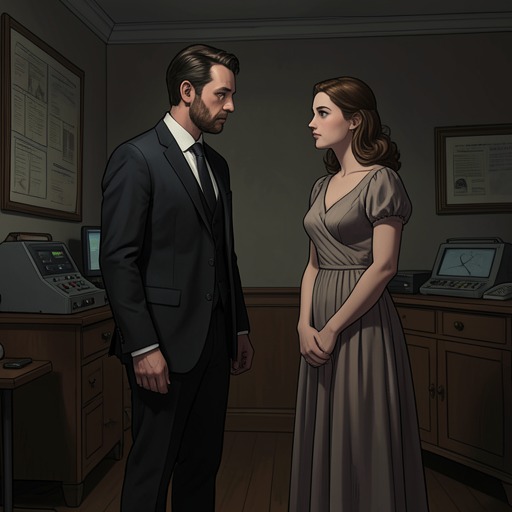
Karen and Graham break up
Daisy Jones & the SixThe Breakup Begins Backstage
After they leave the stage, Karen accidentally bumps into Graham and apologizes. He answers that she has about a million things to be sorry for. The exchange turns a minor collision into the opening of a much larger reckoning: Graham is angry, while Karen feels he is treating his own pain as the only pain that counts. Graham starts screaming and calls her names. Karen knows he is hurting, but also knows he has not undergone what she has. His grief does not, in her view, give him the right to yell at her.
The confrontation is not private for long. Warren arrives backstage to find Karen and Graham screaming at each other. That their conflict spills into the band’s shared space makes the rupture more than a lovers’ quarrel: the two are also colleagues whose daily work depends on being able to remain together. The scene offers no easy division between the personal and professional. The injury between them is already audible to the people around them.
The Loss They Cannot Share
Later, Karen goes to Graham’s room and knocks. Graham understands why they could not have a baby, but says he felt alone in what he had lost, as though he were the only one grieving. His anger at Karen grows from that isolation. The disagreement is not simply over whether having a child was possible; it is over what that impossibility meant to each of them, and whether either could recognize the other’s experience without making it identical to their own.
At the door, Karen has no solution to offer. She thinks there is nothing she can say that will fix what has happened. She tells Graham that he does not understand her and expects her to be someone she is not. Graham answers that she never loved him as he loved her. Karen acknowledges, in retrospect, that both statements were true. Their words name a mismatch that neither affection nor explanation can erase: Graham wanted a shared future that Karen could not inhabit on his terms, and Karen felt that being loved by him also meant being asked to become someone else.
An Embrace Without Reconciliation
Karen leans into Graham and presses her body against his. He does not put his arms around her at first, but eventually does. Graham remembers her as warm in his arms and her hands as cold. The physical closeness briefly returns them to tenderness, but it does not undo what they have said. Their embrace allows comfort without pretending the conflict has been resolved; the remembered warmth and coldness hold intimacy and distance together in a single image.
Graham’s account makes the contradiction explicit. He calls the harm they caused each other his greatest regret. He says he loved Karen with all his soul, that part of him still loves her, and that another part will never forgive her. Karen, meanwhile, says that even speaking about him feels like poking a bruise. Neither account reduces the relationship to indifference or simple blame. Love remains, but so does the injury, and the two do not cancel one another out.
The End of the Relationship and the Band
Graham knows when he goes to bed that night that he cannot be in a band with Karen. Karen reaches the corresponding conclusion from her side: they cannot be around each other day to day anymore, and she doubts they are strong enough to manage it. The breakup therefore becomes a decision about the conditions of ordinary proximity as well as about love. Their relationship cannot continue, and their shared musical work cannot serve as a neutral ground where the hurt is set aside.
The retrospective accounts preserve the separation between understanding a choice and being able to accept its cost. Graham says he understood why they could not have a baby, yet still felt alone in the loss; Karen understands that he was hurting, yet rejects his anger as a claim over her. Their breakup does not produce a final mutual agreement about whose pain mattered more. It ends instead with each recognizing that the other cannot offer the kind of future or understanding they need, and that continuing together would keep reopening the wound.