L.A.
Daisy Jones & the SixL.A. is more than the backdrop to Daisy Jones’s rise and The Six’s relocation: it is the place where a teenager seeking company first encounters the music world, and where a working band becomes a recording act and then a public spectacle. Its hills, clubs, studios, and temporary homes connect private beginnings to the images and songs that make the musicians famous.
Identity and Early Life
Daisy was born in 1951 and grew up in the Hollywood Hills, the daughter of the British painter Frank Jones and the French model Jeanne LeFevre. Her family’s means gave her access to artists, clubs, and drugs, but that abundance did not provide the attention and connection she wanted from her parents. L.A. therefore enters her story as both a place of privilege and a place of emotional absence: opportunity surrounds her, while genuine interest in who she is remains scarce.
At about fourteen, Daisy could walk from her home down to the Sunset Strip. Restless and unable to enter the bars and clubs, she went there anyway, looking for something to do and for a group to join. She recalled asking a roadie for a cigarette and copying the appearance of girls on the sidewalk, including their headbands and their casual disregard for the expectations she associated with fitting in. The Strip offered a nearby, visible world of musicians and groupies, but Daisy approached it as an outsider trying to become part of a scene.
The Strip and Musical Aspiration
The Sunset Strip is presented as glamorous and seedy at once. That contrast makes it a fitting first landscape for Daisy’s musical ambition: it promises access to excitement and artistic life, but she reaches it as a teenager without an established place in either. Her early presence there precedes the public identity of Daisy Jones; the location belongs first to her attempt to find company and a self she can inhabit.
The proximity between home and Strip matters. Daisy did not have to be taken into the music world by a career or a formal invitation; she could walk toward it. Yet being physically close to clubs did not mean she could enter them. L.A. gives her a first taste of the gap between desire and access, a tension that later takes a different form when she has the resources and fame to move through the industry on her own terms.
The Six Establishes a Base
L.A. also becomes the working base for The Six. When the band arrived, Rod Reyes arranged rooms for them at the Continental Hyatt House and called in favors that helped them begin playing larger gigs. The hotel marks an early stage of their move from a developing group into the city’s music business: they had accommodation and a manager opening doors, but their local foothold was still being assembled.
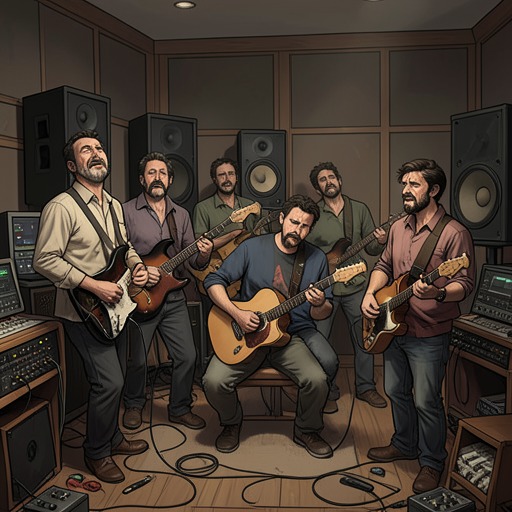
The group later settled into a rented house in Topanga Canyon while preparing to record its debut album. Karen initially thought the house was a dump, recalling its front door off its hinges and chipped stained-glass windows. Her response changed after Camila Dunne arrived and admired it; Camila, in turn, remembered the rosemary bushes surrounding the house. These small domestic impressions make the move more than a logistical step. The band’s L.A. life acquired a shared home, and Camila’s arrival altered how one member understood that home.
Recording brought the band into a more formal local infrastructure. Teddy Price and a crew of technicians, including lead engineer Artie Snyder, set up at Sound City Studios in Van Nuys as The Six prepared its debut. Years later, Daisy’s refusal to attend recording sessions at the Record Plant in West Hollywood left her in breach of her Runner Records contract. L.A.’s studios thus appear at different points in her career as places of access and obligation: recording is the route into a professional music life, but a recording contract can also become a constraint she refuses to meet.
Songs, Images, and Public Recognition
The city and its surrounding landscape helped give the group’s work a visual identity as well as a recording base. For the Aurora cover, Rod Reyes brought photographer Freddie Mendoza into the process. Mendoza proposed the desert mountains; the band’s memories of possible alternatives included a boat and a sunrise. The resulting session took place in the Santa Monica Mountains, where the group posed against a guardrail amid road, dust, and open terrain.
Mendoza captured Daisy and Billy Dunne looking toward each other while the others faced the camera. He also took an image of their torsos that became especially consequential: their faces were absent, but their bodies, the open sky between them, and an object in Daisy’s pocket made the photograph legible to viewers as a charged image of sex, drugs, summer, and rock music. The photograph’s meaning exceeded the band’s immediate marketing task. Elaine Chang described Daisy’s confident presentation of her body as self-possession rather than an appeal to Billy or the viewer, and recalled the cover’s importance to young fans. L.A.’s nearby mountain landscape became the setting for an image through which Daisy’s public identity could be read as autonomous.
Fame and the City as a Point of Return
By the end of 1976, Honeycomb had reached number three on the Billboard Hot 100, and The Six and Daisy had appeared on Don Kirshner’s Rock Concert and The Tonight Show Starring Johnny Carson. When Camila, six months pregnant, returned to L.A. with Julia as the band prepared for a European tour, the city functioned as a point of return for family even while the musicians’ work increasingly carried them elsewhere. A few weeks after that tour ended, Billy Dunne recalled waking to Camila in labor and taking her to the hospital; the recollection records a family event, though it does not identify the hospital’s location.
The band’s later success made L.A. part of a much larger circuit of attention. In 1978, Turn It Off topped the charts for four weeks, Aurora was selling more than 200,000 units weekly, and the tour sold out stadiums. The interview about the Rolling Stone cover, with its headline The Six That Should Be Seven, had already turned the group’s shared stage image into a public story. On tour, the split between Billy and Daisy was even reflected in two buses bearing different images, while the band’s demands for matching amenities revealed how closely their status and rivalry had become entangled.
L.A.’s significance is therefore cumulative rather than confined to a single landmark. It is Daisy’s childhood ground and her first route toward the Strip; the band’s early lodging and domestic base; the site of recording work; and the nearby landscape from which a defining cover image emerged. The city links the musicians’ attempts to make a life together with the commercial machinery that makes them famous, while allowing the narrative to return to the beginnings that fame cannot erase.